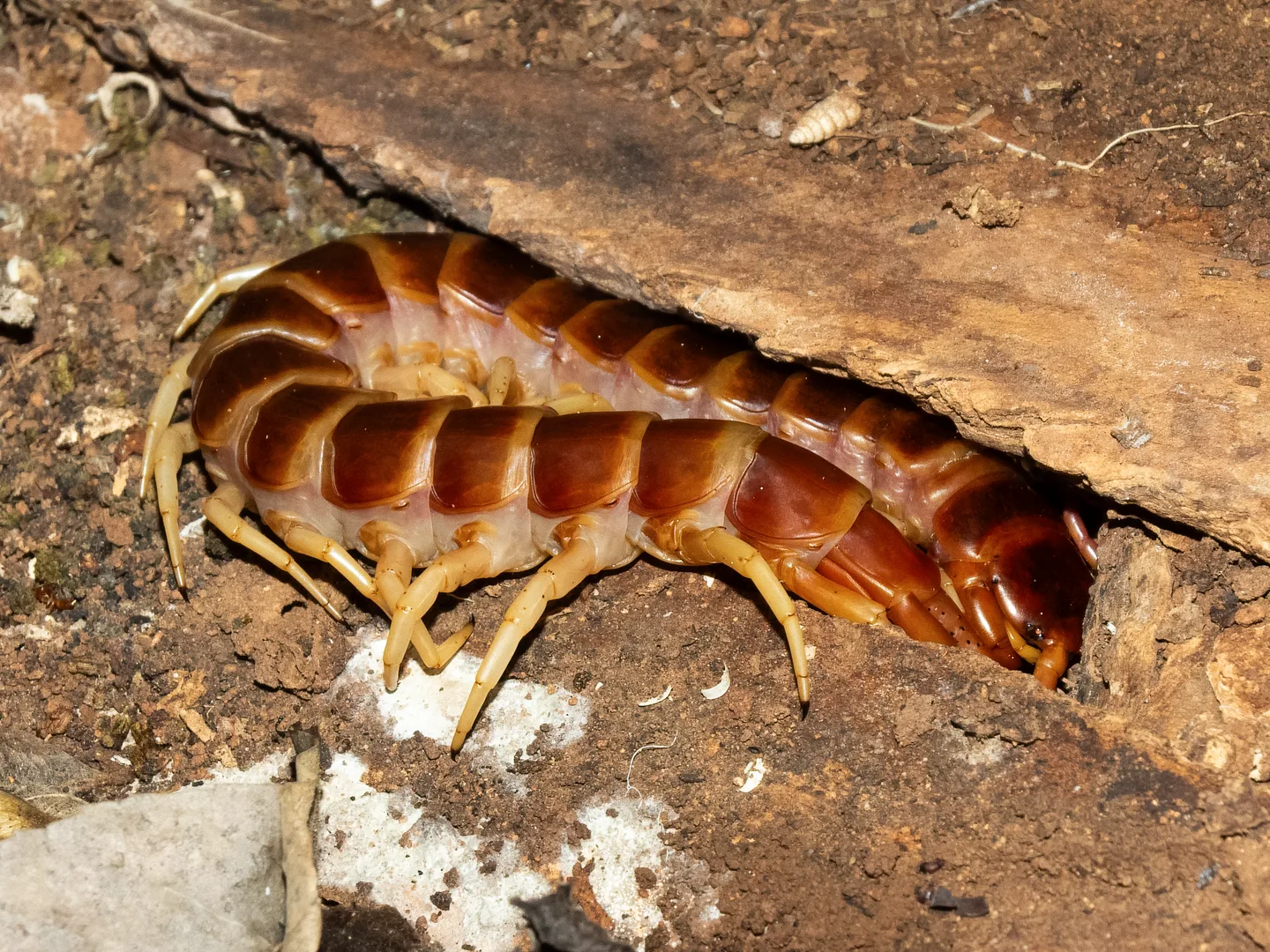
Amazonian Giant Centipede (Scolopendra gigantea), La Guajira, CO
Field
notes
The centipede that hunts bats
Bats can fly away from trouble, yet a 2017 report says large Amazonian giant centipedes (Scolopendra gigantea) are known to climb cave ceilings and catch bats. A University of the West Indies guide says centipedes have very poor eyesight and rely on their antennae to find prey.
It is a big animal. Animal Diversity Web says it can grow to 12 inches long, and the 2017 report, citing a 2000 diagnostic account of the species, says it can reach lengths to 30 centimeters. Every body segment carries one pair of legs, and the number of pairs is always odd, from 21 to 23.
Snake for supper On Aruba on 2 January 2017, Dr. H. Dilrosun watched a giant centipede about 18 cm long attack a Baker’s cat-eyed snake. The snake died about half an hour after it was first seen, and the centipede then began to eat it.
Fangs made from legs
The legs on the first body segment are modified into venom-bearing fangs called maxillipeds, which the centipede uses to hunt. Its rear legs are spiny to ward off potential predators.
Its menu runs from crickets, worms, snails and roaches to lizards, toads and mice. Frogs, snakes and birds are on record too.
Animal Diversity Web says the venom is strong enough to seriously wound a human. Doctors in Venezuela who reported a bite to a 28-day-old baby noted that accidents with Scolopendra are not rare in adults, but severe envenomings with death are exceptional. The baby was given hydrocortisone and was feeding normally again after three days.
Built for damp places
Centipedes have no waxy covering on their cuticle, the outer skin, so they are limited to humid places, where they can usually be found in soil, leaf litter or rotten wood. They breathe through openings called spiracles, and Animal Diversity Web says those openings let centipedes lose a lot of water quickly.
The species lives in tropical and subtropical forests across northern South America and some continental islands, including Aruba.
Animal Diversity Web’s account, last updated in 2001, gives a normal lifespan of about ten years. For centipedes in general, a University of the West Indies guide says most live about one to three years, while others may live up to five to six.
The female broods her eggs until the hatchlings can get their own food.
Published Updated
Traits
Intel
& FAQ
Guess
first
How big is a Amazonian Giant Centipede, really? Slide, lock in, and see what the sources say. Every answer is a figure from this page, quoted from where it came from.
Sources
- 01Scolopendra gigantea. Animal Diversity Web, University of Michigan.
- 02Van Buurt & Dilrosun (2017). Predation by an Amazonian Giant Centipede (Scolopendra gigantea) on a Baker’s Cat-eyed Snake (Leptodeira bakeri). Reptiles & Amphibians.
- 03Rodriguez-Acosta et al. (2000). Centipede (Scolopendra gigantea Linneaus 1758) envenomation in a newborn. Revista do Instituto de Medicina Tropical de São Paulo.
- 04Scolopendra gigantea (Giant Centipede). The Online Guide to the Animals of Trinidad and Tobago, University of the West Indies.
What the sources say: 48 claims checked word for word against these sources →