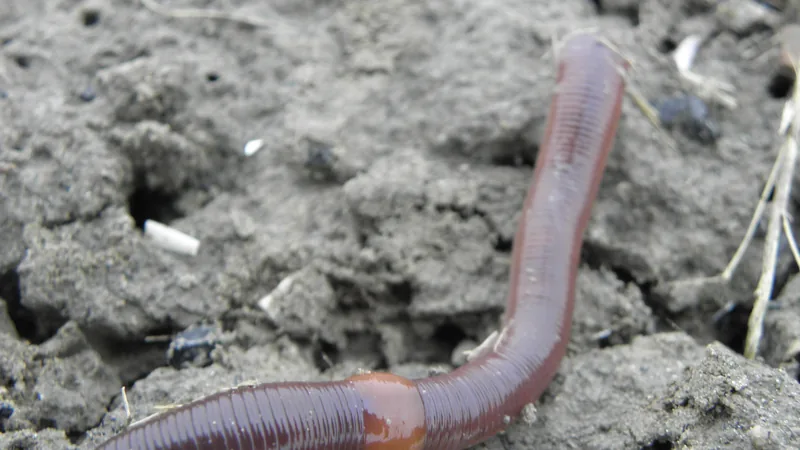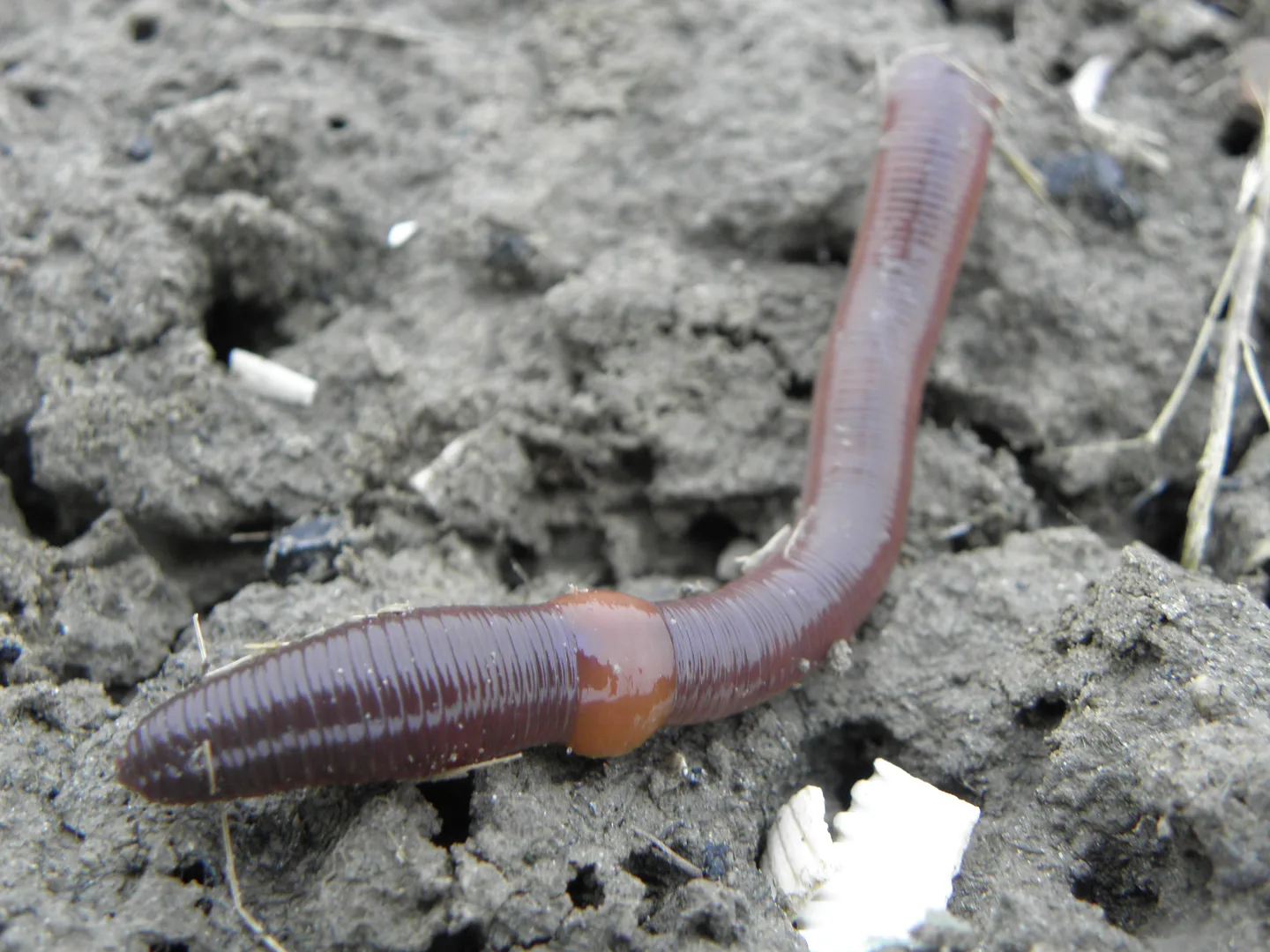
Common earthworm (Lumbricus terrestris) on bare soil
Field
notes
A body that crawls in waves
The common earthworm, Lumbricus terrestris, is a soft-bodied animal supported by a hydrostatic skeleton, which means it moves mainly by changing the shape of its soft segments, not by bending rigid parts at joints. It moves in waves. In normal movement, a segment gets longer when its circular muscles contract and shorter when its longitudinal muscles contract. The waves come at 5 to 20 a minute. Researchers have also recorded when its setae, which are bristles, poke out as it moves. Pressure recordings from crawling and burrowing worms point to the importance of the circular muscles in extending the head end and in the first push into soil.
Size, weight and lifespan
A common earthworm typically measures 8 to 15 cm long, and occasionally up to 35 cm. It grows rapidly for approximately 3 years and reaches an average weight of approximately 9.5–11 g in culture and 5–6.25 g in field populations. After 3 years, the average weight begins to decrease.
Its lifespan is approximately 5–9 years in culture and probably less in the field. Not many earthworms survive 7 years in the field.
Deep burrows, surface meals
This worm is anecic, meaning it lives in deep vertical burrows of 2 m. It generally only emerges to feed on surface litter. It is not frost-tolerant, which indicates that it hibernates in deep soil layers during the winter. A worm can move 4–19 m in a single night, but this movement is random. Anecic worms like this one are associated with mixing soil horizons, the layers of soil, in the areas they invade.
A slow crawler gone global
Each worm is a simultaneous hermaphrodite and mates reciprocally, with two worms mutually exchanging sperm. It leaves its burrow to mate on the soil surface. Because each worm is a hermaphrodite, only two are needed to found a population.
Slow under its own power Self-propelled spread is slow at 6.3 m/year or about 6 km/1000 years. Most of the invasion can be attributed to human activity.
The species is thought to be native to West Europe, but it is now globally distributed in temperate to mild boreal climates. Once it is present in an environment, its activities can radically alter the way litter on the forest floor decomposes. In English it is called the nightcrawler or the dew worm.
Published
Traits
Intel
& FAQ
Guess
first
How big is a Common Earthworm, really? Slide, lock in, and see what the sources say. Every answer is a figure from this page, quoted from where it came from.
Sources
- 01Misirlioğlu, Tsekova & Stojanović (2016). On the presence of Lumbricus terrestris Linnaeus 1758 (Oligochaeta, Lumbricidae) on the Balkan Peninsula: some aspects of ecology and distribution. Turkish Journal of Zoology.
- 02Seymour (1969). Locomotion and Coelomic Pressure in Lumbricus Terrestris L. Journal of Experimental Biology.
- 03Quillin (1999). Kinematic scaling of locomotion by hydrostatic animals: ontogeny of peristaltic crawling by the earthworm Lumbricus terrestris. Journal of Experimental Biology.
- 04Lumbricus terrestris Linnaeus, 1758. Integrated Taxonomic Information System (ITIS).
What the sources say: 40 claims checked word for word against these sources →