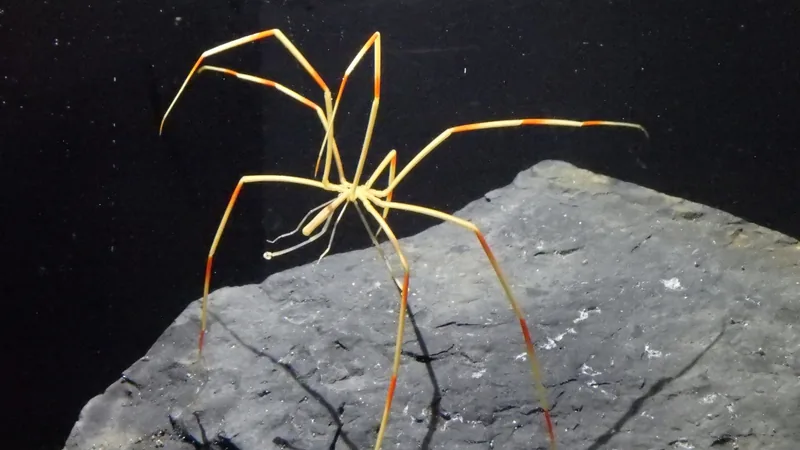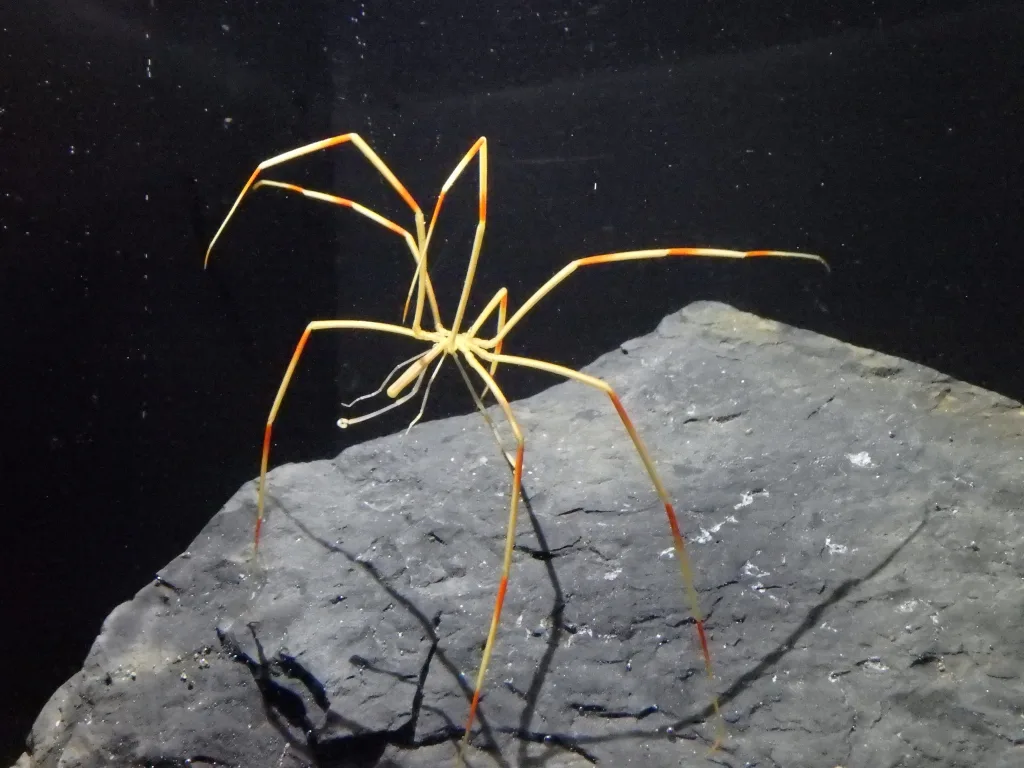
Photograph of C. megalonyx sea spider on a rock.
Field
notes
Breathing through its skin
Sea spiders have no gills. They breathe through the cuticle, the outer layer of the body, which contains pores. One study modelled the oxygen flowing in through all those pores and found it closely matched what the animals use, which means the pores help oxygen diffuse in.
In one study, the bigger the animal, the more porous its cuticle, especially in Colossendeis megalonyx. The authors suggest that may help a larger body get enough oxygen.
Sea spiders also use their guts as pumps. Contractions of the gut’s many side branches drive flows of gut fluid and hemolymph (the fluid that fills an arthropod’s body). That study called it a previously undescribed way of moving oxygen inside the body.
Warm water is a problem. In tests from -1.8 °C up to 9 °C, giant Antarctic sea spiders from two genera, including Colossendeis, were highly sensitive to elevated temperature, but C. megalonyx kept performing at considerably higher temperatures than another giant, Ammothea glacialis.
A giant that hunts open-water prey
Its family, the Colossendeidae, includes the largest and most conspicuous of the sea spiders, with some species reaching leg spans of 40-50 cm. Around McMurdo Sound in Antarctica, colossendeids are abundant at scuba depths.
Researchers diving there recorded C. megalonyx feeding on pelagic organisms, meaning animals of the open water. It fed particularly on the pteropod Clione antarctica. Video of captive spiders showed them capturing C. antarctica rapidly. The researchers suggest that, at least near the shore, pelagic invertebrates are an important food source for this species.
Eggs on ice, parenting unclear
Divers there frequently saw stacks of usually two, sometimes three or four, colossendeids on top of each other, a mating posture in other sea spiders. Researchers collected several mating groups of C. megalonyx and kept them at between -1.5 and -0.5 °C, and two groups laid eggs in the lab. The first mass held thousands of eggs, averaging about 107 micrometres across.
Egg care without a backpack Most other groups of sea spiders brood their eggs on the father’s ovigerous legs, but brooding has never been observed in the family Colossendeidae. One adult stayed on or close to the egg mass for almost three days, appearing to groom it, and in that time the mass became firmly attached to the rock.
The authors think that adult was male, and potentially the father. Development was slow. The first larva hatched about eight months after the eggs were laid, and the hatched larvae were negatively buoyant, meaning they sank, and crawled slowly in the dish.
One species or many?
This spider is found around Antarctica and in Subantarctic waters, and is also found in South America, South Africa and Madagascar, at depths from 3 to 4900 m. A DNA study of over 500 specimens found 15 to 20 distinct groups in its mitochondrial DNA. Yet nuclear DNA results from some of those specimens suggested that several of those lineages can hybridize and should not be read as separate species.
Published
Traits
Intel
& FAQ
Sources
- 01Dietz et al. (2015). Regional differentiation and extensive hybridization between mitochondrial clades of the Southern Ocean giant sea spider Colossendeis megalonyx. Royal Society Open Science.
- 02Moran, Lobert & Toh (2024). Spawning and larval development of Colossendeis megalonyx, a giant Antarctic sea spider. Ecology.
- 03Moran et al. (2018). Predatory behavior of giant Antarctic sea spiders (Colossendeis) in nearshore environments. Invertebrate Biology.
- 04Shishido et al. (2019). Polar gigantism and the oxygen–temperature hypothesis: a test of upper thermal limits to body size in Antarctic pycnogonids. Proceedings of the Royal Society B: Biological Sciences.
- 05Lane et al. (2018). Cuticular gas exchange by Antarctic sea spiders. Journal of Experimental Biology.
- 06Woods et al. (2017). Respiratory gut peristalsis by sea spiders. Current Biology.
What the sources say: 45 claims checked word for word against these sources →