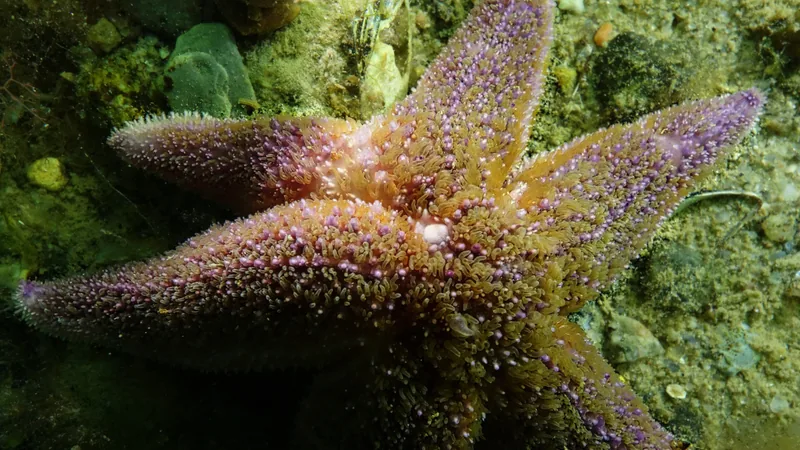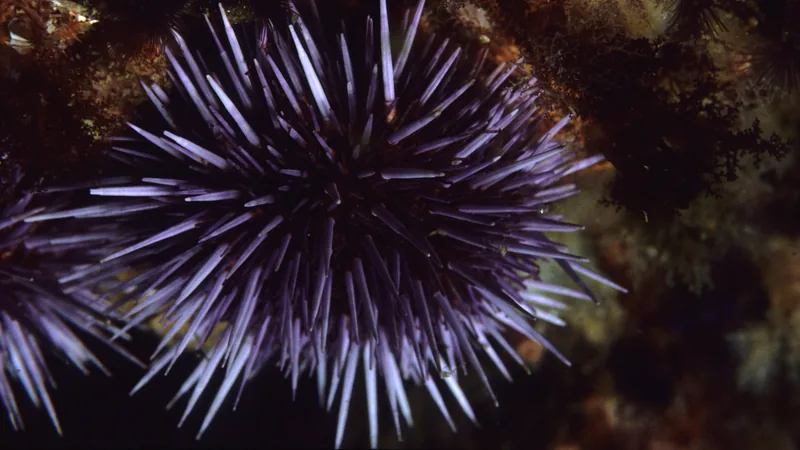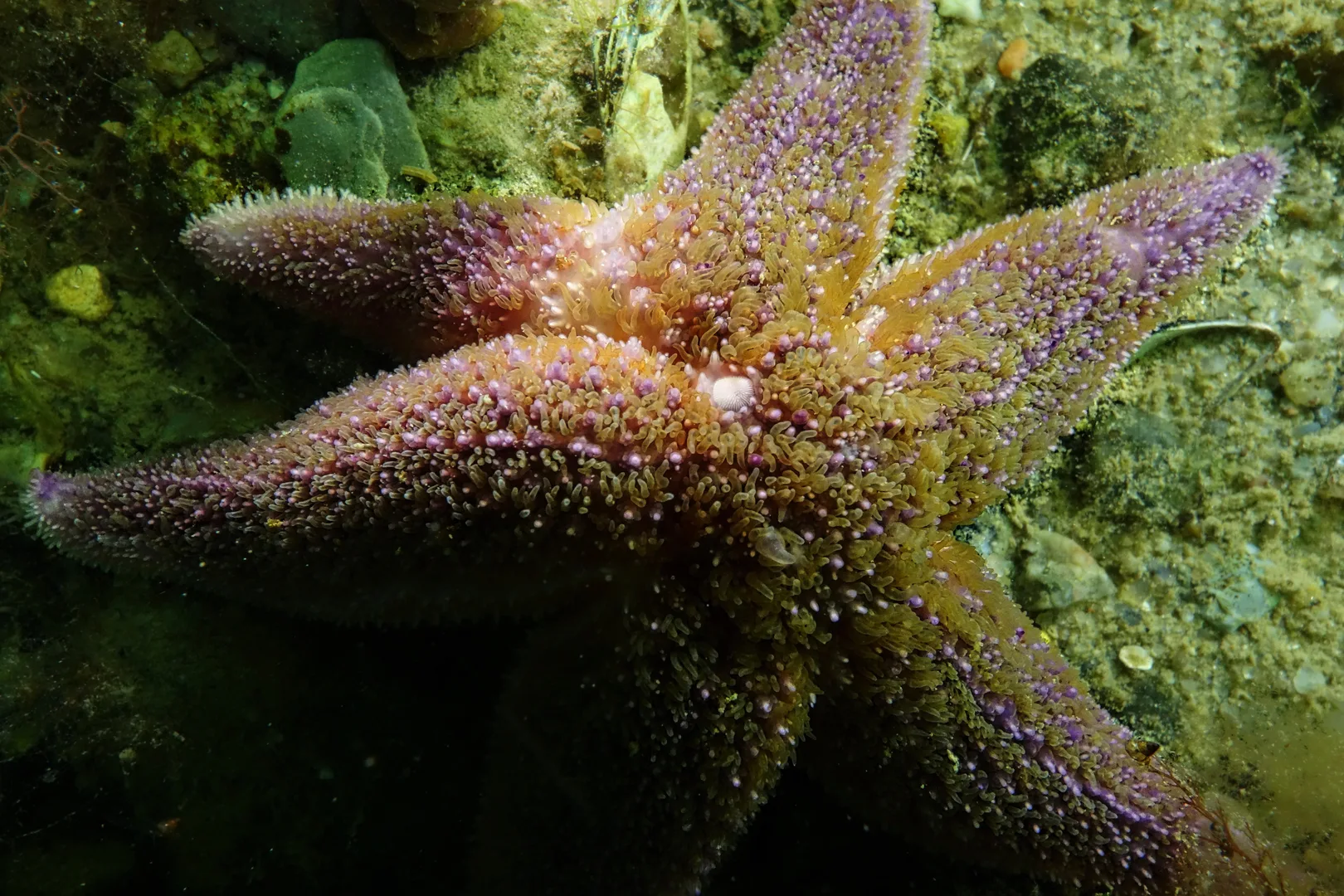
On a rocky seabed among green seaweed, in the north-east Atlantic.
Field
notes
A stomach that leaves the body
The common starfish (Asterias rubens) has no head and no jaws or teeth. Its mouth is on the underside, where the grooves from its five arms meet. So how does it eat a mussel?
It grips the shell with its tube feet, the tiny sucker-tipped feet that cover its body. Then it pulls. Once it opens a gap of less than 0.1 mm, it everts its stomach lobes into the shell, turning its stomach inside out. The meal is digested right there in the mussel. With no teeth, the starfish waits until the prey is a soft mass before it pulls its stomach back in.
Arms that grow back Asterias rubens can regenerate an arm within 1 to 2 years.
Size, age and range
It is the most common and familiar starfish in the north-east Atlantic. It may grow up to 52 cm across, but 10 to 30 cm is usual. The colour varies, though it is usually orange, pale brown or violet, and deep-water animals are pale.
A review of its biology gives a lifespan of seven to eight years, citing a 1972 study. The same review lists 5 to 10 years in its table.
The species is abundant from Arctic Norway down the Atlantic coasts to Senegal, and is only found occasionally in the Mediterranean. It lives from the shore down to depths of 650 m. It is found on all British and Irish coasts, especially among beds of mussels and barnacles.
Smell, light and a slow crawl
It has a well-developed sense of smell, with preferences and avoidances. It moves into a water current, and moves harder into it when living prey such as a mussel is nearby. It can also sense light: at the end of each arm sits an eye spot.
It eats a wide range of living prey and carrion, including molluscs, worms and other echinoderms. The review also notes that some other seabed animals avoid it. They can detect it as it releases a surface-active saponin, a soapy chemical, from its body surface.
It is no sprinter. Animal Diversity Web puts its average pace at six inches per minute in a straight line.
Published