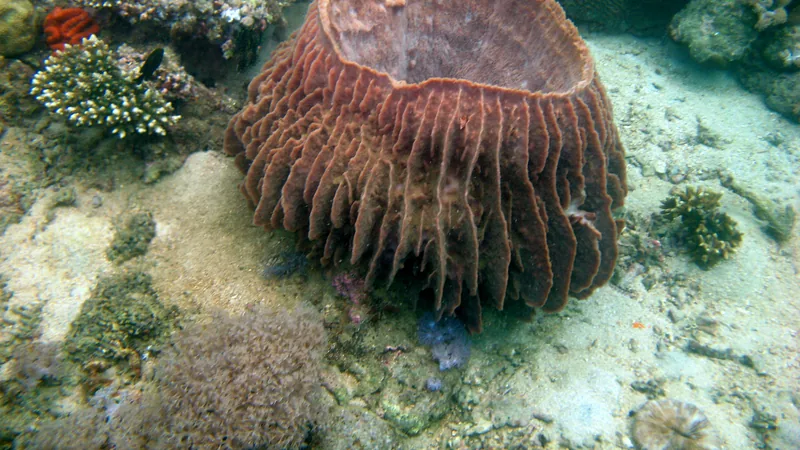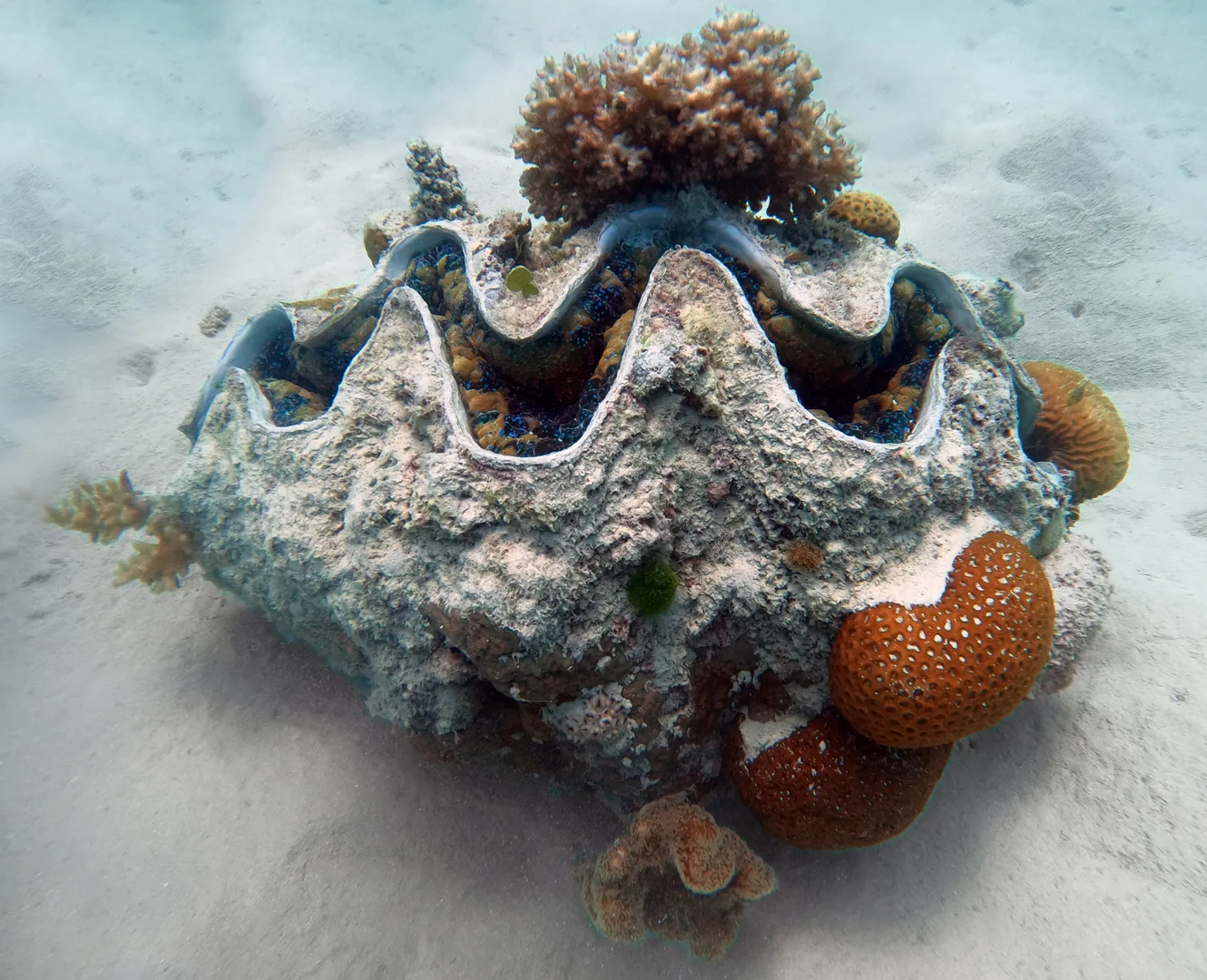
Michaelmas Cay, Great Barrier Reef, Queensland
Field
notes
A farm inside the flesh
A giant clam does not feed alone. Dallas World Aquarium says the majority of its nutrients come from a partnership with billions of algae that live in its tissues. In return for shelter from predators, the algae hand over the carbon by-products of photosynthesis, which is how algae turn sunlight into food. The genome team reports that every giant clam species has this partnership with algae called Symbiodiniaceae.
Sunlight has to reach those algae. The clam’s mantle, the fleshy edge that spreads out of the shell, carries pale or clear spots known as windows.
Windows Clear patches on the mantle let sunlight in, and the algae need that light for photosynthesis.
The clam still filters too. It pulls seawater in through one siphon (a hole) and strains out plankton, the drifting plants and animals of the sea.
Biggest of its kind
This is the largest living bivalve, a two-shelled mollusc like a mussel or an oyster. NOAA ranks Tridacna gigas as the biggest of all the giant clam species, growing to more than a metre wide and more than 496 pounds (225 kg). The genome team reports the largest individual as 137 cm long and 500 kg. A fully grown adult can no longer close its shell completely.
It also lives a long time. Dallas World Aquarium says it is not uncommon for one to pass 100 years. A 1965 study of a 52 cm clam from Bikini Atoll counted bands in its shell, read them as yearly rings, and put it in its 9th year.
Stuck in one spot
A giant clam is sessile, meaning it stays put. Its larvae swim and feed in the water until they are big enough to settle, then they remain in that place for the rest of their lives. Adults release eggs and sperm into the water, and fertilisation happens there.
NOAA places the species across the Indo-Pacific and the Great Barrier Reef, from Myanmar to Kiribati and from the Ryukyu Islands of Japan down to Queensland, Australia. It sits on coral reefs, atoll lagoons and fringing reefs, typically 6 to 65 feet down, often among hard coral or on bare sand.
Harvested to the brink
The IUCN Red List assessed it as Critically Endangered in 2024. NOAA says decades of heavy, unregulated collecting have made it very scarce across much of its range, and that catching it for meat and shells is the main threat. In 2024 NOAA Fisheries proposed listing it as endangered under the US Endangered Species Act, and it is on CITES Appendix II.
Published
Traits
Intel
& FAQ
Guess
first
How big is a Giant Clam, really? Slide, lock in, and see what the sources say. Every answer is a figure from this page, quoted from where it came from.
Sources
- 01Giant clams. Dallas World Aquarium.
- 02True Giant Clam. NOAA Fisheries.
- 03Neo & Li (2024). Tridacna gigas. The IUCN Red List of Threatened Species 2024: e.T22137A119167161.
- 04Li et al. (2024). The genome sequence of the giant clam, Tridacna gigas (Linnaeus, 1758). Wellcome Open Research.
- 05Bonham (1965). Growth Rate of Giant Clam Tridacna gigas at Bikini Atoll as Revealed by Radioautography. Science.
What the sources say: 40 claims checked word for word against these sources →