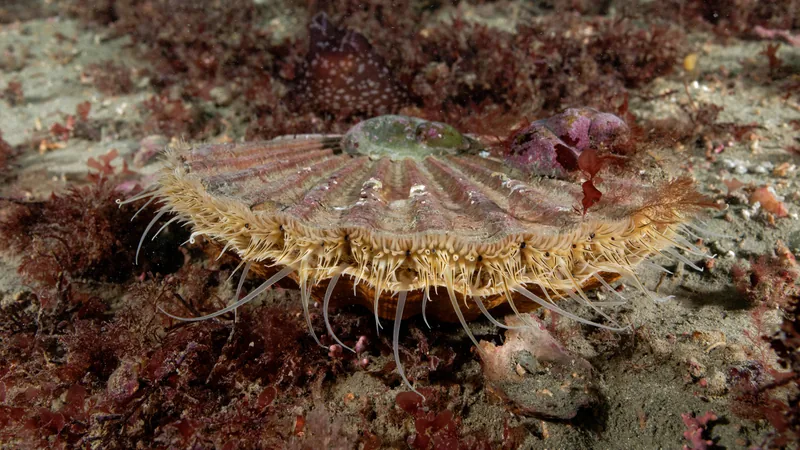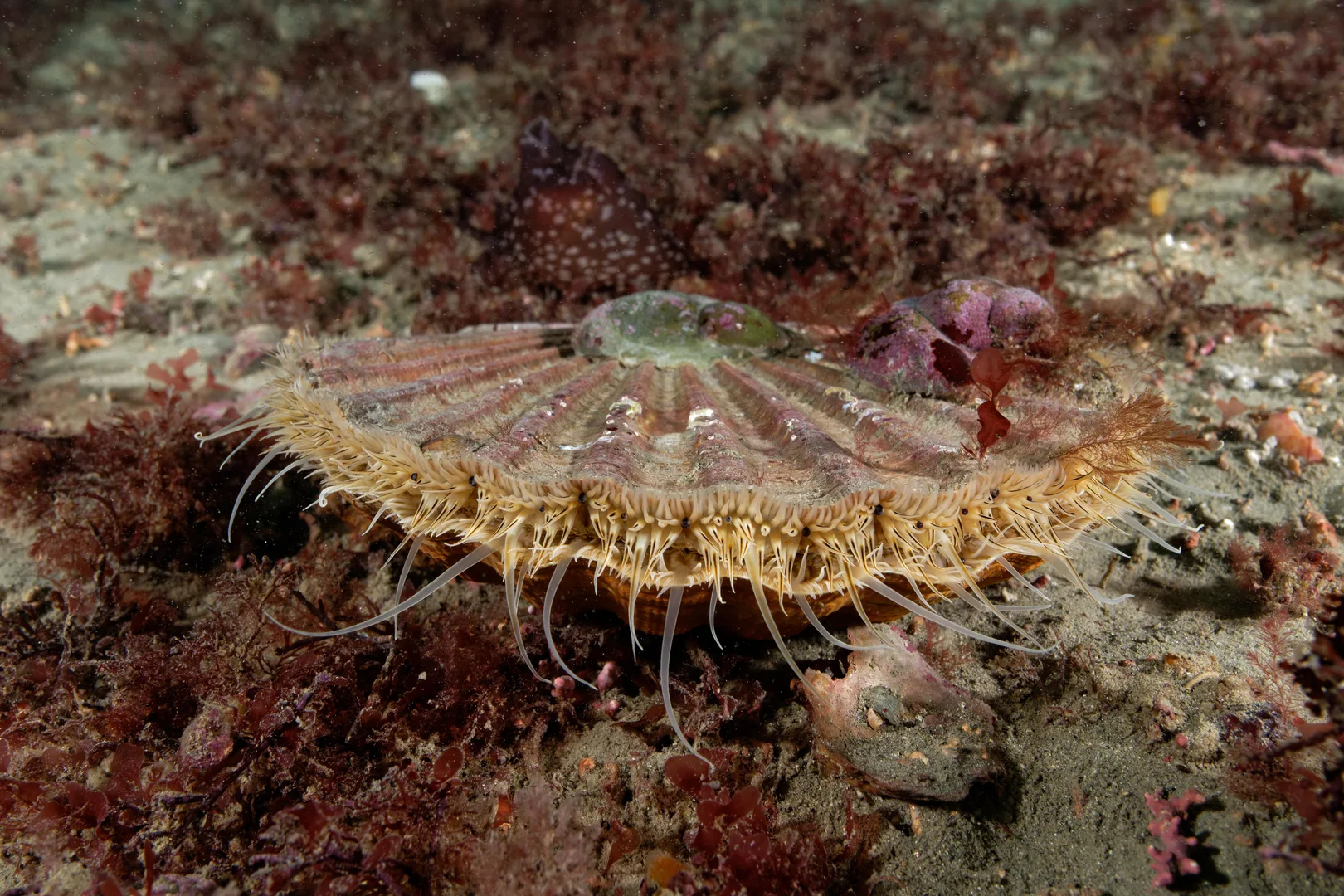
The scallop is a bivalve mollusc found in temperate European waters, from Norway to Spain.
Field
notes
Eyes all around the rim
The great scallop (Pecten maximus) carries numerous tiny eyes, set among the bases of the sensory tentacles around the edge of its mantle. They are blue-green and no more than about 1.5 mm across, and they have a highly specialized retina. A shadow or a movement can make the scallop swim, orient itself, or shut its shell.
Clap and go It swims by rapidly clapping its valves, which pushes water out on either side of the hinge so that the curved edge of the shell leads the way.
Dodging starfish
Swimming is mostly saved for escapes. In one study, extracts from two starfish that eat molluscs set off a full swimming response, while starfish that are not predators only caused a short jump or a closed shell. Normally the scallop lies in a shallow hollow in the seabed. It makes the hollow itself: strong shell closures squirt water from inside the shell, and the jets blow sediment away.
How big, how old, how far
The shell grows up to 15 cm long, and specimens of up to 21 cm have been recorded, though that is exceptional. Scallops caught for sale are usually 10 to 16 cm. Each year adds a growth ring to the shell, and these rings are used to age scallops. A great scallop can live 11 to 20 years. One author puts the maximum age at about 22 years.
It lives along the European Atlantic coast from northern Norway south to the Iberian peninsula, and has also been reported off West Africa, the Azores, the Canary Islands and Madeira. It lies at 10 to 110 m, on clean firm sand or fine gravel.
A filter feeder with a fishery
A great scallop is an active suspension feeder: it filters seston (the mix of tiny particles drifting in seawater) from the water, including phytoplankton, especially single-celled algae, plus bacteria and other microbes. Shellfish can pile up algal neurotoxins this way. The genome paper calls the scallop resistant to saxitoxin and domoic acid, two such toxins.
It is fished commercially across its range, most heavily around France and the United Kingdom. The same paper called it the most valuable single-species fishery in the English Channel, with about 35,000 tonnes landed internationally in 2016.
Published
Traits
Intel
& FAQ
Guess
first
How big is a Great Scallop, really? Slide, lock in, and see what the sources say. Every answer is a figure from this page, quoted from where it came from.