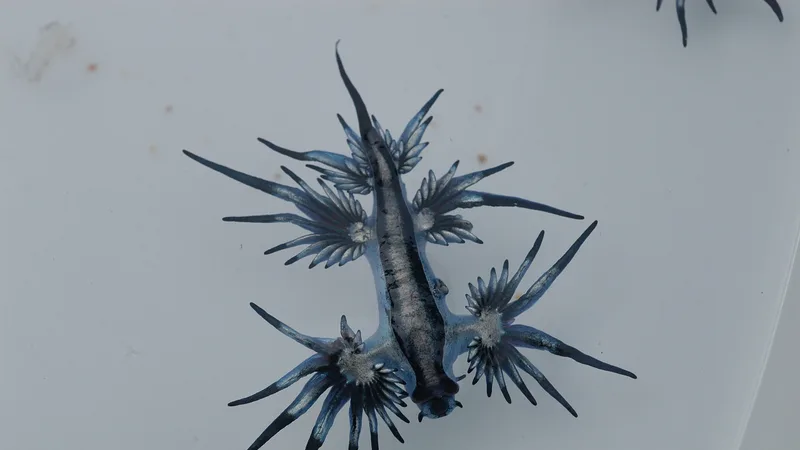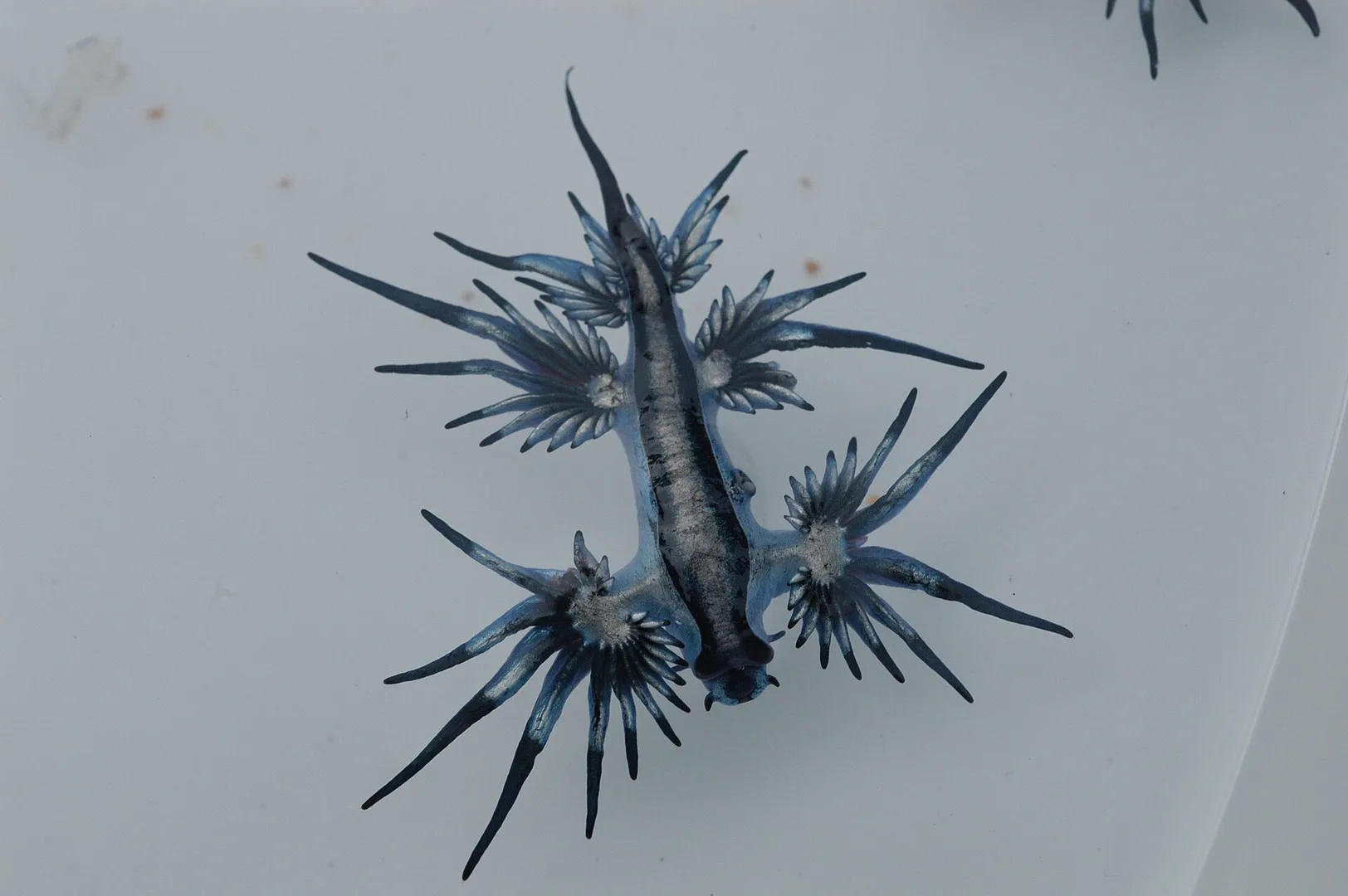
Blue sea slugs washed up onto MacMasters Beach, New South Wales, Australia
Field
notes
Adrift at the Surface, Upside Down
The blue sea dragon (Glaucus atlanticus) is a nudibranch, a shell-less sea slug, about 3 centimeters long, barely over an inch. It spends its life drifting at the surface of the open ocean, kept afloat partly by air bubbles in its stomach. It lives in tropical and temperate waters of the Atlantic, Pacific and Indian oceans. Along with the rest of the “blue fleet” of surface-dwelling animals it drifts among, it is carried by the currents and the winds.
Because it floats upside down, its foot faces the sky, and its colors are a textbook example of countershading. The foot is blue, which helps camouflage it from seabirds hunting above. Its true back faces down and is silvery grey, camouflaging it from fish looking up from below.
Hands Made of Stinging Fingers
Down each side of its body, the blue sea dragon carries tendril-tipped appendages called cerata that spread like wings. Scientists long thought cerata were mainly for defense. A 2025 study that reared the slugs in aquaria filmed something else. Some used their front-most cerata as hands to catch live whitebait, holding the fish between them while biting near its gills, and used the same “hands” on jellyfish. The base of those front cerata is longer than the rest and may work like an arm: researchers watched it move flexibly to grasp prey.
Stealing a Killer’s Weapons
The blue sea dragon usually preys on stinging animals that drift at the surface, such as the Portuguese man o’ war, the blue button (Porpita) and the by-the-wind sailor (Velella). It uses its jaws and radular teeth to grab and tear their soft tissues and tentacles. It swallows their stinging cells and concentrates them inside pouches called cnidosacs at the tip of each ceras. It also appears to select the man o’ war’s most venomous stinging cells to store.
A borrowed sting, concentrated The blue sea dragon stores the stinging cells it steals in its cerata in a more highly concentrated dose, which gives an animal about 3 centimeters long a vicious sting.
A Warning Worth Heeding
Blue sea dragons sometimes wash ashore, and an encounter with even a dead one can result in getting stung. Contact with one that has fed on a man o’ war can cause symptoms similar to a man o’ war sting, including nausea, pain, vomiting, allergic skin reactions and possible blistering. A man o’ war’s stinging cells can even cause death. Researchers say a blue sea dragon should be considered as harmful to people as the animals it preys on, and that people should avoid touching one.
Published Updated
Traits
Intel
& FAQ
Guess
first
How big is a Blue Sea Dragon, really? Slide, lock in, and see what the sources say. Every answer is a figure from this page, quoted from where it came from.
Sources
- 01Blue Glaucus. Oceana.
- 02Blue Dragon Sea Slug. Bureau of Ocean Energy Management, U.S. Department of the Interior, 2024.
- 03Rudman, W.B. (1998). Glaucus atlanticus Forster, 1777. Sea Slug Forum, Australian Museum.
- 04Yamamoto, Kanai, Miura & Oguchi (2025). Blue angels have devil hands: Predatory behavior using cerata in Glaucus atlanticus. Ecology.
- 05Pinotti, Bom & Muxagata (2019). On the occurrence and ecology of Glaucus atlanticus Forster, 1777 (Mollusca: Nudibranchia) along the Southwestern Atlantic coast. Anais da Academia Brasileira de Ciências.
What the sources say: 39 claims checked word for word against these sources →