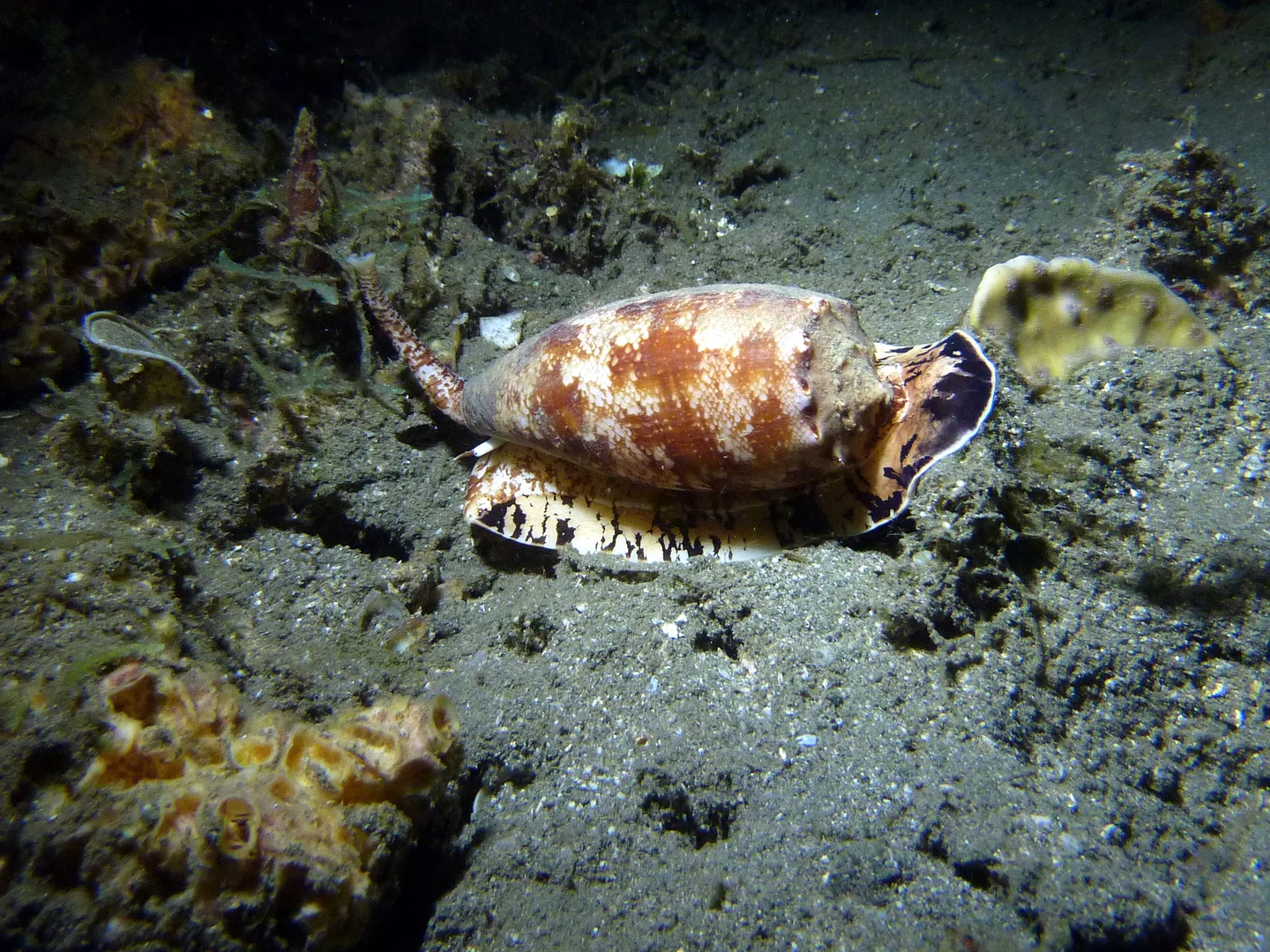
A geography cone hunting over sand at night off West New Britain, Papua New Guinea.
Field
notes
A Pretty Shell With a Harpoon Inside
The Geography Cone Snail (Conus geographus) wears a smooth shell with small bumps at the shoulder, mottled brown or red over white, cream or rose pink. It measures 70 to 150 millimeters and weighs between 13.3 and 62 grams, with an average of 38.8 grams. It lives on living or broken coral reefs and in sandy tidal zones across the tropical and subtropical Indo-Pacific, including the northern shores of Australia. It is found mostly just below the tideline, with a recorded depth range of 0 to 200 meters. By day it lies buried in the sand; at night it hunts.
The Nirvana Cabal Conus geographus is believed to prey on fish hiding in reef crevices at night. Its venom insulin appears to be part of a toxin mix researchers call the nirvana cabal, released into the water to disorient schools of small fish.
Fishing With a Sugar Crash
Researchers found specialized insulins as major components in the venoms of two fish-hunting cone snails, Conus geographus and the tulip cone (Conus tulipa). Injected into fish, the venom insulin causes hypoglycemic shock, a dangerous drop in blood sugar. Its discoverers say their evidence suggests it is “specifically used as a weapon for prey capture” by cone snails that hunt with a net strategy: disoriented fish are easier to engulf with the snail’s distended false mouth, which works like a net.
It also uses the hook-and-line method: it slowly approaches its prey, waving its proboscis like a lure to attract the fish before stinging it with its radula. The fish jerks violently for a few moments and is hit with a paralyzing venom that stiffens it, and the snail swallows its catch whole, regurgitating the bones hours or days later. Either way, the venom goes in through a hollow radular tooth used as a harpoon.
Gene-sequencing work on its venom duct found that the most highly expressed toxin is not paralytic: it “causes sensory disorientation.” The team’s data suggest that disorienting prey is central to how the snail uses its venom.
The Deadliest Shell on the Reef
The same team calls Conus geographus “the deadliest snail on earth,” the cone snail behind most of the human fatalities recorded in the medical literature. Citing earlier work, their paper states that in the absence of medical intervention, 70% of human stinging cases are fatal. Another team found an apparent link between the amount of venom a snail injects and the size of its shell, and used it to extrapolate a human lethal dose of 0.029 to 0.038 milligrams per kilogram of body weight from one historic fatal case.
The venom insulin also interests diabetes researchers. A later study found that venom insulins from Conus geographus, the tulip cone and a third species, Conus kinoshitai, differ in sequence, yet all bind to and activate the human insulin receptor. Tested in zebrafish and mice, venom insulins significantly lowered blood glucose in a lab model of diabetes, which the authors say offers insight into designing new diabetes drugs.
Published Updated
Traits
Intel
& FAQ
Guess
first
How big is a Geography Cone Snail, really? Slide, lock in, and see what the sources say. Every answer is a figure from this page, quoted from where it came from.
Sources
- 01Conus geographus (geography cone snail). Animal Diversity Web, University of Michigan.
- 02Lorenz & Morrison (2026). Conus geographus. The IUCN Red List of Threatened Species 2026: e.T192772A251030063.
- 03Safavi-Hemami et al. (2015). Specialized insulin is used for chemical warfare by fish-hunting cone snails. Proceedings of the National Academy of Sciences.
- 04Ahorukomeye et al. (2019). Fish-hunting cone snail venoms are a rich source of minimized ligands of the vertebrate insulin receptor. eLife.
- 05Hu et al. (2012). Elucidation of the molecular envenomation strategy of the cone snail Conus geographus through transcriptome sequencing of its venom duct. BMC Genomics.
- 06Dutertre et al. (2014). Intraspecific variations in Conus geographus defence-evoked venom and estimation of the human lethal dose. Toxicon.
What the sources say: 45 claims checked word for word against these sources →