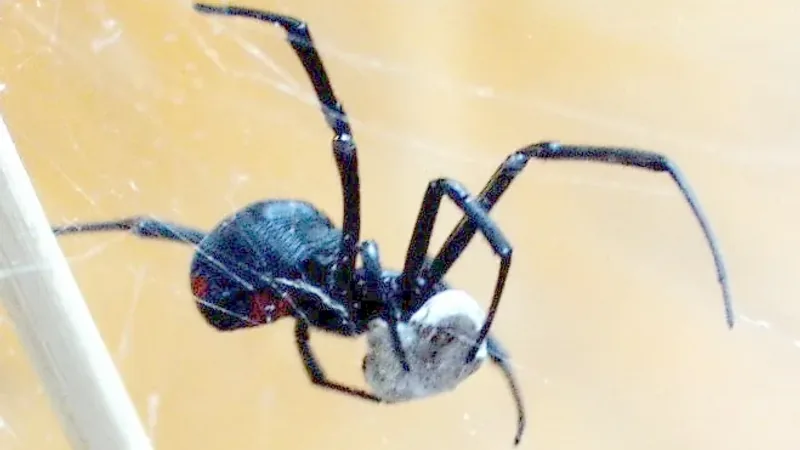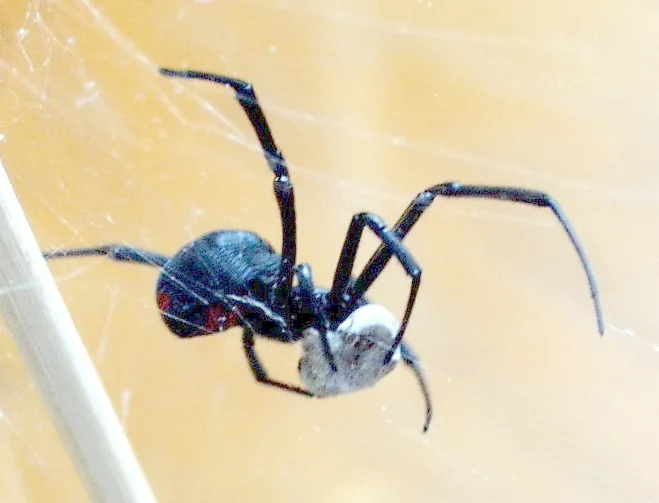
Latrodectus mactans eating
Field
notes
The southern black widow (Latrodectus mactans) is a shiny black spider found across the southeastern United States, its range reaching as far north as Ohio and as far west as Texas. Females carry the species’ famous look: a body about 1.25 cm (0.5 in) long, typically 3.75 to 5 cm (1.5 to 2 in) including the legs, and usually a red hourglass mark on the underside of the abdomen. Males are smaller, typically with a body just 0.6 cm long, and lack the female’s hourglass. The species averages about 1 gram. Females typically live around 1.5 years; males survive just two to five months, and a mature male abandons his home and spends considerable effort finding a female. Both primarily inhabit low-lying areas, and are often found in wood and rock piles, rodent burrows, and hollow stumps outdoors, or in sheds, garages, basements, and outhouses indoors.
A Venom Built to Overload
The venom contains the neurotoxin alpha-latrotoxin. By 2017 only 19 toxins had been identified from widow spider venom, and 10 of them are latrotoxins, large proteins more than 1,000 amino acids long that make up the major fraction of venom in this spider family. In the venom of a close relative, Latrodectus tredecimguttatus, researchers isolated alpha-latrotoxin, which provokes a massive transmitter release from vertebrate nerve endings, alongside five latroinsectotoxins that act on insects and one latrocrustatoxin active only on crustaceans.
Motor Overload Black widow venom acts on the presynaptic motor endplate, where nerve meets muscle, releasing massive amounts of noradrenaline and acetylcholine into the synapses. The result is excessive stimulation and fatigue of the motor end plate and muscle.
Tangled Webs and Comb Feet
The web is built in an erratic manner with no distinguishable pattern, and widow cobwebs carry sticky “gumfooted” lines. Flies, crickets, grasshoppers, moths, beetles, and other arthropods become trapped in it. The spider has a row of strong, curved bristles on its hind legs, forming a comb, which it uses to fling silk over its prey. It then bites the prey and later drags it to its hub, or retreat, to be eaten.
The Cannibal Myth and the Hourglass
Widow spiders got their name from the belief that females kill and eat their mates after mating, but that was mainly observed in crowded laboratory conditions. In natural settings, it is believed to have more to do with the male’s physical inability to escape than with the female’s interest in eating him. The hourglass itself varies: a study of females in Mexico recorded 40 distinct hourglass patterns, and the authors suggest Mexico may hold more widow species than are currently recognized. The female hangs upside down in her web so that her red hourglass serves as a warning signal to predators. In Florida, where the native spider has been rapidly disappearing, cohabitation experiments found introduced brown widows were six times more likely to kill and eat southern black widows than to kill bold cobweb spiders. The researchers suggest this predation is a significant factor in its local extinction from urban structures.
Published Updated
Traits
Intel
& FAQ
Guess
first
How big is a Southern Black Widow, really? Slide, lock in, and see what the sources say. Every answer is a figure from this page, quoted from where it came from.
Sources
- 01Eiden & Kaufman (2013). Southern black widow Latrodectus mactans (Fabricius) (Arachnida: Araneae: Theridiidae). EDIS.
- 02Latrodectus mactans. Animal Diversity Web, University of Michigan.
- 03Binder (1989). Acute Arthropod Envenomation: Incidence, Clinical Features and Management. Medical Toxicology and Adverse Drug Experience.
- 04Grishin (1998). Black widow spider toxins: the present and the future. Toxicon.
- 05Oldrati et al. (2017). Peptidomic and transcriptomic profiling of four distinct spider venoms. PLOS ONE.
- 06Blackledge, Summers & Hayashi (2005). Gumfooted lines in black widow cobwebs and the mechanical properties of spider capture silk. Zoology.
- 07Cabrera-Espinosa & Valdez-Mondragón (2021). Distribución y modelaje de nicho ecológico, comentarios biogeográficos y taxonómicos del género de arañas Latrodectus (Araneae: Theridiidae) de México. Revista Mexicana de Biodiversidad.
- 08Coticchio, Vetter & Cassill (2023). Predation by the Introduced Brown Widow Spider (Araneae: Theridiidae) May Explain Local Extinctions of Native Black Widows in Urban Habitats. Annals of the Entomological Society of America.
What the sources say: 40 claims checked word for word against these sources →