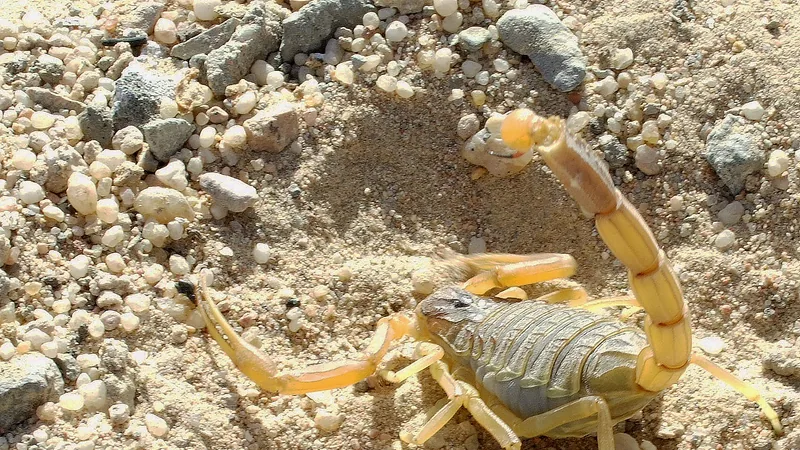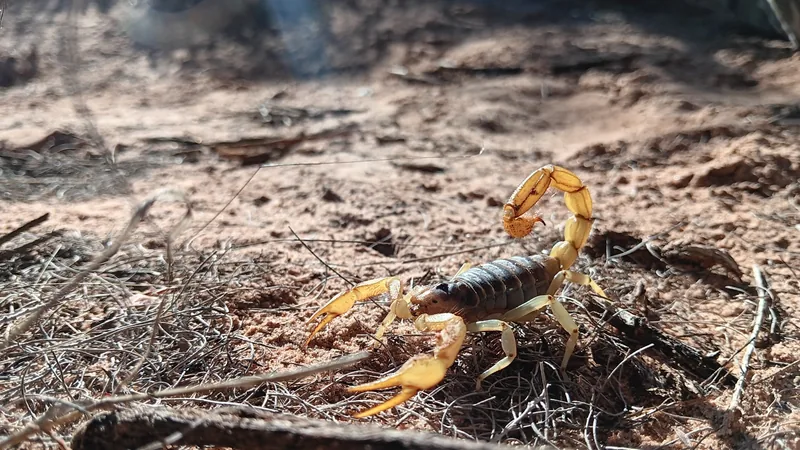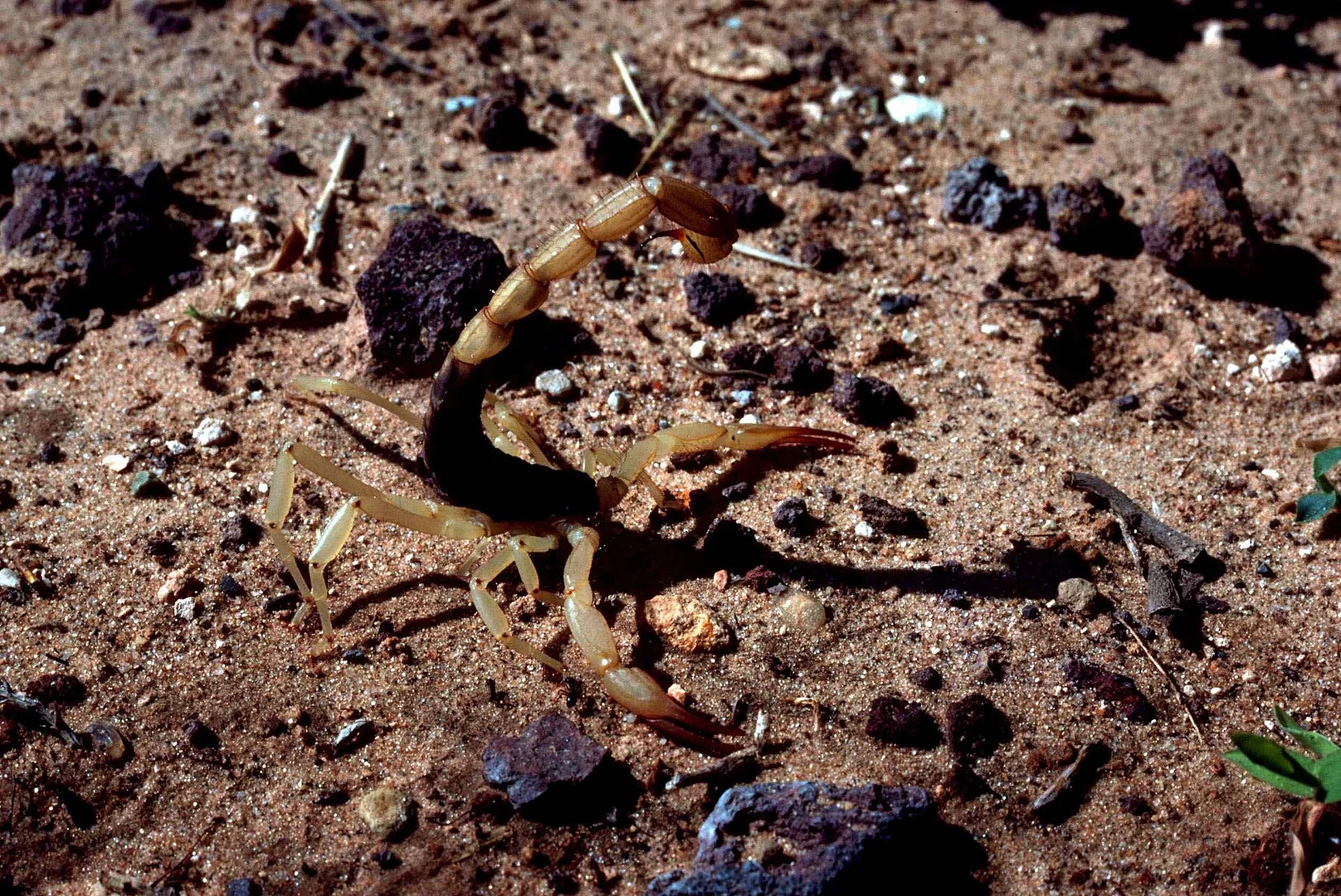
An Arizona bark scorpion on gravel, tail raised.
Field
notes
Small, and the Best Climber in Arizona
At a glance the Arizona Bark Scorpion (Centruroides sculpturatus) looks unremarkable. It reaches only an inch and a half at maturity, comparatively small for a scorpion, and its more slender tail segments and pincers may set it apart from the state’s less toxic species. Of the thirty species of scorpions found in Arizona, the Arizona Poison and Drug Information Center regards only this one as life-threatening, and calls it the best climber of the scorpion species. Scorpions are relatively inactive during daylight hours, and the majority of stings reported to the center occur at night during the warm summer months.
A Nerve Cell Held Open
Researchers who study it call the Arizona bark scorpion North America’s most venomous scorpion. Scorpion venom is a cocktail of toxins, and some of them switch on voltage-gated sodium channels, the microscopic gates nerve cells use to fire, causing intense pain. A review of 670 patients stung in central Arizona in 1982 described the action of this species’ venom as prolonged and excessive firing of neuronal axons, the long fibres that carry a nerve cell’s signal.
A Channel Stuck in the On Position The venom of some scorpion species leaves a nerve cell’s sodium gates incompletely closed. A slow influx of sodium follows, and the axon fires without regulation.
In an experiment on single frog nerve fibres, published in 1975, the venom brought about repetitive firing, some of it spontaneous, and eventually left the fibre’s membrane unable to fire.
The Animals That Shrug It Off
Not every predator is impressed. High-speed video of pallid bats hunting bark scorpions shows the scorpions stinging, sometimes multiple times, with none of the bats reacting during or after the encounter, and four of the five bats filmed consumed the scorpion at the end of it. Direct injection of venom at the mouse lethal dose, the concentration that kills half a group of mice, had no effect on bat behavior either, and at the highest dose tested three of four bats showed no effects.
Grasshopper mice have their own answer. Bark scorpion venom induces pain in many mammals, house mice, rats and humans among them, by switching on a nerve channel called Nav1.7, and it has no effect on a second channel, Nav1.8. Grasshopper mice carry a changed Nav1.8 that binds bark scorpion toxins and blocks the action potential, the electrical pulse a nerve passes along, turning the venom into a painkiller. They regularly attack and consume bark scorpions, grooming only briefly when stung.
When a Sting Turns Serious
A scorpion sting can cause immediate local pain with minimal swelling, and numbness and tingling that may travel across the body. Small children are at the highest risk of severe reactions. A 2023 clinical review reports that adults are stung more often than children, that children more often develop severe illness, and that a scorpion-specific antivenom is available in the United States. In a randomized trial of fifteen children admitted to intensive care, all eight who received that antivenom had their symptoms resolve within four hours, against one of the seven who received a placebo. The same review records no reported deaths from scorpion stings in Arizona since 1968.
Published Updated
Traits
Intel
& FAQ
Sources
- 01Scorpions. Arizona Poison and Drug Information Center, University of Arizona.
- 02Hopp, Arvidson & Razak (2017). Arizona bark scorpion venom resistance in the pallid bat, Antrozous pallidus. PLOS ONE.
- 03Rowe et al. (2013). Voltage-Gated Sodium Channel in Grasshopper Mice Defends Against Bark Scorpion Toxin. Science.
- 04Cahalan (1975). Modification of sodium channel gating in frog myelinated nerve fibres by Centruroides sculpturatus scorpion venom. The Journal of Physiology.
- 05Curry et al. (1983). Envenomation by the Scorpion Centruroides Sculpturatus. Journal of Toxicology: Clinical Toxicology.
- 06Boyer et al. (2009). Antivenom for Critically Ill Children with Neurotoxicity from Scorpion Stings. New England Journal of Medicine.
- 07Webber & Bryson (2015). Geographic variation in the thermal biology of a widespread Sonoran Desert arachnid, Centruroides sculpturatus (Arachnida: Scorpiones). Journal of Arid Environments.
- 08Scorpion Toxicity. StatPearls, NCBI Bookshelf, 2023.
- 09Scorpion. San Diego Zoo Wildlife Alliance.
What the sources say: 38 claims checked word for word against these sources →