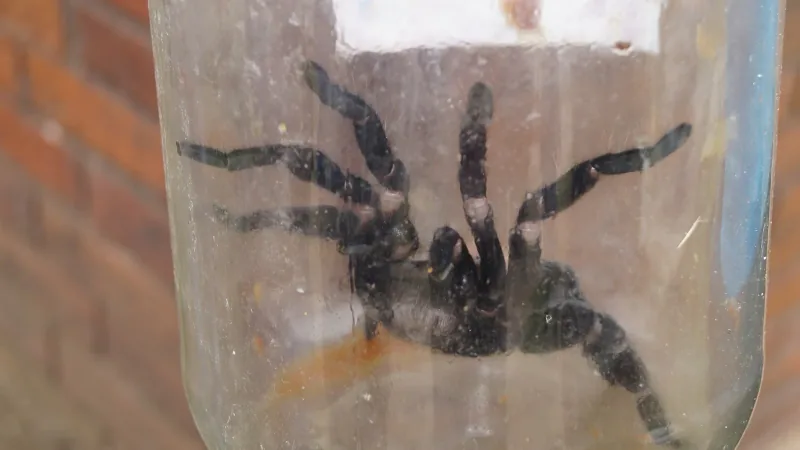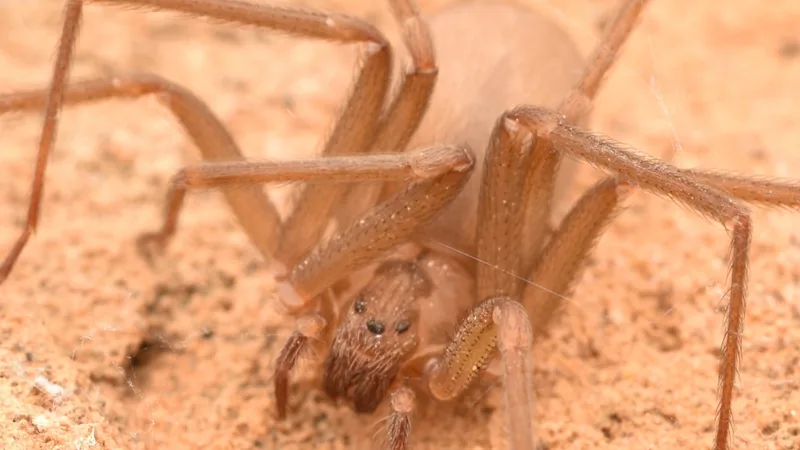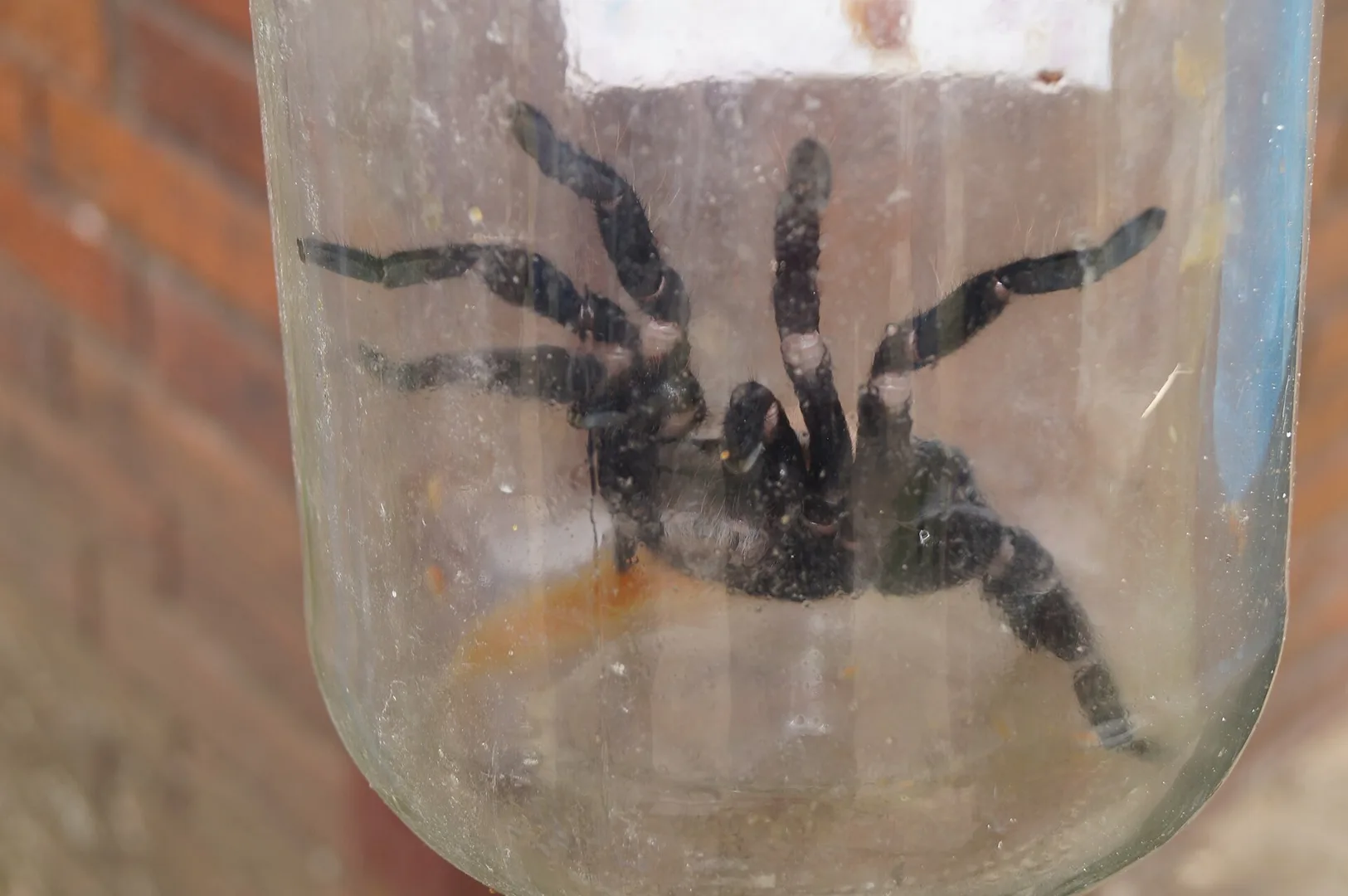
Grammostola rosea photographed from above, showing the rose-tinted carapace that gives the species its name
Field
notes
Two Joints Without Extensors
Spiders have flexor muscles to pull their legs in, but a 1957 study of spider leg muscles confirmed that they have no extensor muscles at two of their leg joints. The study raised the possibility that the flexors there work against the spider’s own blood pressure, so that haemolymph, the fluid inside its body, would do the straightening a muscle normally does.
A Tiny Oxygen Gradient A Chilean rose tarantula’s lungs are so refined that a difference in oxygen partial pressure of just 0.12 to 0.16 kilopascals across the lung barrier covers its resting oxygen needs, against about 7.5 kilopascals that mammals require.
Built to Wait, Built to Molt
This is a medium-sized tarantula that lives on the ground. Females average a leg span of 12 to 13 centimeters and males about 9 centimeters, though males have proportionally longer legs. Females live up to twenty years in human care, far outliving males, which die within a few months of mating.
Among spiders it counts as large, at more than 14 grams. Its metabolic rate is 63 percent of the value expected for other spiders of its body mass, and researchers have recorded that rate dropping at 30°C when it is deprived of food.
To grow, it must go through several molts, and spiderlings molt five or six times in their first year. The species is native to desert and scrub habitat across Chile, Argentina, and Bolivia, where it hunts at night. It feeds on a variety of invertebrates as well as small vertebrates such as mice, frogs, and lizards, relying on its size to subdue them.
The Bristle Defense
It can throw irritating hairs from its body in defense, and doctors studying tarantula bites note that New World species like this one typically cause injuries to people through their urticating hairs, which can penetrate skin and mucous membranes and cause local tissue reactions. The hairs appear rose-colored on Grammostola rosea, which is where the “Chilean rose” name comes from.
Forty-Eight Toxin-Like Peptides
Scientists sequencing genes from Grammostola rosea venom glands predicted forty-eight new toxin-like peptides from the sequences. One of them, GTx1-15, inhibits one voltage-dependent calcium channel and two voltage-dependent sodium channels. Doctors reporting a bite from this species that left a woman with weeks of cramping note that trouble with both kinds of channel could affect muscle contractions.
Published Updated
Traits
Intel
& FAQ
Guess
first
How big is a Chilean Rose Tarantula, really? Slide, lock in, and see what the sources say. Every answer is a figure from this page, quoted from where it came from.
Sources
- 01Chilean rose tarantula. Smithsonian's National Zoo and Conservation Biology Institute.
- 02Parry (1957). Spider Leg-muscles and the Autotomy Mechanism. Journal of Cell Science.
- 03Canals, Veloso & Solís (2015). Adaptation of the spiders to the environment: the case of some Chilean species. Frontiers in Physiology.
- 04Kimura, Ono & Kubo (2012). Molecular Cloning and Sequence Analysis of the cDNAs Encoding Toxin-Like Peptides from the Venom Glands of Tarantula Grammostola rosea. International Journal of Peptides.
- 05Kimura (2021). Stability and Safety of Inhibitor Cystine Knot Peptide, GTx1-15, from the Tarantula Spider Grammostola rosea. Toxins.
- 06Gooley et al. (2025). A Case Report of Delayed, Severe, Paroxysmal Muscle Cramping after Chilean Rose Tarantula (Grammostola rosea) Envenomation. Clinical Practice and Cases in Emergency Medicine.
What the sources say: 36 claims checked word for word against these sources →