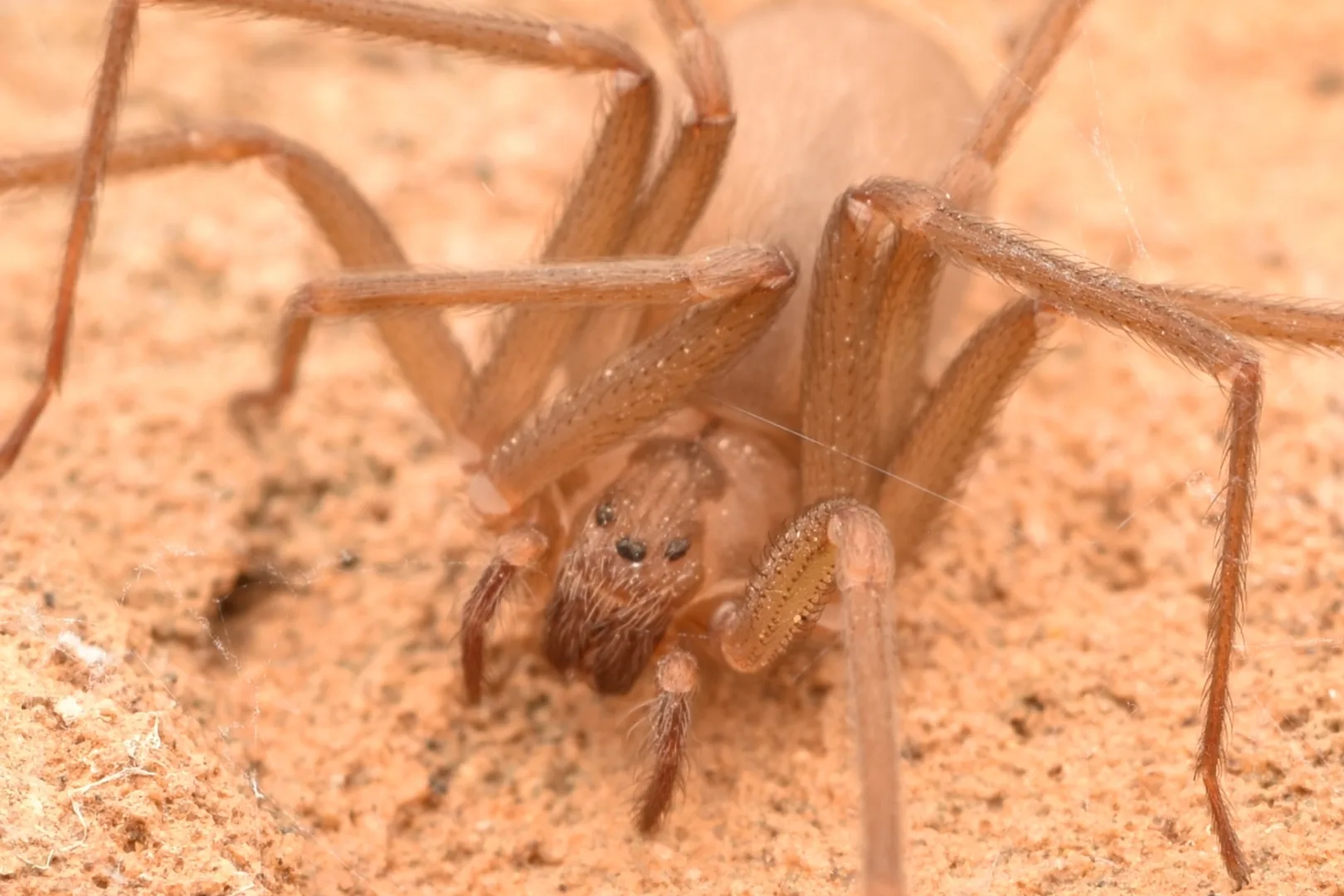
Brown Recluse ( Loxosceles reclusa )
Field
notes
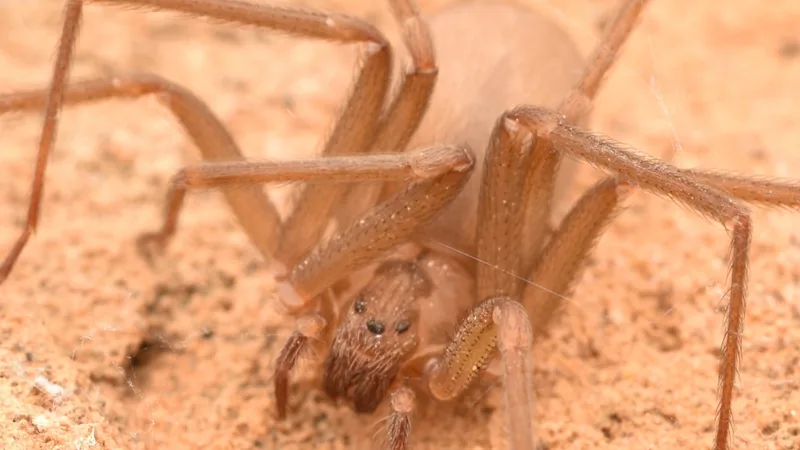
Six eyes and a violin
The brown recluse is a small spider with one striking mark. A dark violin shape sits on its back, with the neck of the violin pointing toward the rear of its body. Adults are about 7 to 12 mm long, and females average about 9 mm compared with about 8 mm for males. With its legs stretched out, it is about the size of a US quarter.
It lives across the south central and Midwestern United States. Outdoors it shelters under rocks, logs, woodpiles and debris. It is also well adapted to living indoors. In one Arkansas study of 626 spiders, most were found in buildings and outbuildings, especially in boxes and among papers.
Six eyes Most spiders have eight eyes. Recluse spiders have six, arranged in pairs in a semicircle on the forepart of the cephalothorax, the fused head and thorax.
A night hunter with no web trap
By day the brown recluse hides in a dark, secluded retreat, which it often lines with irregular webbing. At night it hunts insect prey, alive or dead, and it does not use a web to capture food. Its prey includes rather dangerous animals such as other spiders and ants. It strikes these with a sudden lunge and bite, then backs away at once while the venom paralyzes them. After the prey is overcome, it moves in to feed.
Adults often live about one to two years. The maximum age from emergence to death was 894 days for a female and 796 for a male.
Venom that kills tissue
A major part of the venom is sphingomyelinase D, which causes hemolysis, the destruction of red blood cells. Within 10 minutes of the injection, the capillaries around the bite constrict. If the skin turns purple, it then turns black as cells die. That is necrosis, or tissue death. Eventually the dead core falls away and leaves a deep pit that gradually fills with scar tissue.
The vast majority of bites heal without severe scarring. Reactions run from no noteworthy symptoms to severe necrosis, and the majority stay local and heal within 3 weeks. Less than 1% of cases bring the blood problems of severe systemic loxoscelism. Fatalities are extremely rare, and in 1998 a physician who had worked on recluse bites and venom for 40 years noted that none of the deaths attributed to it had been proven to be its doing.
Blamed for wounds it did not make
Bites usually happen only when the spider is trapped against skin, such as when a sleeper rolls onto it or someone puts on clothes it has crawled into. In one occupied Kansas home, 2,055 brown recluses were collected over 6 months, and no envenomations of the inhabitants occurred.
Outside its range, diagnoses outrun the spider. In Florida, medical personnel diagnosed 124 brown recluse bites in 6 years, across 31 of the state’s 67 counties. In 100 years, only 11 finds of about 70 Loxosceles spiders had been made in 10 counties. Necrotic wounds can also come from bacteria, viruses, fungi and other arthropods, and a wrong diagnosis can delay proper care.
Published
Traits
Intel
& FAQ
Guess
first
How big is a Brown Recluse, really? Slide, lock in, and see what the sources say. Every answer is a figure from this page, quoted from where it came from.
Sources
- 01Edwards. Brown Recluse Spider, Loxosceles reclusa Gertsch & Mulaik (Arachnida: Araneae: Sicariidae). Featured Creatures, UF/IFAS Extension, University of Florida.
- 02Jones (2004). Brown Recluse Spider. Ohio State University Extension fact sheet HYG-2061-04, copy hosted by Spartanburg County Public Health.
- 03Potter. Brown Recluse Spider (ENTFACT-631). University of Kentucky Department of Entomology.
- 04Loxosceles reclusa. Animal Diversity Web, University of Michigan.
- 05Vetter & Barger (2002). An Infestation of 2,055 Brown Recluse Spiders (Araneae: Sicariidae) and No Envenomations in a Kansas Home: Implications for Bite Diagnoses in Nonendemic Areas. Journal of Medical Entomology.
- 06Vetter, Edwards & James (2004). Reports of Envenomation by Brown Recluse Spiders (Araneae: Sicariidae) Outnumber Verifications of Loxosceles Spiders in Florida. Journal of Medical Entomology.
What the sources say: 62 claims checked word for word against these sources →