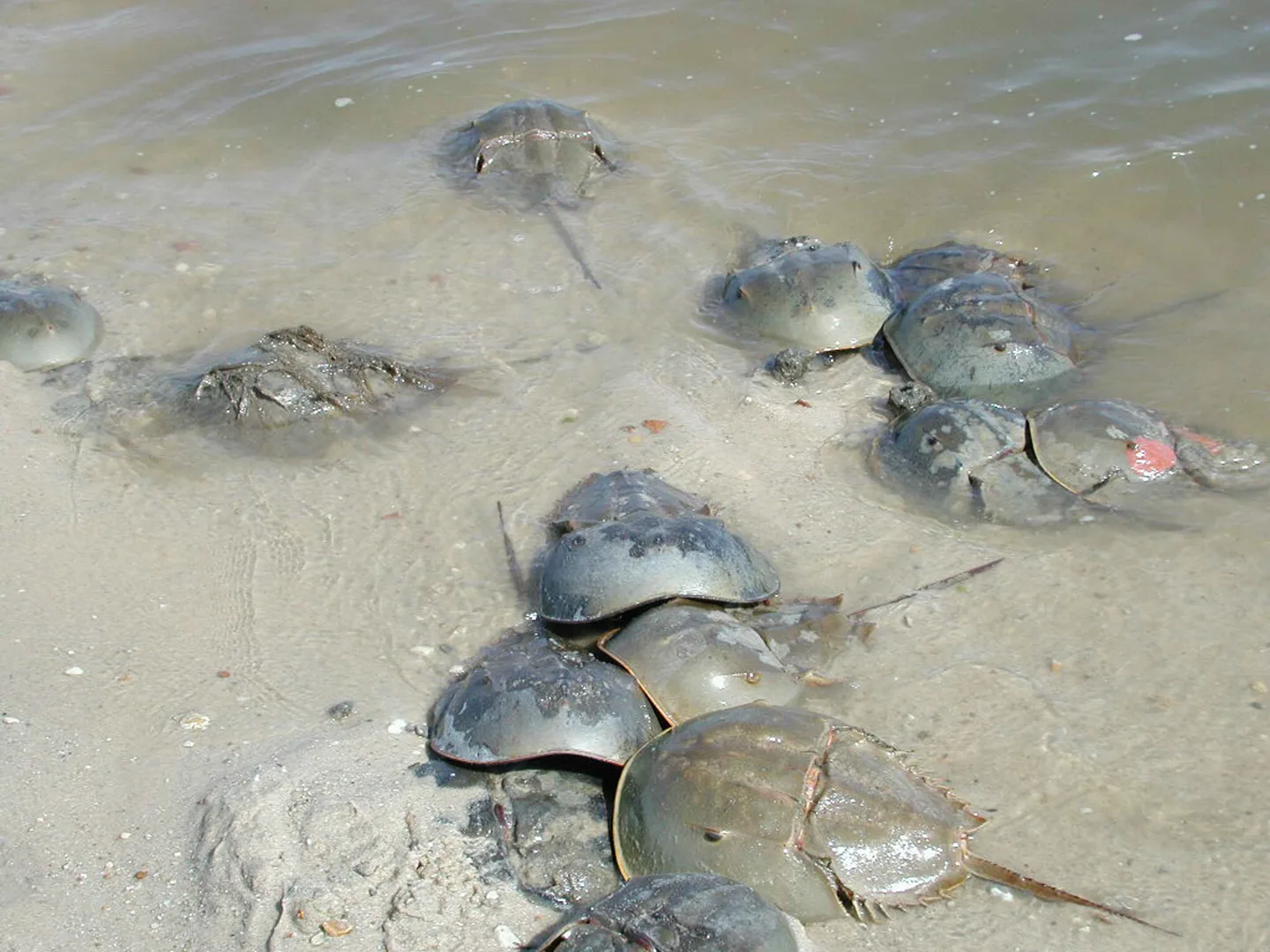
Image title: Arthropods horseshue crabs in water
Field
notes
Blue Blood That Catches Germs
Horseshoe crab blood is straw-colored and turns blue when it meets high levels of oxygen. The blue comes from hemocyanin, a copper-rich protein, where our red blood uses iron-based hemoglobin. The blood carries cells called amebocytes, which make it clot when it meets potentially harmful gram-negative bacteria, a type of germ that carries endotoxins in its cell walls.
Labs use that reaction in the Limulus Amebocyte Lysate (LAL) test, which checks pharmaceuticals and medical devices for potentially deadly endotoxins.
Blood donors without a choice Each year, the medical industry catches around half a million horseshoe crabs just to harvest their blood. A review of the practice reports that mortality after harvest ranges from 10 to 30%. A synthetic alternative is slowly replacing it.
A Cousin of Spiders
Despite the name, Atlantic horseshoe crabs are more closely related to spiders and scorpions than to true crabs. Their body has three parts: the prosoma (the front shell shaped like a horseshoe), the opisthosoma (the back section) and the telson, the tail. The spiky tail is usually mistaken for a weapon, but it is harmless. It helps the crab flip itself over if waves on the beach turn it over.
This design has stayed relatively unchanged in appearance for 350 million years. Adults are up to 2 feet long including the tail and weigh 3 to 4 pounds. The largest crabs are found on the Georgia coast, where mature females grow to about 11 pounds (4.8 kg). Males are typically 25 to 30% smaller than females. In the wild they live 20 to 40 years.
They have ten eyes, and the two large compound eyes on the sides are mainly used to locate a mate. Their rods and cones, the cells that detect light, are the largest of any known animal.
Life on the Sandy Bottom
The species lives in shallow coastal waters on sandy or muddy bottoms, on the Atlantic coast from Maine to the Yucatan Peninsula. It eats worms, bivalves and other small bottom-dwelling organisms.
The Moonlight Egg Rush
In the spring, crabs come ashore during the new and full moons to spawn. A female drags a male clasped to her shell, and she can lay 100,000 eggs over a few nights. The eggs are a critical food source for the red knot, a migratory bird with one of the longest known migration ranges, 9,000 miles.
Published
Traits
Intel
& FAQ
Guess
first
How big is a Atlantic Horseshoe Crab, really? Slide, lock in, and see what the sources say. Every answer is a figure from this page, quoted from where it came from.
Sources
- 01Atlantic Horseshoe Crab. Marine Biological Laboratory, University of Chicago.
- 02Atlantic Horseshoe Crab (Limulus polyphemus). U.S. Fish & Wildlife Service.
- 03Northeast Coastal and Barrier Network Species Spotlight: Atlantic Horseshoe Crab. National Park Service.
- 04Krisfalusi-Gannon et al. (2018). The Role of Horseshoe Crabs in the Biomedical Industry and Recent Trends Impacting Species Sustainability. Frontiers in Marine Science.
- 05Smith et al. (2016). Limulus polyphemus. The IUCN Red List of Threatened Species 2016: e.T11987A80159830.
What the sources say: 44 claims checked word for word against these sources →