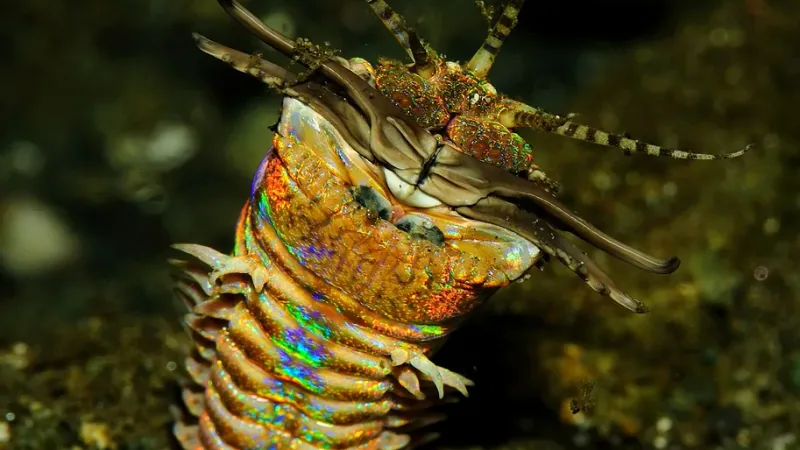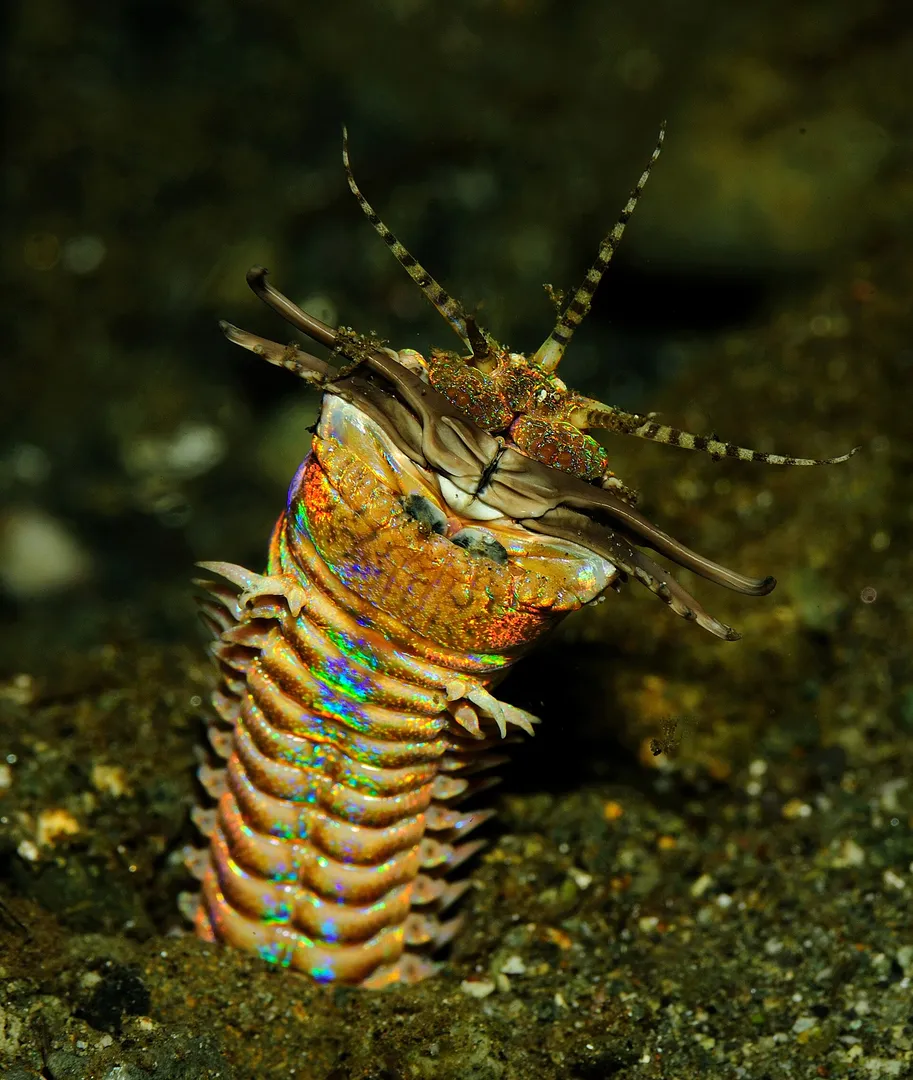
A bobbit worm with its antennae fanned and jaws open at the mouth of its burrow, Anilao, Philippines.
Field
notes
Buried Alive, Waiting
A bobbit worm lives out of sight, in a mucus-lined burrow in rocks or sediment. Eunice aphroditois can grow up to three meters long, about ten feet, on a body up to two centimeters across, and it stays buried in the loose seabed with five striped antennae poking out of the sand. The largest one recorded measured 299 centimeters and weighed 433 grams, and it may be the longest polychaete, a bristly marine worm, on record. These worms live in the sedimentary beds of warmer oceans, including the Indo-Pacific and the Atlantic.
A bobbit worm is not blind: it has two eyes on the front of its head. Researchers think its five antennae help lure and detect prey, and that it detects a meal mainly by sight and touch. By day it waits for something to brush an antenna. At night it changes tactics and actively hunts, poking out of its burrow to snatch passing prey.
The Bite
When a fish drifts close, the worm’s jaws sit “under tension like an armed spring trap.” It rapidly thrusts out an eversible pharynx, a throat that turns inside out to strike, tipped with sharp maxillae, its jaw pincers, grabbing prey and sometimes splitting a fish in half. In the attacks researchers filmed, the whole ambush, from snatch to the worm vanishing back underground, took about a tenth of a second. Whatever it catches also gets injected with a toxin that helps digest the meal. Bobbit worms are known to bite humans and can cause severe wounds.
Fish Fight Back A fish called Scolopsis affinis, which feeds near the seabed, turns on its hunter: when one spots a hidden bobbit worm, it blasts jets of water into the burrow, and others often join in.
Researchers diving in Indonesia filmed 46 of these water-jet attacks. In 16 of them, the worm reacted by pulling in an antenna or retreating completely into its burrow.
An Old Trick
Ambush burrowing like this is not new. In Taiwan, scientists described a fossil burrow up to two meters long, L-shaped, with distinct feather-like structures around its upper shaft. Compared with the burrows of living animals, its shape strongly suggests ambush-predatory worms that lived about 20 million years ago. Further back still, 400-million-year-old rocks in Canada preserve fossil jaws over a centimeter long from Websteroprion armstrongi, an extinct bristle worm with a body estimated at more than a meter long. Giant, heavily jawed worms are not a recent invention, even if that ancient one’s feeding habits remain unclear.
Published Updated
Traits
Intel
& FAQ
Guess
first
How big is a Bobbit Worm, really? Slide, lock in, and see what the sources say. Every answer is a figure from this page, quoted from where it came from.
Sources
- 01The Bobbit Worm. Smithsonian Ocean, Smithsonian Institution.
- 02Lachat & Haag-Wackernagel (2016). Novel mobbing strategies of a fish population against a sessile annelid predator. Scientific Reports.
- 03Pan et al. (2021). The 20-million-year old lair of an ambush-predatory worm preserved in northeast Taiwan. Scientific Reports.
- 04Shinomiya et al. (2023). Molecular and Morphological Assessment of Juvenile and Adult Forms in the Giant Worm Eunice Cf. Aphroditois (Annelida: Eunicidae) and Its Phylogenetic Position in the Family. Zoological Science.
- 05Eriksson, Parry & Rudkin (2017). Earth’s oldest ‘Bobbit worm’ – gigantism in a Devonian eunicidan polychaete. Scientific Reports.
What the sources say: 41 claims checked word for word against these sources →