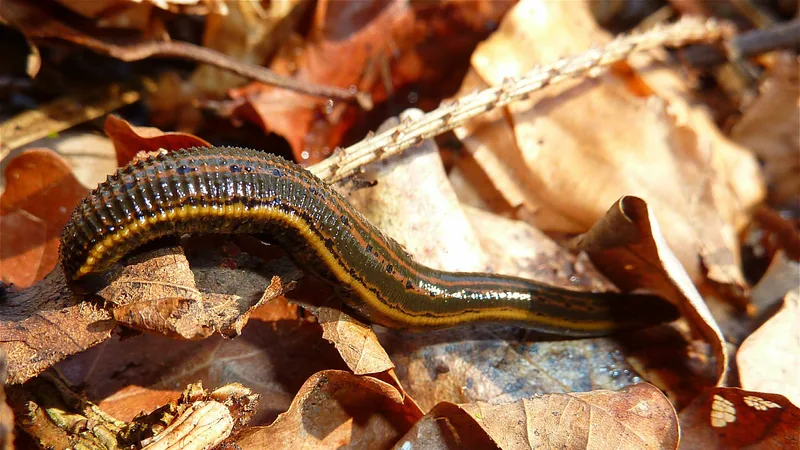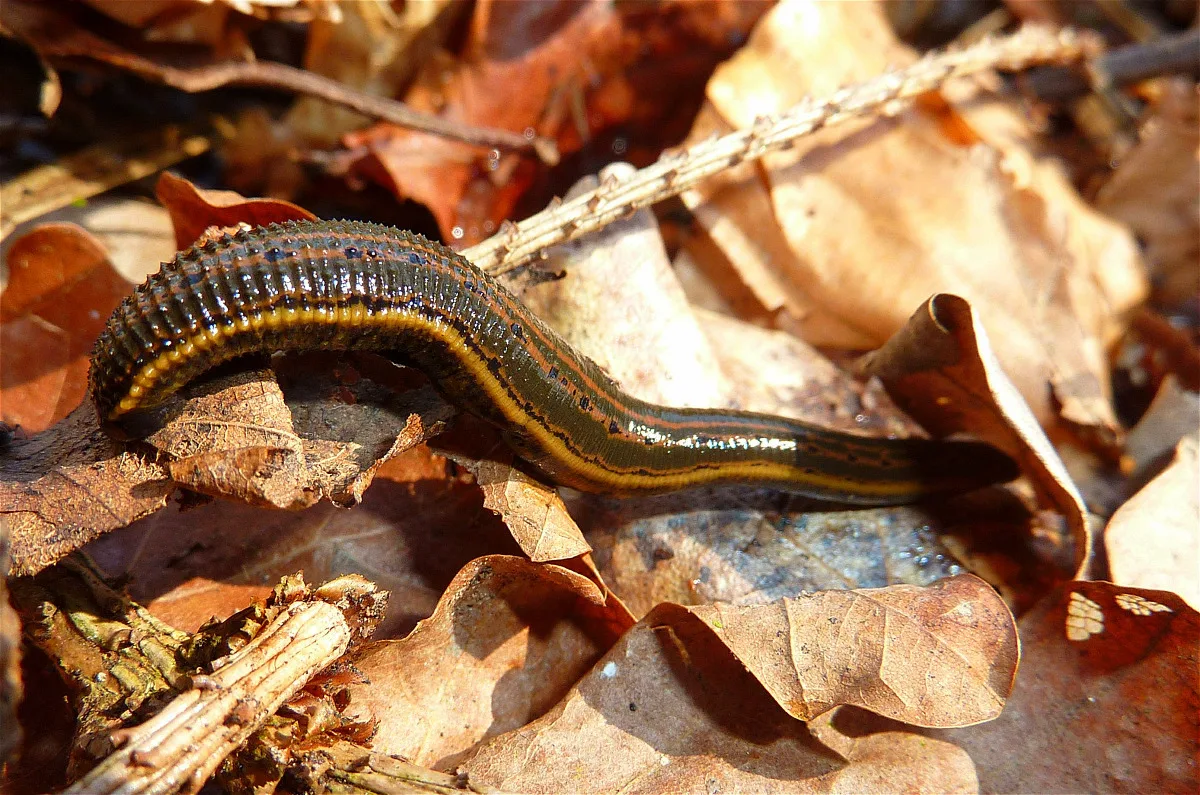
European medicinal leech among fallen leaves
Field
notes
Three Jaws and a Chemical Cocktail
The European medicinal leech drinks blood, and it brings its own toolkit. It latches on with three jaws lined with around 100 tiny teeth. While it feeds it releases hirudin, a natural anticoagulant, meaning a chemical that stops blood clotting so the meal keeps flowing. A 1986 study calls hirudin a potent thrombin inhibitor made in the leech’s salivary glands. Animal Diversity Web adds that the bite leaves a star-shaped scar with three arms.
Size, Age and Very Rare Meals
Buglife gives its length as up to 20 cm and calls it the largest native leech in the UK. Its body has 34 segments and it has five pairs of eyes. A 1988 lab study of leeches named as Hirudo medicinalis found that 1-g leeches took a meal of 8.4 g, about 8 times their own body mass, in around 25 minutes.
That meal goes a long way. An adult may not feed again for 12 to 18 months. A UK wildlife park says it can live up to 20 years in captivity, and Buglife says it takes at least two years to reach breeding age, and maybe four.
Shadow reflex Moving shadows overhead often mean a mammal is near, and the leech reacts to them, especially when it is hungry.
Ponds, Frogs and Cattle
It lives in ponds, lakes and small pools across much of Europe and into Asia. Buglife describes its home in the UK as usually small pools with muddy bottoms fringed with reeds. Adults typically feed on mammals such as deer, sheep and cattle that come into the water for a drink. Young leeches feed on the young of frogs, toads and newts.
Nearly Bled Out of Existence
Medicinal leeches were once used heavily in medicine, and many wild populations were collected to supply bloodletting. Buglife says the species is now rare across Europe and extinct in much of its former range, mainly due to that overharvesting. The IUCN rates it Near Threatened. In the UK, Buglife counts around 20 isolated populations.
Leeches still have a place in the clinic. A 2014 review reports that the FDA approved leeches in July 2004 as a medical device for plastic and reconstructive surgery. Mind the species, though. Buglife says health care professionals still use a related species, the Mediterranean medicinal leech (Hirudo verbana).
Published
Traits
Intel
& FAQ
Guess
first
How big is a European Medicinal Leech, really? Slide, lock in, and see what the sources say. Every answer is a figure from this page, quoted from where it came from.
Sources
- 01Utevsky, Zagmajster & Trontelj (2014). Hirudo medicinalis. The IUCN Red List of Threatened Species 2014: e.T10190A21415816.
- 02Medicinal Leech. Buglife.
- 03European medicinal leech. New Forest Wildlife Park.
- 04Hirudo medicinalis. Animal Diversity Web, University of Michigan.
- 05Lent et al. (1988). Ingestive Behaviour and Physiology of the Medicinal Leech. Journal of Experimental Biology.
- 06Harvey et al. (1986). Cloning and expression of a cDNA coding for the anticoagulant hirudin from the bloodsucking leech, Hirudo medicinalis. Proceedings of the National Academy of Sciences.
- 07Mumcuoglu (2014). Recommendations for the Use of Leeches in Reconstructive Plastic Surgery. Evidence-Based Complementary and Alternative Medicine.
What the sources say: 42 claims checked word for word against these sources →