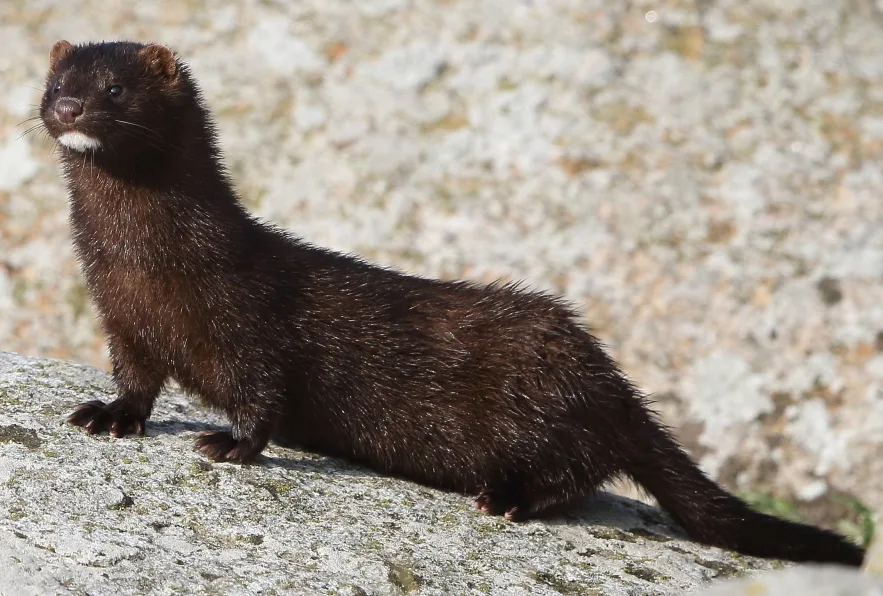
American mink at Lista, Norway
Field
notes
A weasel built for water
The American mink, Neogale vison, is a long, slender member of the weasel family with short legs and a pointy, flat face. Its toes are partially webbed, a sign of its semi-aquatic life. Its fur is soft and thick, and oily guard hairs waterproof the coat.
Body length is usually around 610 millimeters, about 2 feet, with up to half of that being the tail. Females are, on average, substantially smaller than males. Adult females weigh 0.7 to 1.1 kilograms, while males range from 0.9 to 1.6 kilograms. In the wild a mink may live up to 10 years, and one in captivity may reach 11.4 years.
Fearless on land and underwater
Across North America they favor forested areas close to water. They are mostly active at night, especially near dawn and dusk. They are skilled swimmers and climbers. Searching for food, they can swim up to 30 meters underwater and dive to depths of 5 meters.
Like most mustelids, they are aggressive and fearless predators. They do not hesitate to defend themselves against animals larger than themselves. They live mostly alone, and males are particularly intolerant of one another. They mark the edges of their home range with musky secretions from enlarged anal glands.
Summer meals include crayfish and small frogs, plus shrews, rabbits, mice and muskrats. Fish, ducks and other water fowl provide additional food choices. In winter they primarily prey on mammals.
Eiders versus mink In the Brokey archipelago of West Iceland, the invasive American mink cut common eider nest numbers by roughly 60%. Its arrival drove the eiders’ population changes more than climate did.
An escape artist abroad
Fur farms opened the door. In the British Isles, mink escaped from fur farms. In southern Chile and Argentina, mink were imported to fur farms during 1930 to 1950. Accidental escapes and intentional releases then led to feral populations in many areas.
On Navarino Island in Chile, where the native animals evolved without land predators, a study of 414 scats found a diet of mainly mammals and birds. In Finland’s Baltic archipelago, researchers found that female mink swam shorter distances as sea eagle predation risk rose.
Published
Traits
Intel
& FAQ
Guess
first
How big is a American Mink, really? Slide, lock in, and see what the sources say. Every answer is a figure from this page, quoted from where it came from.
Sources
- 01Neovison vison (American mink). Animal Diversity Web, University of Michigan.
- 02AnAge entry for Neovison vison. AnAge: The Animal Ageing and Longevity Database, Build 15, Human Ageing Genomic Resources.
- 03Ibarra et al. (2009). Invasive American mink Mustela vison in wetlands of the Cape Horn Biosphere Reserve, southern Chile: what are they eating? Oryx.
- 04Jónsson et al. (2023). Long-term data reveal contrasting impacts of native versus invasive nest predators in Iceland. Ecology Letters.
- 05Salo et al. (2008). Risk induced by a native top predator reduces alien mink movements. Journal of Animal Ecology.
- 06Reid, Schiaffini & Schipper (2016). Neovison vison. The IUCN Red List of Threatened Species 2016: e.T41661A45214988.
What the sources say: 50 claims checked word for word against these sources →