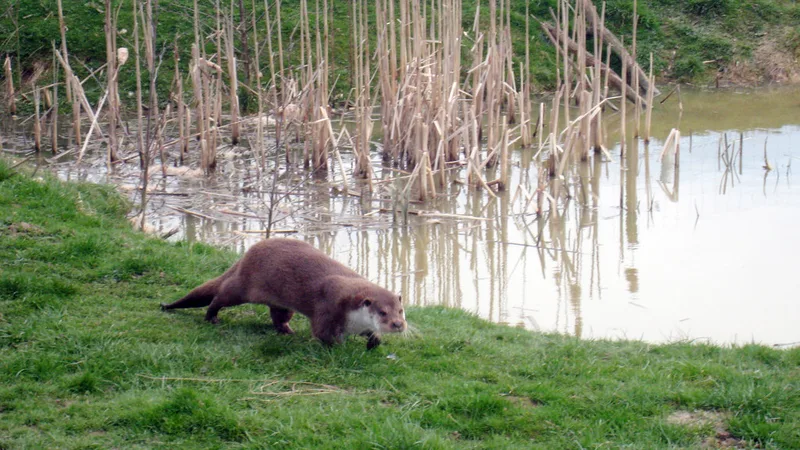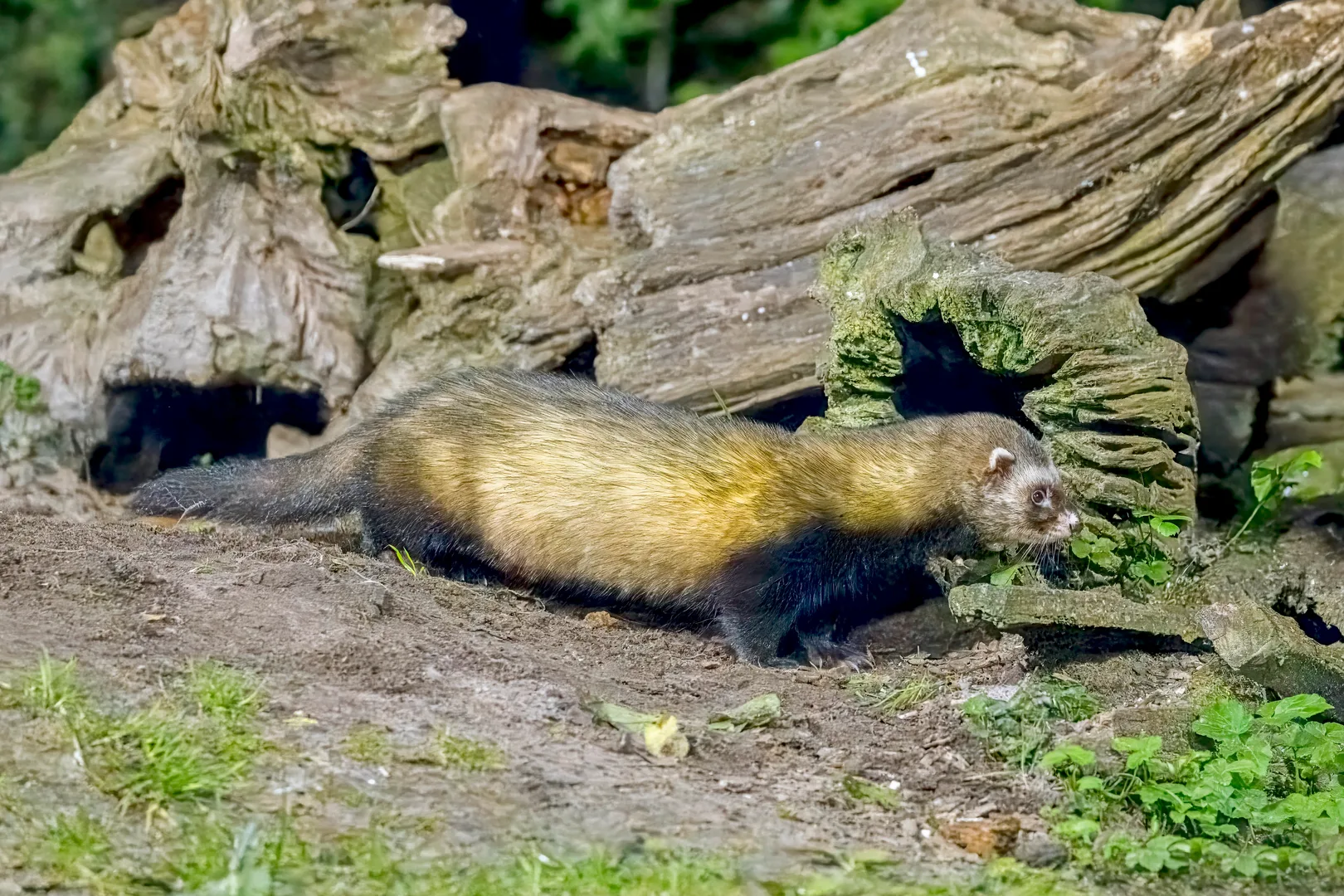
European polecat (Mustela putorius) in Drenthe, Netherlands
Field
notes
A Masked Mustelid
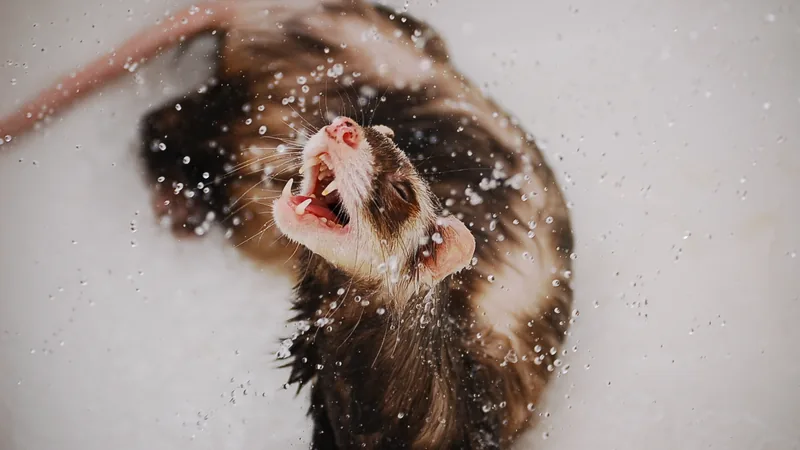
A European polecat has a long, slim body on short legs: males measure 33 to 45 centimetres and females 32 to 39, plus a 12 to 19 centimetre tail, and males weigh around 0.8 to 1.9 kilograms against females at 0.5 to 1.1. A raccoon-like dark mask crosses its eyes between pale cheek patches and a pale muzzle, and a paler buff undercoat shows through the darker hairs on its body. Its domesticated descendant, the ferret, is slightly smaller. Like all mustelids, a polecat has a pair of anal glands that emit a strong-smelling secretion, and it releases some of it when excited or threatened. Polecats show the strongest sexual dimorphism among mustelids, a gap that may come from strong mating competition among males. In the wild a polecat lives about five to six years. One captive polecat lived 11.1 years, and anecdotal reports of 14 years in captivity remain unconfirmed.
Rabbits, Rats and Tight Squeezes
Polecats are primarily nocturnal. In summer, rabbits are a major food source, and a polecat is slender enough to hunt them inside their burrows; in winter, rats become a favoured food. A polecat may squeeze through a gap as small as 4 centimetres. Birds, eggs, amphibians and reptiles are on the menu too, and when food is scarce, insects and fruit.
Locked Jaw Like other mustelids, a polecat has a “key-lock” jaw: the hinge between the lower jaw and the skull is nearly sealed into a permanent joint, very difficult to separate even after death. It gives mustelids their tenacious grip, and polecats and ferrets can be lifted and suspended by whatever they are gripping with their teeth.
Picking Off the Male Frogs
Polecats don’t hunt frogs at random. Studying agile frogs at their breeding ponds, researchers found that polecats preyed selectively on males. In ponds visited by polecats the sex ratio was less male-biased, fewer males actively searched for females, and females could choose between calling males and mate with just one, instead of being coerced into mating with several.
Where Snow Draws the Line
Polecats occur over large parts of Europe, but their northern range limit lies in southern Fennoscandia, and what sets that limit was unknown. A 2022 study tested whether climate or land-use factors matter more for polecat habitat in Sweden and found the number of snow days each year was the most important: more snow, less suitable habitat. How snow limits polecats is still poorly understood, but the authors suggest shrinking snow cover will likely push the range north. That might raise Scandinavia’s polecat numbers, in contrast to many populations elsewhere in Europe, where numbers are declining.
Published Updated
Traits
Intel
& FAQ
Guess
first
How big is a European Polecat, really? Slide, lock in, and see what the sources say. Every answer is a figure from this page, quoted from where it came from.
Sources
- 01Polecat. Vincent Wildlife Trust.
- 02Mustela putorius (European polecat). Animal Diversity Web, University of Michigan.
- 03Mustela putorius. AnAge: The Animal Ageing and Longevity Database.
- 04Lodé (2001). Mating system and genetic variance in a polygynous mustelid, the European polecat. Genes & Genetic Systems.
- 05Poole (1972). Some behavioural differences between the European polecat, Mustela putorius, the ferret, M. furo, and their hybrids. Journal of Zoology.
- 06Lodé et al. (2004). Sex–biased predation by polecats influences the mating system of frogs. Proceedings of the Royal Society of London. Series B: Biological Sciences.
- 07Osinga, Thurfjell & Hofmeester (2022). Snow limits polecat Mustela putorius distribution in Sweden. Wildlife Biology.
- 08Fernandes & Kranz (2025). Mustela putorius. The IUCN Red List of Threatened Species 2025: e.T41658A215860613.
What the sources say: 37 claims checked word for word against these sources →