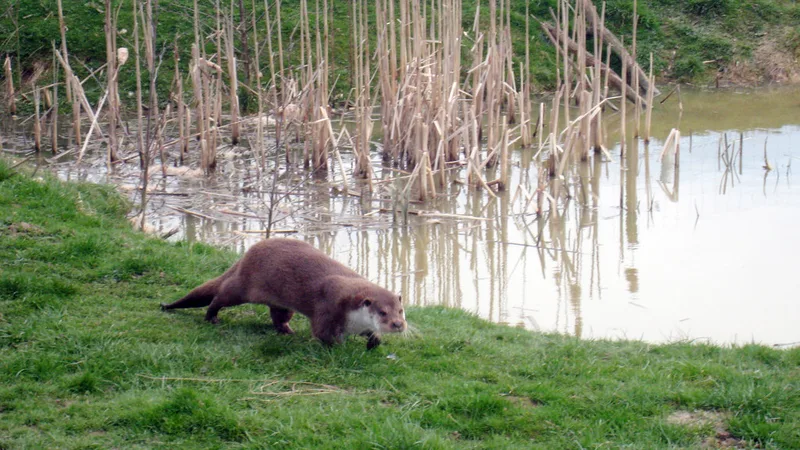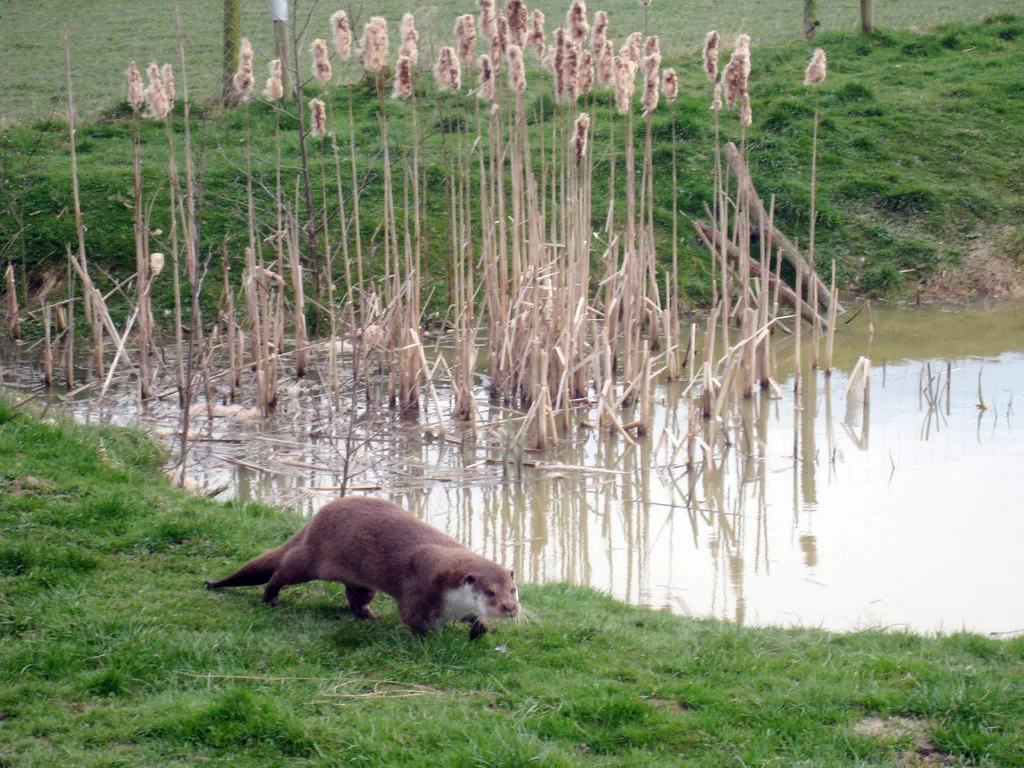
Eurasian otter (Lutra lutra) near Talavera de la Reina, Toledo, Spain.
Field
notes
The World’s Most Widespread Otter
The Eurasian otter (Lutra lutra) is the most widely distributed otter species, found across Europe, North Africa and Asia as far as Japan and Indonesia. In the UK, otters weigh 7 to 11 kilograms and measure 94 to 155 centimetres from nose to tail, and males are larger on average. The longevity record in captivity belongs to a female who lived to 18.2 years old. Rivers, lakes, coastal fjords, peat swamps and rice paddies count as home. In a territory of 1 to 4 miles, each otter keeps fixed places for getting in and out of the water, rolling, sunbathing and sliding down “otter stairways”.
Whiskers That Hunt in the Dark
Its vibrissae, whiskers above its lips, detect changes in the water current and the presence of prey, and track the movements of fish underwater. It can dive for up to two minutes and is most active at dusk and during the night. Its catch list is long: fish, crustaceans, amphibians, small mammals, birds, eggs, insects and worms, about a kilogram of food a day.
The mix shifts with season and place. On five woodland rivers in eastern Poland, fish made up 51% of what otters ate by weight in spring and summer but 40% in autumn and winter, when amphibians rose to 58%. A review of 37 European diet studies found that otters in Mediterranean areas relied less on fish, and more on aquatic invertebrates and reptiles, than otters in temperate areas.
A Smell Left as a Signature
Eurasian otters are basically solitary. Mates pair only briefly and mothers keep their young with them for a time, though loose groups of up to six sometimes turn up. They are vocal too, with basic calls for alarm, greeting and mating plus up to 12 others, from shrill whistles and yelps to high-pitched screams of distress.
Spraint is the name for otter droppings, left on rocks and logs close to the water as a way of communicating with other otters. Along 28 kilometres of the River San in south-eastern Poland, a three-week survey of both banks counted an average of 4.18 new spraints per kilometre per day, and the more of a stretch’s banks were steep and rocky, the more spraints it collected.
Paired scent glands at the base of the tail give off a heavy, musky smell, and scent marks carry news of territory boundaries, identity and sexual state. Eurasian otter males form a dominance hierarchy, and the highest-ranking ones hold, and mark, the best ranges.
Poisons and a Comeback
A 1998 study named PCBs, industrial chemicals, as one of the major factors in the otter’s serious decline over the previous decades. Rat poison turns up too: in mustelids collected in south-western France from 1990 to 2002, the rodenticide bromadiolone was found in the livers of two of eleven otters.
The Woodland Trust calls the otter’s return across the UK a conservation success story: by the 1950s, hunting, habitat destruction and chemicals in rivers had left it on the brink of extinction there. In one area of southern England, otters and polecats were absent in the 1990s but back by the 2000s, and a 2009 study found the invasive American mink there had switched from mostly nocturnal to mostly daytime activity, which the researchers suggest may help it avoid them. The IUCN Red List classes the Eurasian otter as Near Threatened.
Published Updated
Traits
Intel
& FAQ
Guess
first
How big is a Eurasian Otter, really? Slide, lock in, and see what the sources say. Every answer is a figure from this page, quoted from where it came from.
Sources
- 01Lutra lutra (European otter). Animal Diversity Web, University of Michigan.
- 02Otter. San Diego Zoo Wildlife Alliance.
- 03AnAge entry for Lutra lutra. AnAge: The Animal Ageing and Longevity Database, Human Ageing Genomic Resources.
- 04Otter (Lutra lutra). Woodland Trust.
- 05Loy (2025). Lutra lutra. The IUCN Red List of Threatened Species 2025: e.T12419A227078232.
- 06Jędrzejewska et al. (2001). Feeding habits of the otter and the American mink in Białowieża Primeval Forest (Poland) compared to other Eurasian populations. Ecography.
- 07Weber (1990). Seasonal exploitation of amphibians by otters (Lutra lutra) in north-east Scotland. Journal of Zoology.
- 08Clavero, Prenda & Delibes (2003). Trophic diversity of the otter (Lutra lutra L.) in temperate and Mediterranean freshwater habitats. Journal of Biogeography.
- 09Brzeziński & Romanowski (2006). Experiments on sprainting activity of otters (Lutra lutra) in the Bieszczady Mountains, southeastern Poland. Mammalia.
- 10Murk et al. (1998). Application of biomarkers for exposure and effect of polyhalogenated aromatic hydrocarbons in naturally exposed European otters (Lutra lutra). Environmental Toxicology and Pharmacology.
- 11Fournier-Chambrillon et al. (2004). Evidence of secondary poisoning of free-ranging riparian mustelids by anticoagulant rodenticides in France: implications for conservation of European mink (Mustela lutreola). Journal of Wildlife Diseases.
- 12Harrington et al. (2009). The impact of native competitors on an alien invasive: temporal niche shifts to avoid interspecific aggression. Ecology.
What the sources say: 44 claims checked word for word against these sources →