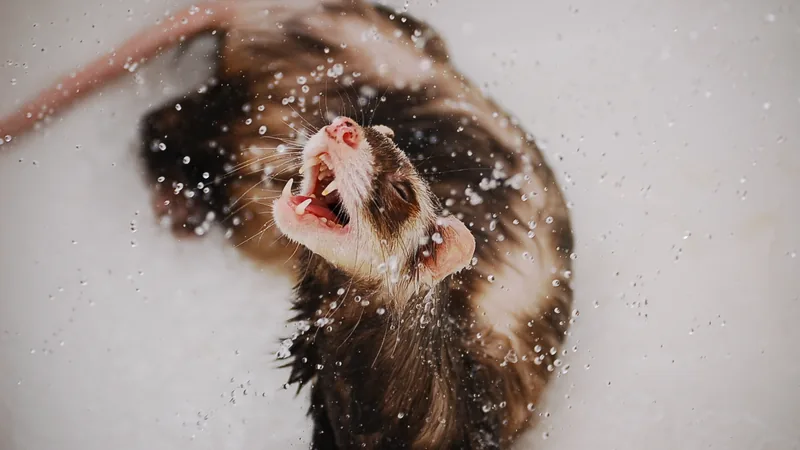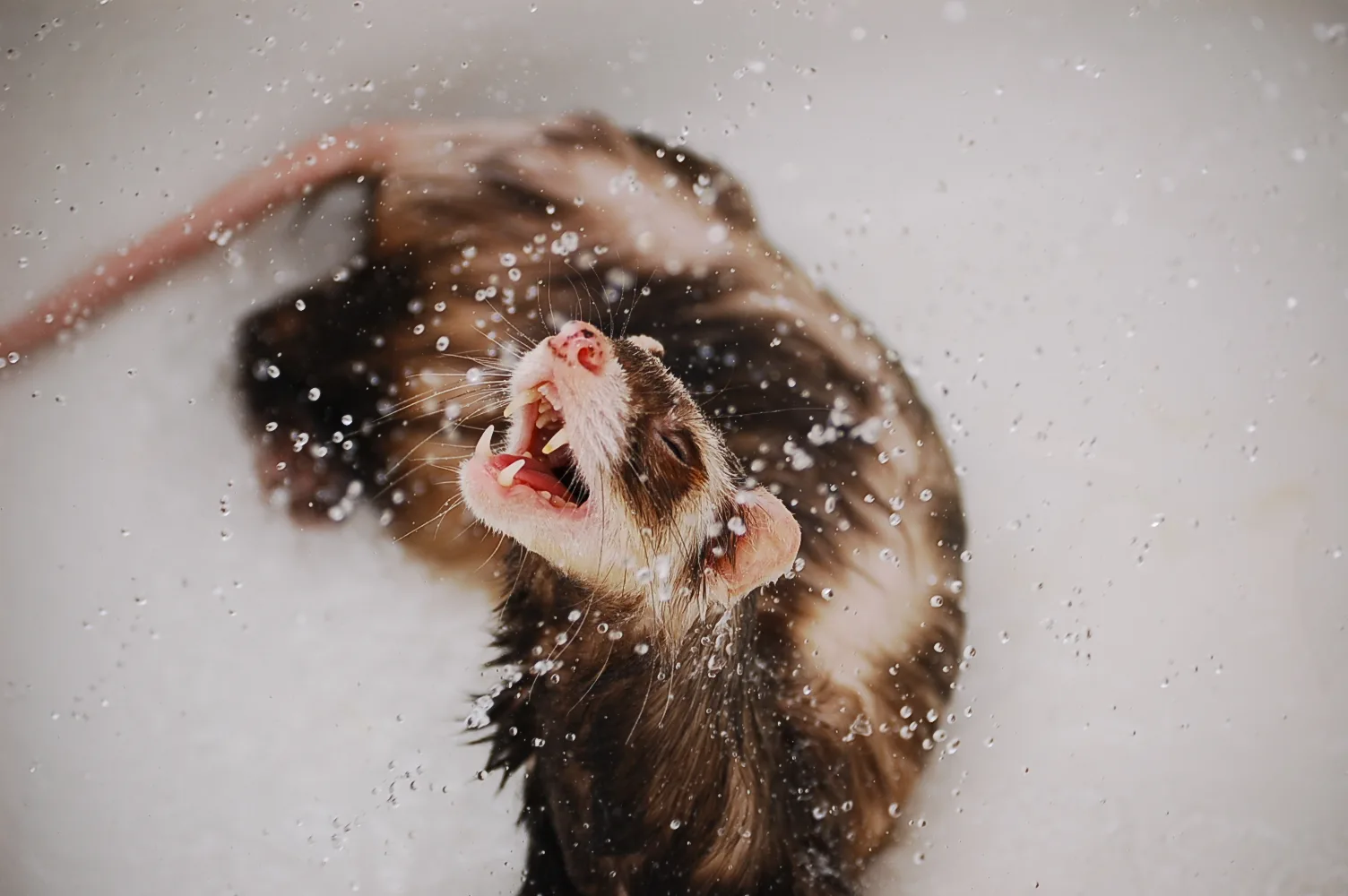
Playing in the snow.
Field
notes
A small carnivore that mostly sleeps
Ferrets are small carnivores in the weasel family. In lab recordings of two adult males, ferrets spent over 60% of their time asleep.
Sleep comes in stages, and one is REM (rapid eye movement) sleep. In those males, REM took up 40.28% of total sleep time. The high REM share comes from a high number of REM episodes rather than long REM periods. A second study measured sleep in eight adult ferrets.
REM share In that study, REM sleep filled 24.01% of total recording time, considerably higher than typically reported in placental mammals. The authors suggest REM sleep may have been present in greater amounts in early stages of mammalian evolution.
How big, how long
An intact male, called a hob, weighs 1 to 2 kg. An intact female, called a jill, weighs 0.5 to 1.5 kg. Animal Diversity Web puts males at 0.9 to 2.7 kg, with neutered males often lighter. The body is long and slender: females are typically 33 to 35.5 cm long and males 38 to 40.6 cm, plus a tail of 7.6 to 10 cm. As pets they can live 6 to 10 years, and a review gives 8 to 10 years, and up to 15. Ferrets become sexually active in the first spring after their birth, usually around 9 months of age.
Hunters turned housemates
Ferrets are common pets all over the globe. The same review says they were used as rat and rabbit hunters about 2000 years ago. They are also kept as laboratory animals and for fur.
One study compared ferrets with their wild counterpart, the European polecat, and with hybrids of the two. Ferrets do not develop fear of man. Hybrids raised with their mother through a critical window of 7.5 to 8.5 weeks of age do.
Weak spots
Canine distemper is a virus that affects many pets. It is fatal for virtually all ferrets that meet it. Vaccination protects them.
Another problem is adrenal disease, called hyperadrenocorticism, meaning excessive production of sex steroids. A review says it is unique to ferrets. It calls it one of the most common endocrine (hormone) system diseases in neutered ferrets.
Coat colour matters too. In a study of 152 healthy European pet ferrets, 29% had congenital deafness in one or both ears. It was strictly associated with white coat markings and premature graying. All panda, American panda and blaze ferrets in the study were deaf.
Published
Traits
Intel
& FAQ
Guess
first
How big is a Ferret, really? Slide, lock in, and see what the sources say. Every answer is a figure from this page, quoted from where it came from.
Sources
- 01Marks & Shaffery (1996). A Preliminary Study of Sleep in the Ferret, Mustela putorius furo: A Carnivore With an Extremely High Proportion of REM Sleep.
- 02Jha, Coleman & Frank (2006). Sleep and sleep regulation in the ferret (Mustela putorius furo). Behavioural Brain Research.
- 03Grinblate & Ilgaza (2019). Biology, Reproductive System Particularities and Hyperadrenocorticism in Domestic Ferret (Mustela Putorius Furo). Biomedical Journal of Scientific & Technical Research.
- 04Poole (1972). Some behavioural differences between the European polecat, Mustela putorius, the ferret, M. furo, and their hybrids. Journal of Zoology.
- 05Piazza et al. (2014). Prevalence of deafness and association with coat variations in client-owned ferrets. Journal of the American Veterinary Medical Association.
- 06Matsuoka, Lamirande & Subbarao (2009). The Ferret Model for Influenza. Current Protocols in Microbiology.
- 07Mustela putorius furo (domestic ferret). Animal Diversity Web, University of Michigan.
- 08Pet Talk: Ferret Distemper. Texas A&M University College of Veterinary Medicine & Biomedical Sciences.
What the sources say: 46 claims checked word for word against these sources →