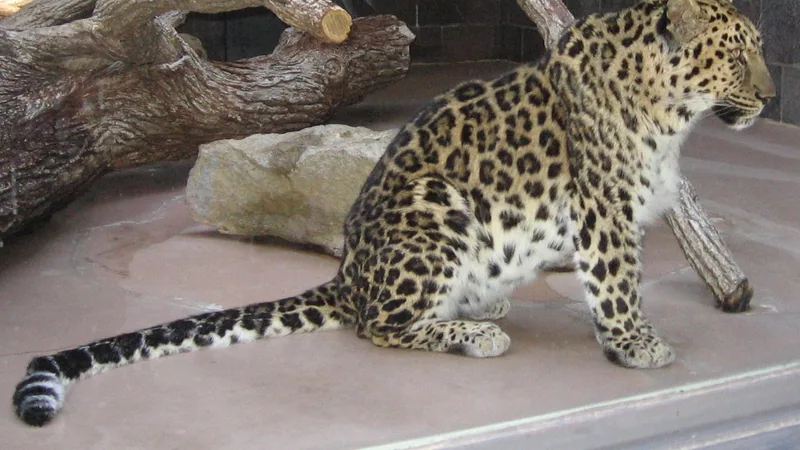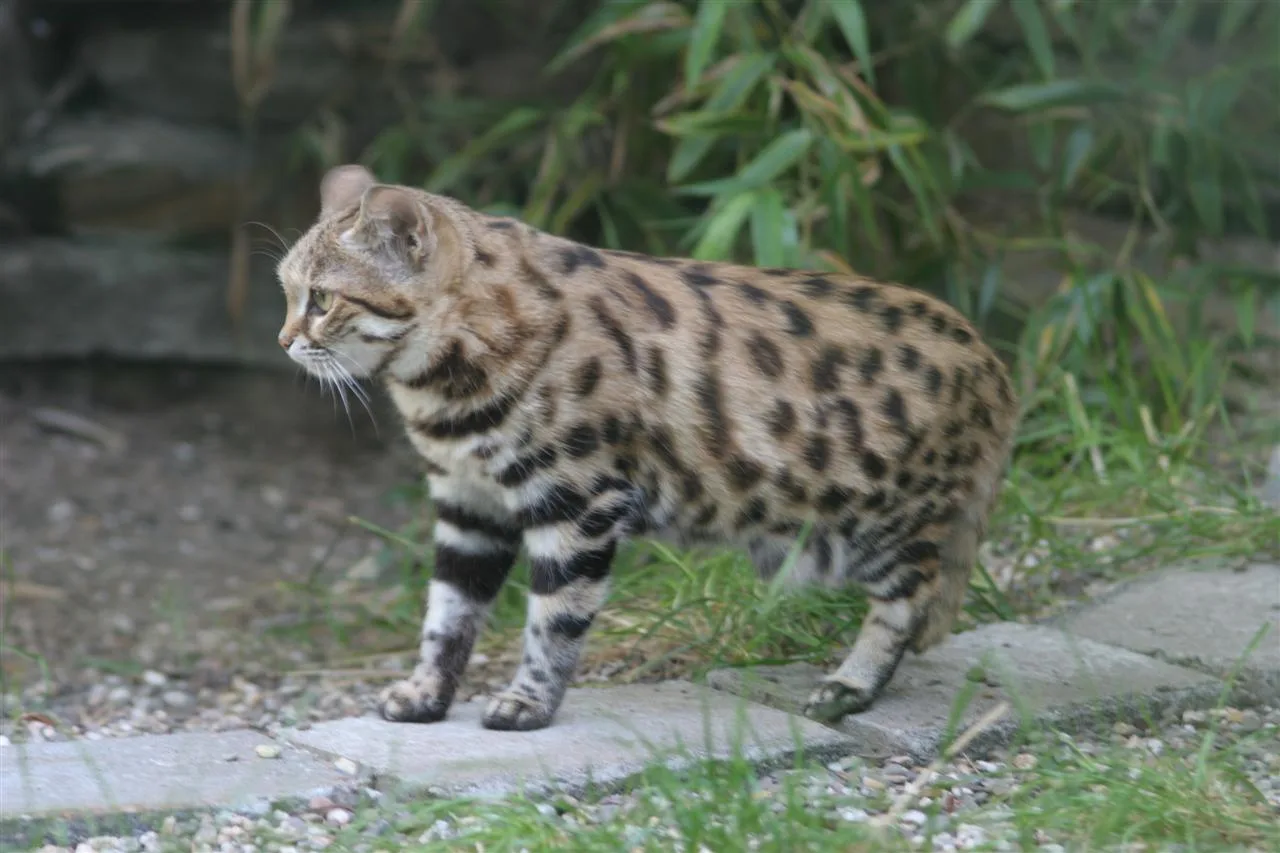
A captive black-footed cat at Wuppertal Zoo, Germany.
Field
notes
A 60 Percent Hit Rate, Under Two Kilograms
The Black-Footed Cat (Felis nigripes) is one of the world’s smallest cats. Females average 1.3 kilograms and males 1.93 kilograms, while the more common African wildcat is considerably larger, at 3.9 kilograms for females and 5.1 for males. Life expectancy in the wild is about five years, although two monitored cats lived to at least seven. In captivity they are reported to live up to 16 years.
Small as it is, the black-footed cat has a hunting success rate of around 60 percent, a figure the researchers who sequenced its genome call remarkably high, citing earlier work. The same paper describes a high metabolic rate: the cat needs to eat about a fifth of its own body weight each day to keep its energy up.
Adults travel an average of 8.42 kilometers a night. A study comparing them with African wildcats found that both caught roughly 12 to 13 prey animals a night, though black-footed cats took smaller prey on average. Small rodents like the large-eared mouse are caught most often. In one study, prey by mass was 72 percent mammals and 26 percent birds, with invertebrates, amphibians and reptiles together making up just 2 percent. In winter they mainly eat larger birds and mammals over 100 grams, and larger kills may be cached for later.
Built for the Dark
Black-footed cats are active throughout the night, and have been recorded hunting at temperatures of -8°C. The genome study found that genes for vision, hearing, and fat and protein metabolism show signs of natural selection or rapid evolution, which the authors call genetic adaptations to night hunting and a high metabolic rate. The species also has sensitive vision and one of the largest ratios of auditory bulla (a bony chamber in the skull that forms part of the ear) to body size of any living cat.
A hollowed-out termite mound makes a good bedroom. By day, black-footed cats shelter in dens dug by other burrowing mammals, especially springhares, or in hollowed-out abandoned termite mounds, which also matter as dens for mothers with kittens.
A Small Range and a Suspected Decline
Black-footed cats are endemic to the arid regions of southern Africa, living in Nama Karoo, open savanna and grassland, and have the most limited distribution of any African cat. The species is listed as present in South Africa, Botswana, Namibia and Zimbabwe. The global population is estimated at fewer than 10,000 mature individuals, nearly two-thirds of them in South Africa, with a continuing decline suspected across the range. At one long-term South African study site, densities fell from 0.17 cats per square kilometer in 1998 and 1999 to 0.03 in 2024. Illegal poison used against predators on livestock farms, domestic dogs and vehicles are among the threats, and the IUCN lists the species as Vulnerable.
Amyloidosis, a disease in which protein deposits build up in many organs and usually end in kidney failure, is blamed for about 70 percent of documented deaths of captive black-footed cats and 16 percent of known deaths in the wild. The genome study suggests that inbreeding, linked to two harmful mutated genes, may raise the risk.
Published Updated
Traits
Intel
& FAQ
Guess
first
How big is a Black-Footed Cat, really? Slide, lock in, and see what the sources say. Every answer is a figure from this page, quoted from where it came from.
Sources
- 01Black-footed Cat. Endangered Wildlife Trust, Red List of Mammals of South Africa.
- 02Felis nigripes (black-footed cat). Animal Diversity Web, University of Michigan.
- 03Yuan et al. (2024). The genome of the black-footed cat: Revealing a rich natural history and urgent conservation priorities for small felids. Proceedings of the National Academy of Sciences.
- 04Sliwa et al. (2026). Felis nigripes. The IUCN Red List of Threatened Species 2026: e.T8542A288685609.
What the sources say: 48 claims checked word for word against these sources →