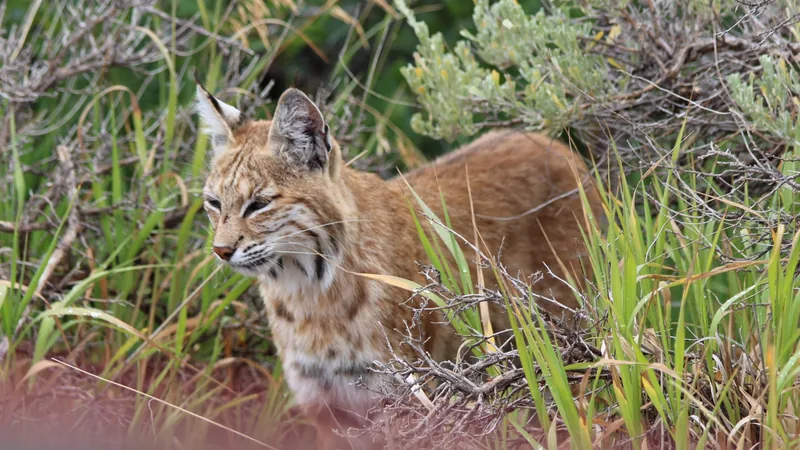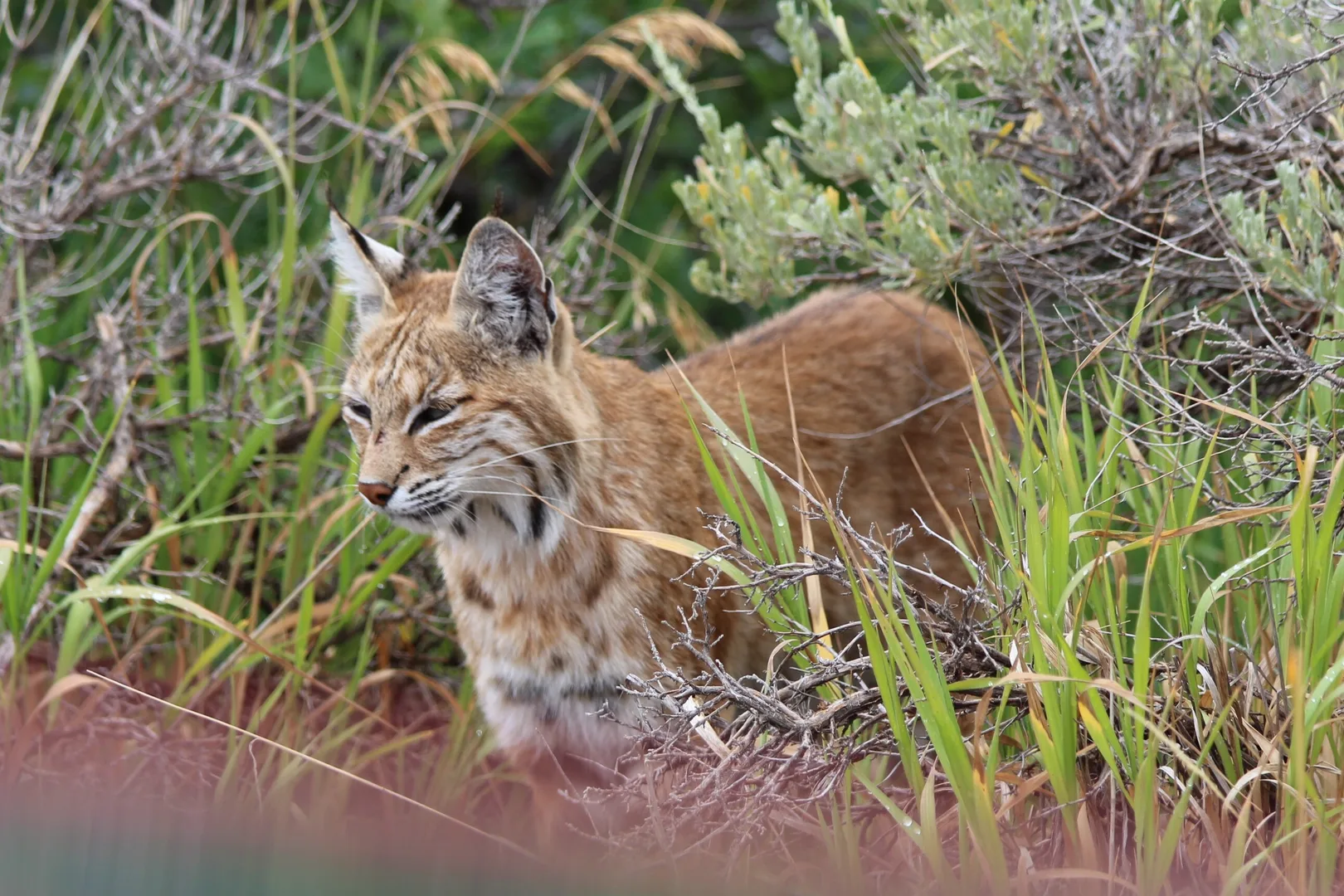
Adult bobcat in grassland, United States
Field
notes
Quiet Feet
To cut the noise it makes while hunting, a bobcat sets each back foot down in a spot where a front foot has already stepped. It stalks, then pounces, and if the pounce works it kills with a bite to the vertebrae, the bones of the neck. When it needs speed, it can run at up to 30 miles per hour (48 km/h).
Size and Range
Bobcats got their name because of their short tails. A bobcat’s body runs 65 to 105 cm long, with the tail adding 11 to 19 cm. It is generally 46 to 64 cm tall at the shoulder and weighs between 4 and 15 kg. Bobcats are bigger in the north of their range and smaller in the south.
The United States holds the majority of the world’s bobcats, and the species ranges from Mexico up to southern Canada. It copes with a lot: northern conifer forests, southeastern swamps, and southwestern deserts and scrub.
Spots, Tails and Bare Paws
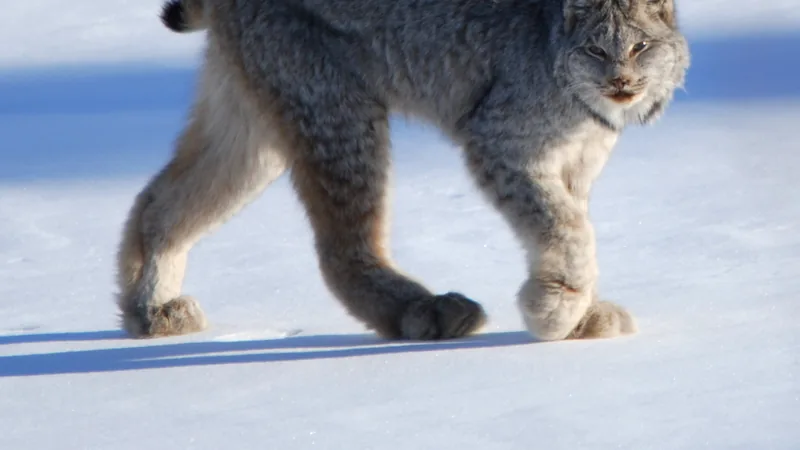
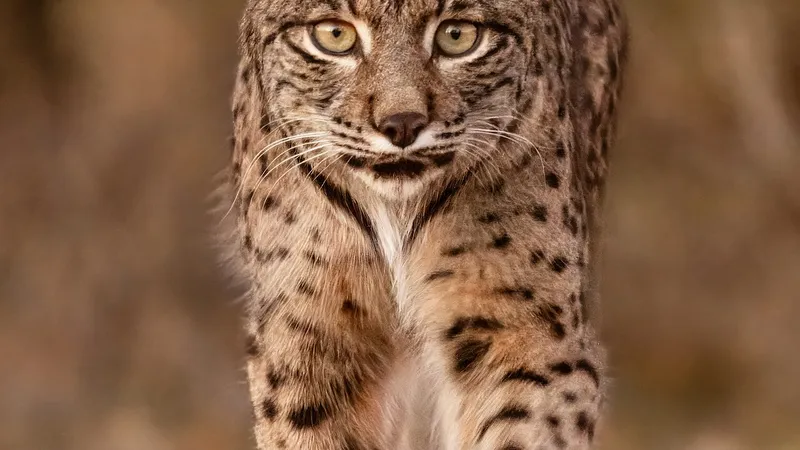
People often mistake a bobcat for one of its three lynx relatives, the Canada, Iberian and Eurasian lynx. Compared with the other lynx, bobcats are slightly smaller and live in warmer climates. The others live in cold northern places where snow lies deep, and have densely furred footpads; the bobcat’s footpads are bare.
Black spots on a brown coat hide it among the rocks and brush where it hunts the cottontail rabbit, its main prey.
Follow the spots A mother’s kittens probably follow the two white spots on the backs of her ears when the light is dim.
A kitten that lags behind makes the mother stop, call softly and lift her tail to flash the white patch underneath.
Dinner, Turf and Years
Bobcats mostly eat rabbits and hares. They may also eat rodents such as squirrels and mice, and can leap high enough to catch low-flying birds. They are solitary and mostly active around dawn and dusk. Each marks its territory with urine, droppings, anal gland secretions and scrapes in the ground, and rarely uses sound to warn other bobcats off. A territory can be one to seven square kilometres.
Most bobcats live five to 15 years in the wild. In human care the median is about 18 years, and the AnAge database records one captive bobcat that reached 32.3 years. The IUCN Red List rates the species Least Concern. The Smithsonian’s National Zoo says bobcats may be hunted for pelts but face a greater threat from habitat loss.
Published
Traits
Intel
& FAQ
Guess
first
How big is a Bobcat, really? Slide, lock in, and see what the sources say. Every answer is a figure from this page, quoted from where it came from.
Sources
- 01Kelly, Morin & Lopez-Gonzalez (2016). Lynx rufus. The IUCN Red List of Threatened Species 2016: e.T12521A50655874.
- 02Bobcat. Smithsonian's National Zoo and Conservation Biology Institute.
- 03Lynx rufus (bobcat). Animal Diversity Web, University of Michigan.
- 04AnAge entry for Lynx rufus. AnAge: The Animal Ageing and Longevity Database, Build 15, Human Ageing Genomic Resources.
What the sources say: 39 claims checked word for word against these sources →