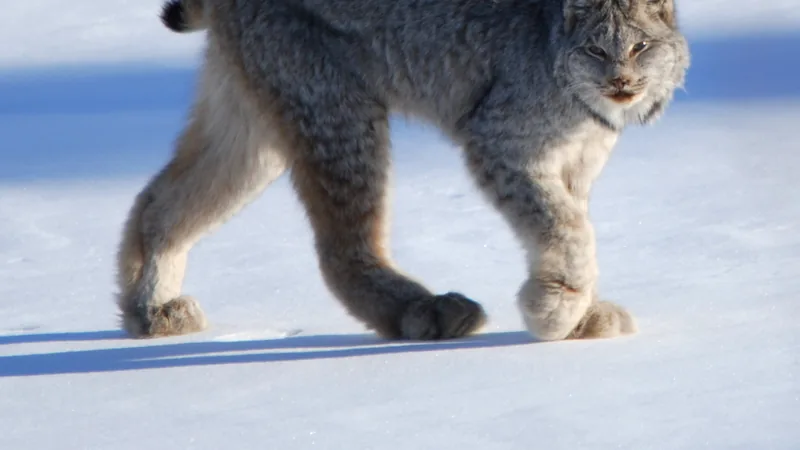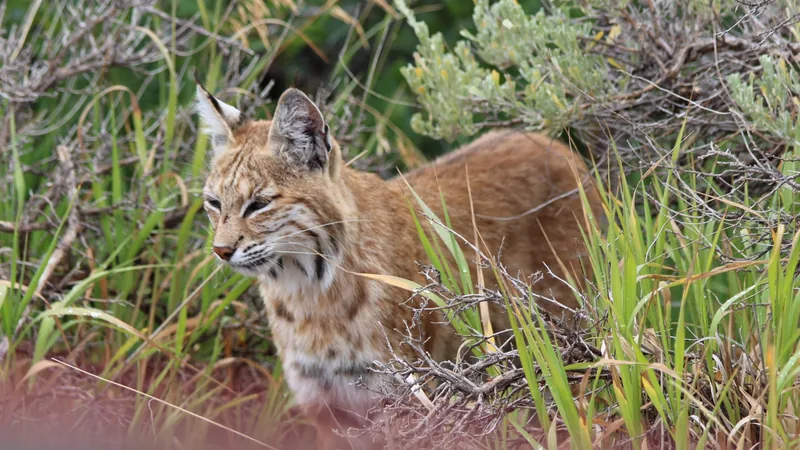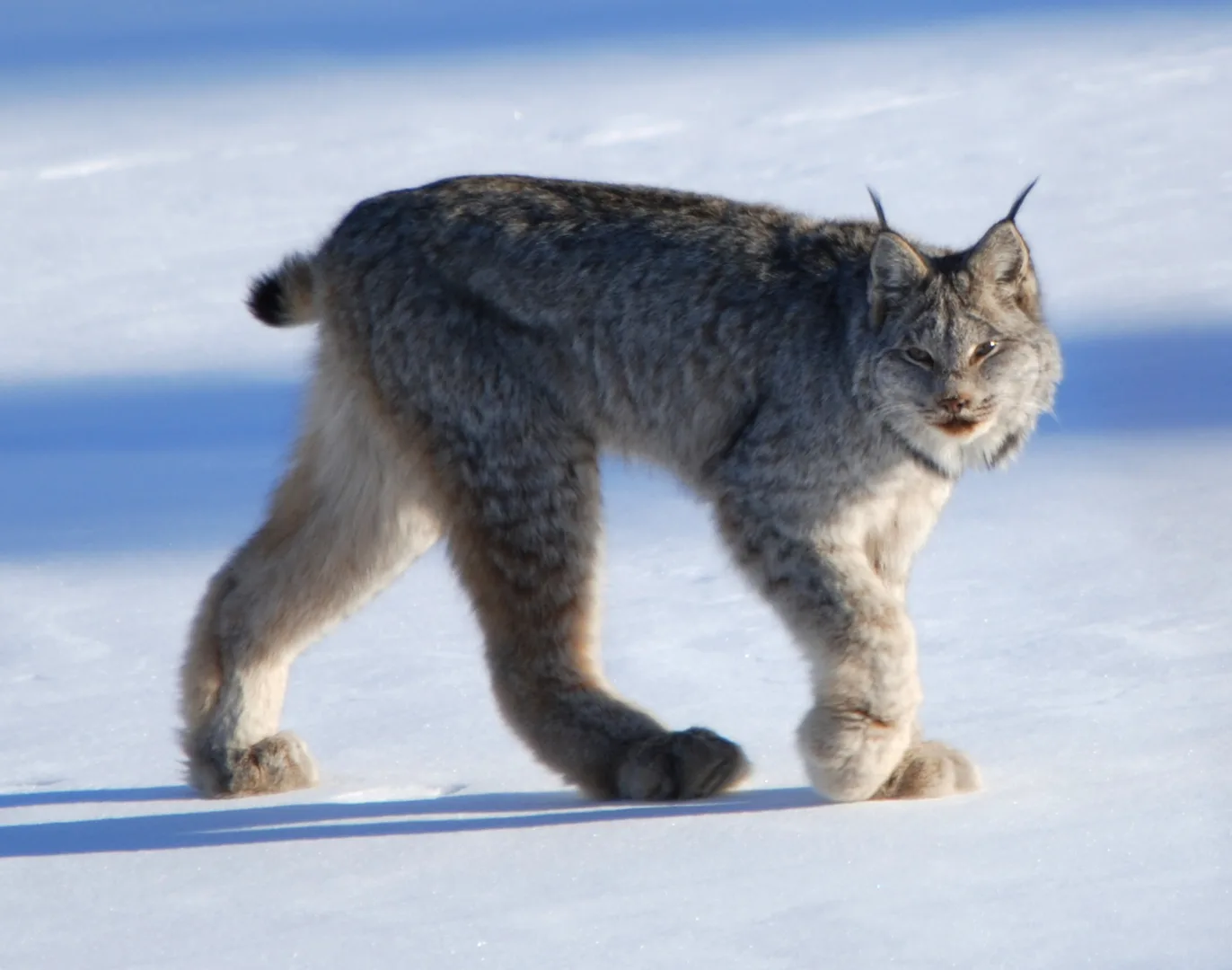
Canada lynx near Annie Lake, south of Whitehorse, Yukon
Field
notes
A cat built from snowshoes
The Canada lynx, Lynx canadensis, is a medium-sized wild cat of the cold northern forests of North America. That habitat is called boreal forest. It favors patches of regenerating forest within older stands of trees, patches that usually feature dense undergrowth where snowshoe hares live.
On average, a lynx is 75 to 90 centimeters (30 to 35 inches) long and weighs around 6 to 14 kilograms (15 to 30 pounds). Males are typically a bit larger than females. In the wild it lives up to 15 years, and in human care up to 22.
Its paws are the trick. They are large for its size and act like snowshoes, letting it pursue fast prey in deep, powdery snow. Long, thin tufts of fur stand on the tips of its ears, and its short tail ends in black.
One main dish
Snowshoe hares make up 60 to 97 percent of a lynx’s diet. An individual lynx eats one hare every 1 to 2 days on average. Rodents, birds, squirrels and other small mammals fill in, particularly in summer.
A lynx normally stalks to within a few short bounds of its prey and then pounces. Some will wait in ambush for hours. Females and young sometimes hunt hares cooperatively, spreading out in a line and moving through relatively open areas. Prey scared up by one cat is often caught by others in the line.
Boom, bust, repeat
Lynx populations peak and crash in roughly 10-year cycles that track the numbers of snowshoe hares, especially in the northern parts of the lynx’s range.
A cycle fur traders noticed The 10-year snowshoe hare cycle is a classic, recognized by fur traders for more than 300 years. Experiments adding food and restricting predator access to field populations were decisive in pinpointing predation as the key mechanism causing these fluctuations.
When hares thin out, lynx numbers fall too. Females give birth to litters of one to four kittens, usually in May or June, and litter size often depends on hare abundance.
Loner with a voice
Lynx are mostly solitary. They communicate mainly by scent marking, but they also use barks, growls, yowls and cries. Home ranges vary in size from 11 to 300 square kilometers. The IUCN rates the species Least Concern.
Published
Traits
Intel
& FAQ
Guess
first
How big is a Canada Lynx, really? Slide, lock in, and see what the sources say. Every answer is a figure from this page, quoted from where it came from.
Sources
- 01Canada lynx. Smithsonian's National Zoo and Conservation Biology Institute.
- 02Lynx canadensis (Canada lynx). Animal Diversity Web, University of Michigan.
- 03Krebs, Boonstra & Boutin (2017). Using experimentation to understand the 10‐year snowshoe hare cycle in the boreal forest of North America. Journal of Animal Ecology.
- 04Murray & Boutin (1991). The influence of snow on lynx and coyote movements: does morphology affect behavior? Oecologia.
- 05Schwartz et al. (2002). DNA reveals high dispersal synchronizing the population dynamics of Canada lynx. Nature.
- 06Murray & Thornton (2025). Lynx canadensis. The IUCN Red List of Threatened Species 2025: e.T12518A275326314.
What the sources say: 42 claims checked word for word against these sources →