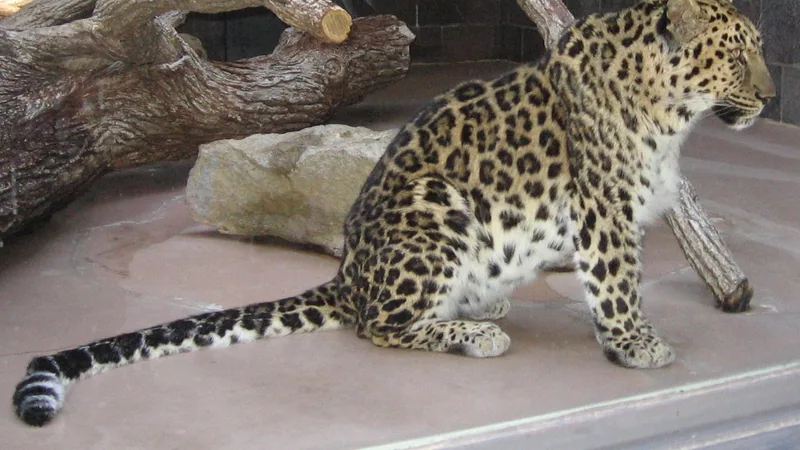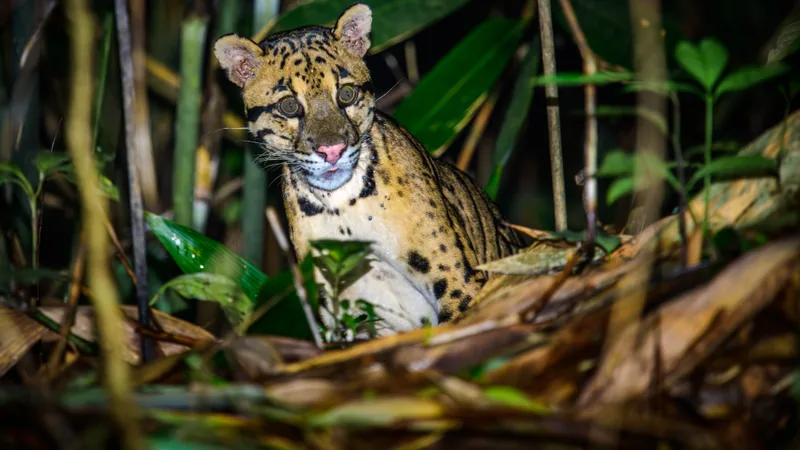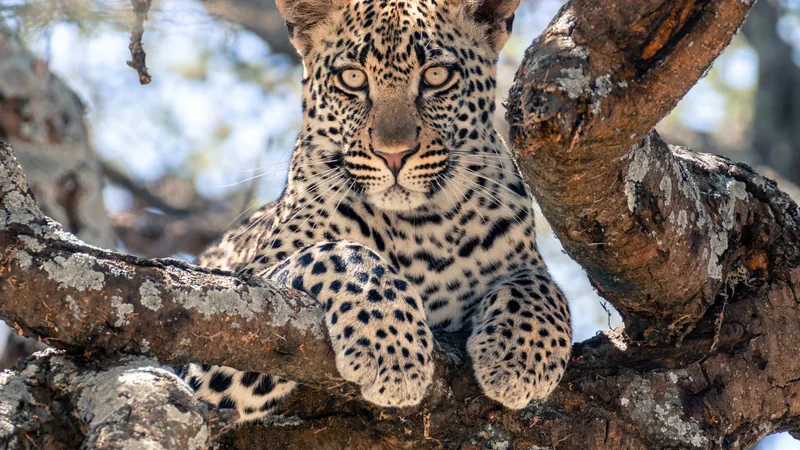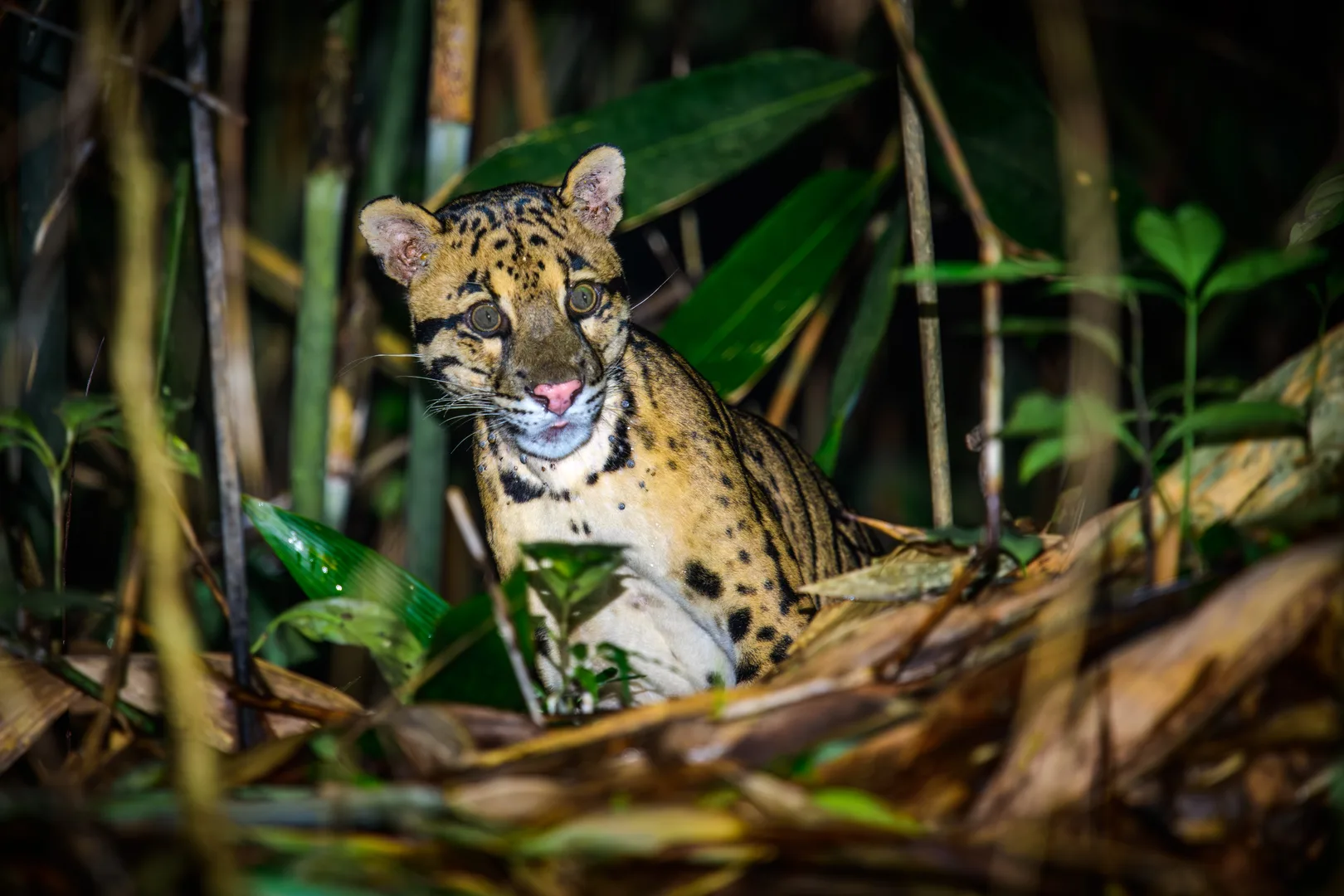
In the forest understorey.
Field
notes
Ankles that spin backward
The clouded leopard can climb down a tree headfirst. Its anklebones are specialised for climbing, and its ankles can rotate backward, so it can also climb upside down and hang from its back feet. That leaves its powerful front paws free to snatch at prey. Its tail is the longest for body size of any cat, and it works as a balance pole on branches.
Fangs out of proportion Its canine teeth are longer in proportion to skull size than those of any other wild cat, and it can open its mouth to about 100 degrees. A skull study found features once thought to belong only to sabertooth cats, which the author mostly ties to a large gape.
A mid-sized cat with a split family tree
Adults usually weigh 18 to 22 kilograms and measure 75 to 105 centimeters from head to rump, with a tail of 79 to 90 centimeters. Despite the name, it is not a kind of leopard. It is a separate species of wild cat. The average life span is 12 to 15 years, and up to 17 in human care.
Until 2006 the cats on Borneo and Sumatra counted as the same species. A study of the coats of 57 clouded leopards found two groups, so the island cats became the Sunda clouded leopard, Neofelis diardi.
Forest hunter of the foothills
This cat lives south of the Himalayas in Nepal, Bhutan and parts of northeastern India, and southward through Myanmar, southern China, Vietnam, Laos, Cambodia, Thailand and mainland Malaysia. It prefers lowland tropical rainforest but also turns up in dry woodlands. Camera traps in Nepal recorded one at 3,498 meters above sea level and found the cats mostly active at dusk and at night. Before that study, nobody had hard evidence of one above 2,300 meters.
Its chief prey are gibbons, macaques, slow lorises, small deer and wild boars. Scientists once thought it hunted mainly in trees. Current thought is that most hunting takes place on the ground. In human care it is one of the most difficult cats to breed, because of aggression between males and females. The IUCN lists it as Vulnerable. Its main threat is habitat loss from a growing number of farms.
Published
Traits
Intel
& FAQ
Guess
first
How big is a Clouded Leopard, really? Slide, lock in, and see what the sources say. Every answer is a figure from this page, quoted from where it came from.
Sources
- 01Gray et al. (2021). Neofelis nebulosa. The IUCN Red List of Threatened Species 2021: e.T14519A198843258.
- 02Christiansen (2006). Sabertooth characters in the clouded leopard (Neofelis nebulosa Griffiths 1821). Journal of Morphology.
- 03Can et al. (2019). Factors affecting the occurrence and activity of clouded leopards, common leopards and leopard cats in the Himalayas. Biodiversity and Conservation.
- 04Kitchener, Beaumont & Richardson (2006). Geographical Variation in the Clouded Leopard, Neofelis nebulosa, Reveals Two Species. Current Biology.
- 05Neofelis nebulosa (clouded leopard). Animal Diversity Web, University of Michigan.
- 06Clouded Leopard. San Diego Zoo Wildlife Alliance.
- 07Clouded leopard. Smithsonian's National Zoo and Conservation Biology Institute.
What the sources say: 41 claims checked word for word against these sources →