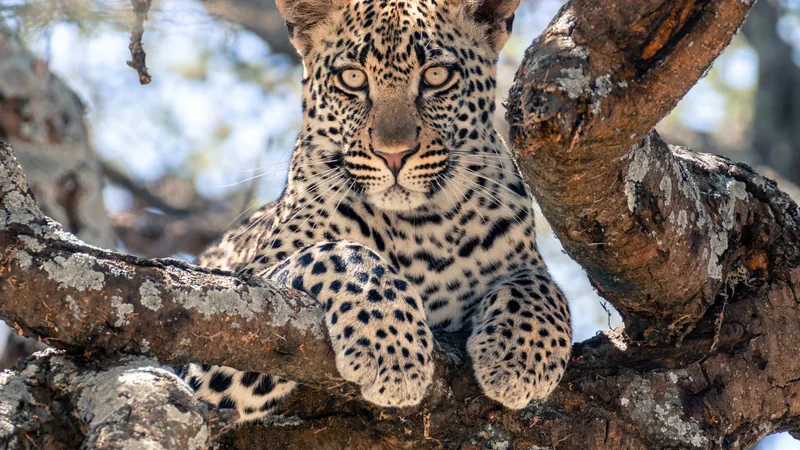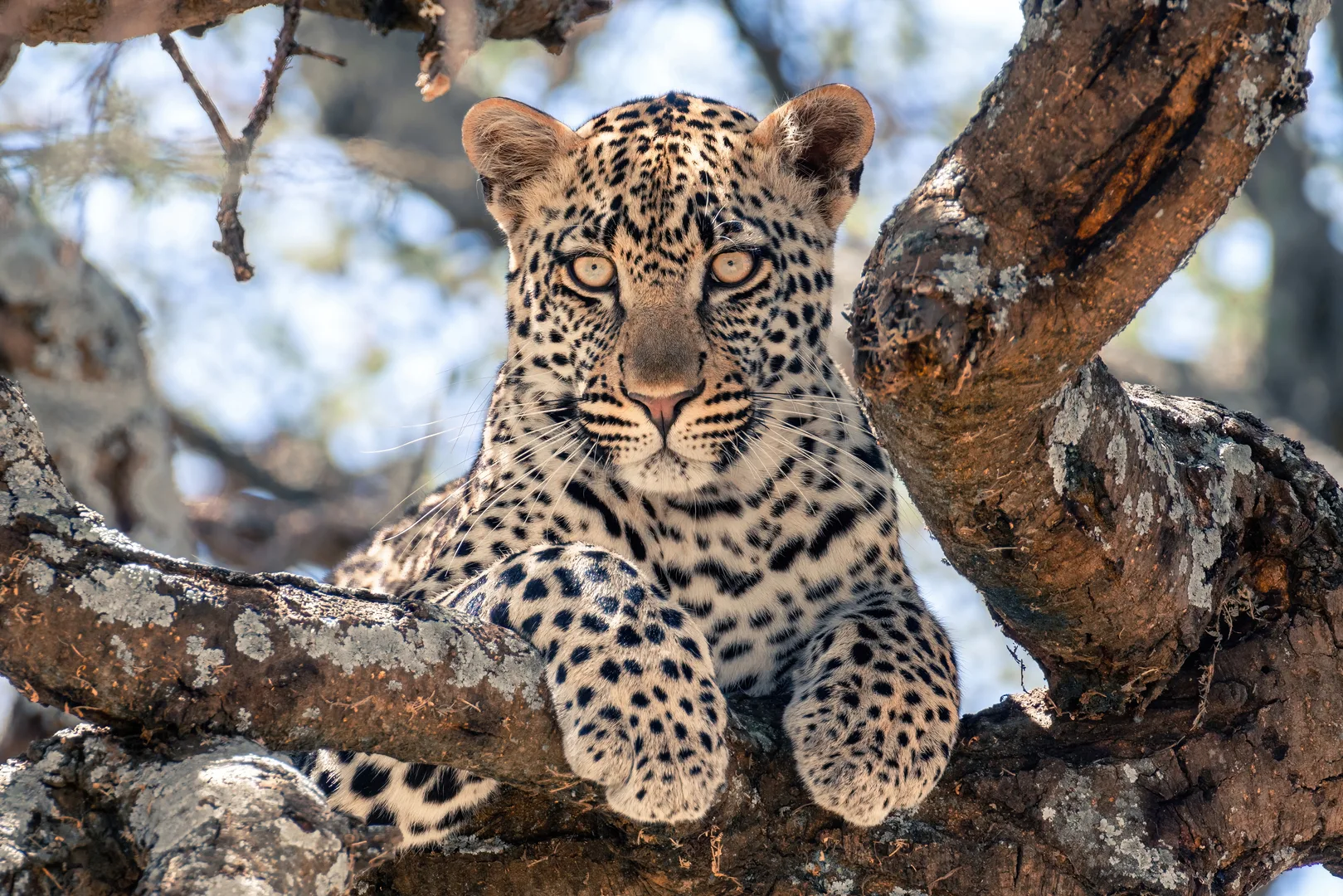
Gaze of a juvenile leopard perched on a tree in the Serengeti National Park
Field
notes
A pantry in the treetops
A leopard can climb as high as 15 meters (50 feet) up a favorite tree while holding a fresh kill in its mouth. The kill can even be larger and heavier than the cat. One leopard was seen dragging a 100 kilogram young giraffe into thick brush to hide it.
Why the effort? Meat stashed up high is out of reach of lions and hyenas, so the leopard can return to eat more later. Leopards are not always at the top of the food chain. In Africa, lions and packs of hyenas or painted dogs can kill leopards, and in Asia a tiger can do the same. Of the large cats, leopards are the most arboreal, meaning tree-living, and their long tails help them balance on narrow branches.
Small for a big cat
Leopards are the smallest of the large cats, a group that also includes lions, tigers and jaguars. Their length runs from 92 to 190 centimeters (3 to 6.2 feet), and the tail measures 64 to 99 centimeters. Females weigh 21 to 60 kilograms and males 36 to 75 kilograms. In human care, median life expectancy is about 18 years.
What they lack in bulk they make up in athletics. Leopards can run in bursts up to 58 kilometers per hour, leap 6 meters forward in a single bound and jump 3 meters straight up.
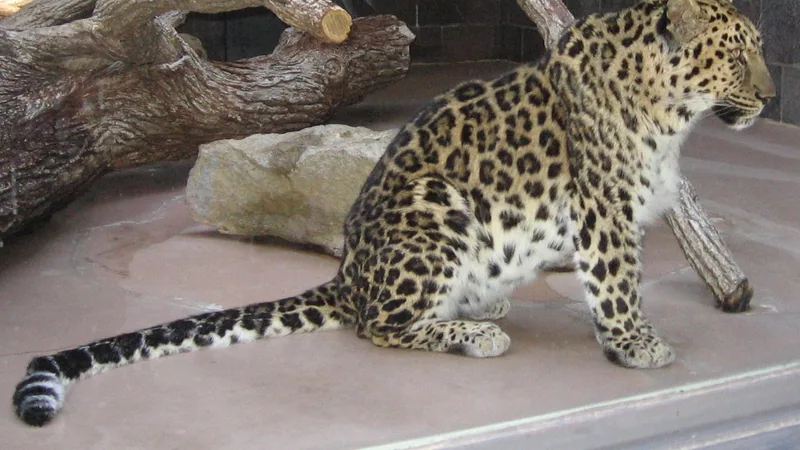
Rosette test. A leopard’s back is covered in flower-shaped spots called rosettes, and each rosette has no dot in the center. A jaguar has a dot inside each of its rosettes.
A silent night shift
Leopards are usually nocturnal, resting by day and hunting at night. Their spots break up the body outline in forests and grasslands. In the thick, dark rainforests of Southeast Asia, some leopards are nearly black, though the spotted pattern shows in certain light.
A leopard stalks and pounces rather than chasing prey over long distances, and it often slinks along on its belly. It hunts with vision, keen hearing and whiskers rather than smell. It can hear five times more sounds than a human, even the ultrasonic squeaks of mice, which are too high for people to hear. Prey is killed with a bite to the throat. The menu includes monkeys, baboons, rodents, snakes, large birds, fish, antelope and warthogs. Leopards also get much of the water they need from their prey.
Widespread, but shrinking
The leopard is the most widespread felid, found across much of Africa and across Asia from the Middle East to the Pacific Ocean. It lives in tropical forests, grassland plains, deserts and alpine areas. Even so, a 2016 study of its range found that the leopard occupied 25 to 37 percent of its historic range, a range loss of 63 to 75 percent. That study recognized nine subspecies, among them the Amur leopard of the Russian Far East and north-eastern China. The IUCN Red List rates the species Vulnerable.
Published
Traits
Intel
& FAQ
Guess
first
How big is a Leopard, really? Slide, lock in, and see what the sources say. Every answer is a figure from this page, quoted from where it came from.
Sources
- 01Leopard. San Diego Zoo Wildlife Alliance.
- 02Panthera pardus (leopard). Animal Diversity Web, University of Michigan.
- 03Jacobson et al. (2016). Leopard (Panthera pardus) status, distribution, and the research efforts across its range. PeerJ.
- 04Stein et al. (2025). Panthera pardus. The IUCN Red List of Threatened Species 2025: e.T15954A286153337.
- 05Parchizadeh & Belant (2021). Brown bear and Persian leopard attacks on humans in Iran. PLOS ONE.
What the sources say: 53 claims checked word for word against these sources →