Kapama River Lodge, South Africa
Field
notes
Square Vocal Folds, Stadium Volume
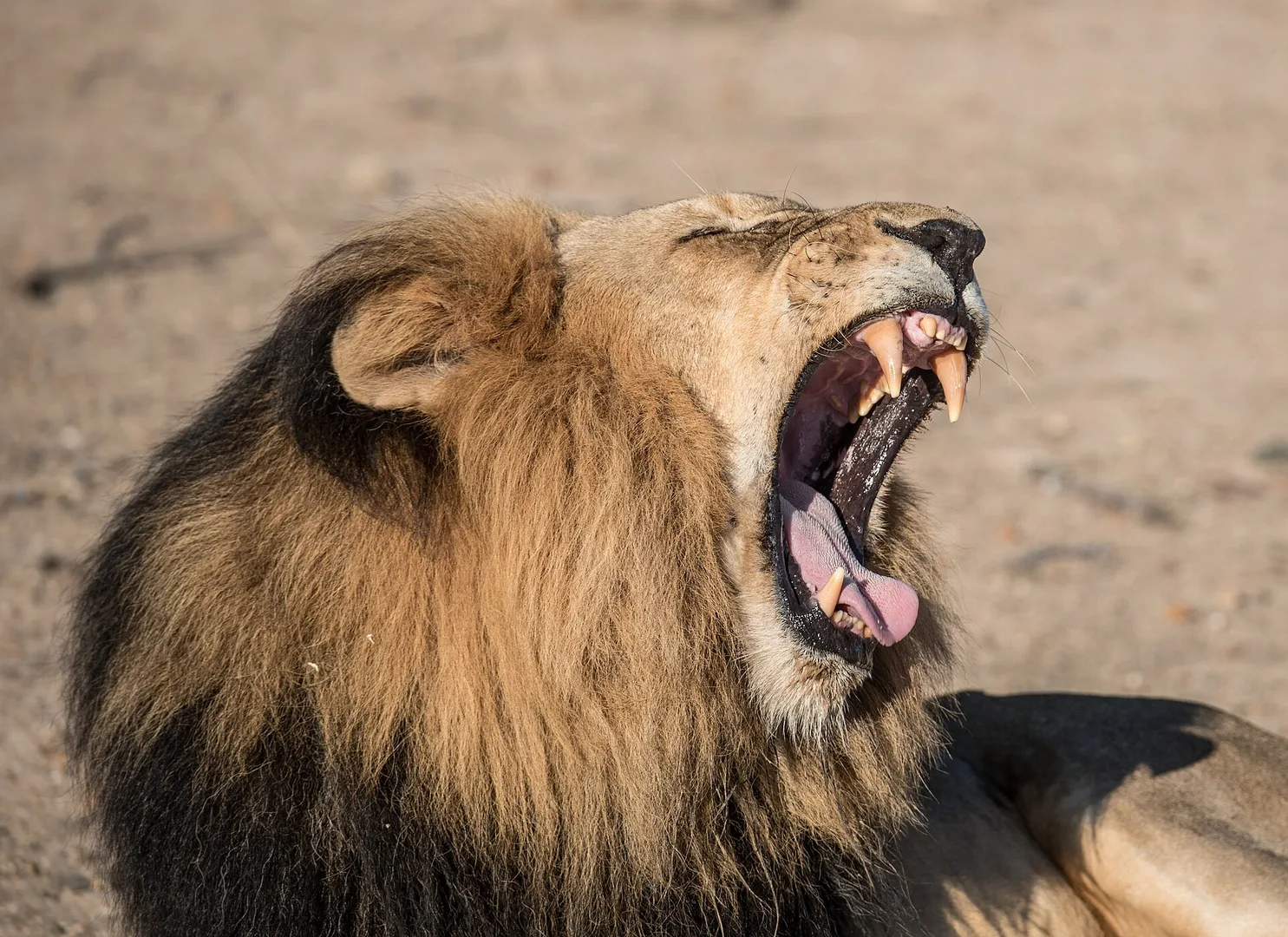
A lion’s roar hits about 114 decibels from a few feet away, roughly 25 times as loud as a gas lawn mower, and can be heard up to three miles off. The secret is shape. Most species have triangular vocal folds, but a lion’s are flat and square, and fat inside each fold helps give them that shape. Square folds respond more easily to the air rushing past them, so a lion gets a louder roar out of less lung pressure. Roaring advertises the pride’s territory and keeps pride members in touch with each other.
Lionesses Run the Hunt
Adult males typically weigh about 189 kilograms, and the heaviest on record hit 272 kg. The mane makes a male look impressive to females and intimidating to rivals, and shields his neck from raking claws in a fight. Females average 126 kg and do most of the hunting, because a big, showy male is much easier for prey to spot. In the Serengeti, a lion hunting alone succeeds about 17% of the time, and a group hunt succeeds 30% of the time: smaller lionesses chase prey toward the center of the group while heavier lionesses wait to ambush it. Prides hold anywhere from 2 to 40 lions. Wild females often live 15 to 16 years, sometimes to 18; males rarely survive past 10, though a few reach 16.
Death by suffocation A lioness often kills by clamping her jaws over the prey’s nose and mouth and holding on until it can’t breathe. She has the jaw power for it. A 2005 study that estimated bite force from the skulls of 39 living and fossil predators put a lion’s canine bite at 1,768 newtons, the strongest of any cat in the study. Adjusted for body size, though, its bite force quotient is 112, behind the tiger’s 127 and the jaguar’s 137.
Night Eyes, Shrinking Range
Lions usually hunt at night, especially around dusk and dawn, and their eyes are built for it. Their retinas are packed with rod cells, the cells that work in dim light, and a mirror-like layer behind the retina called the tapetum lucidum gives light a second pass through those rods. The payoff is roughly six to eight times better vision than a human’s in low light. None of that protects lions from people. The IUCN lists the African lion as Vulnerable. About 23,000 adult and subadult (nearly grown) lions remain in Africa, down from roughly 33,000 in 2006, and they now live in just 7.4% of their historical range.
Published Updated
Traits
Intel
& FAQ
Sources
- 01Klemuk et al. (2011). Adapted to Roar: Functional Morphology of Tiger and Lion Vocal Folds. PLoS ONE.
- 02Born to Roar: Vocal Cord Shape Explains Loud, Low Pitch of Big Cats. EurekAlert! (University of Utah), 2011.
- 03Lion. San Diego Zoo Wildlife Alliance.
- 04Eyes & Vision. Lion Landscapes.
- 05Panthera leo (lion). Animal Diversity Web, University of Michigan.
- 06Conservation Status of the African Lion. Convention on the Conservation of Migratory Species of Wild Animals (CMS), 2023.
- 07Wroe, McHenry & Thomason (2005). Bite club: comparative bite force in big biting mammals and the prediction of predatory behaviour in fossil taxa. Proceedings of the Royal Society B: Biological Sciences.
What the sources say: 2 claims checked word for word against these sources →