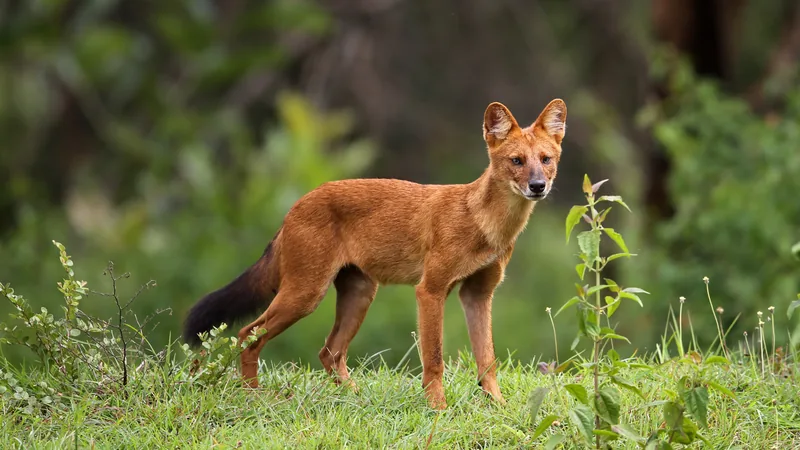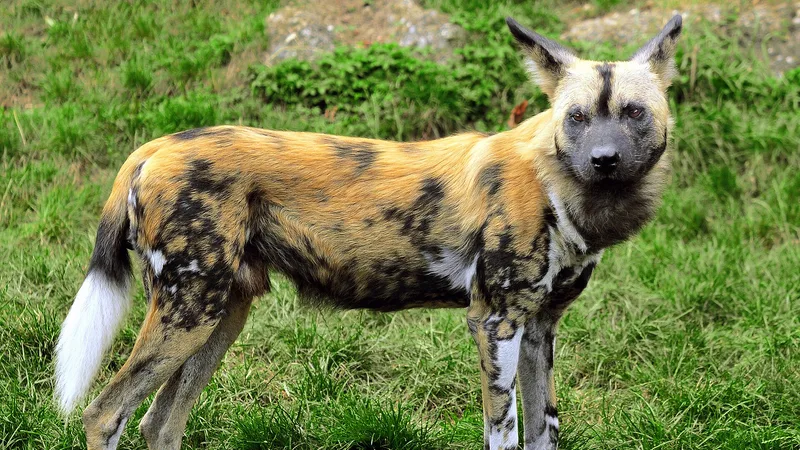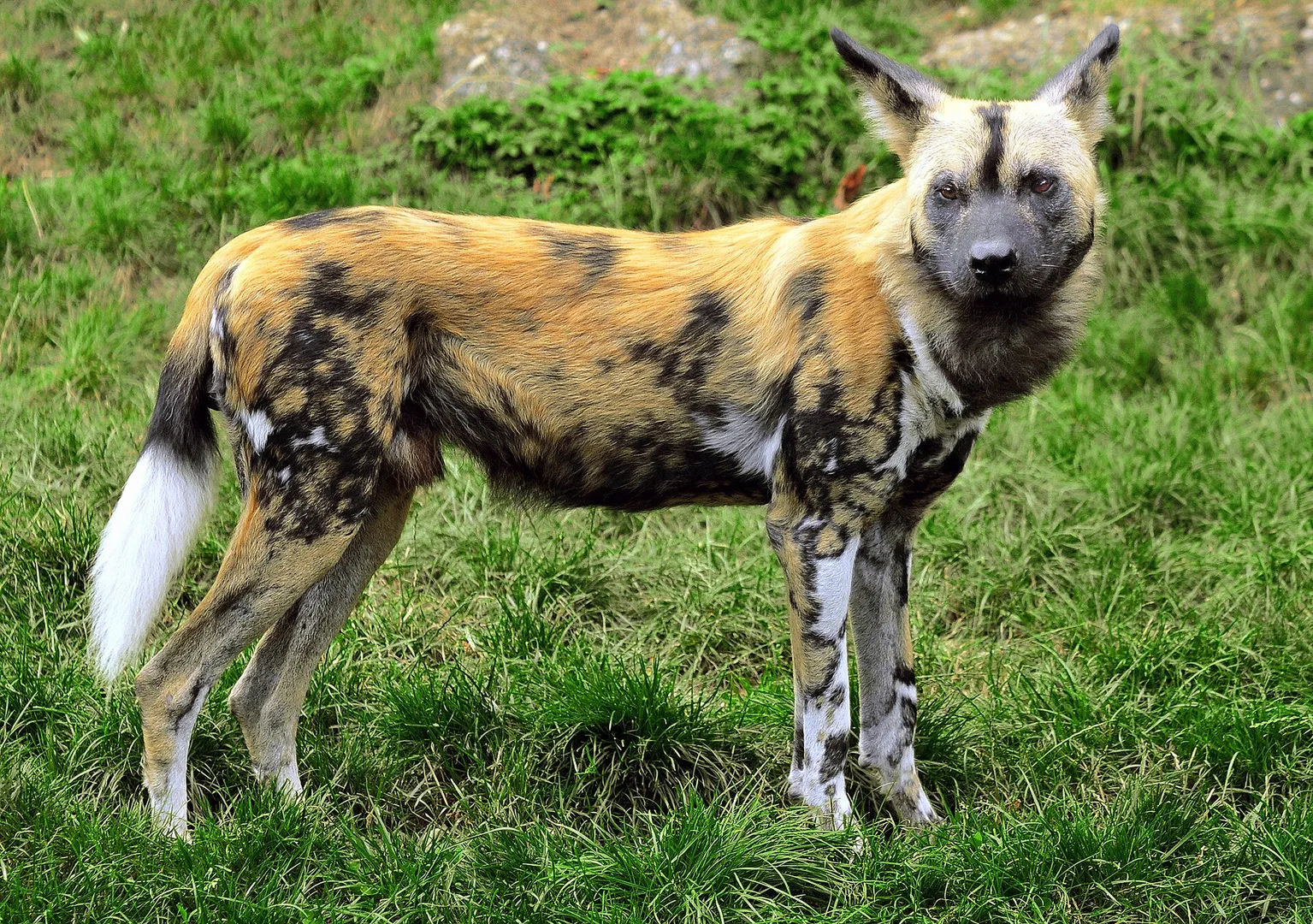
African wild dog at Basel Zoo, Switzerland
Field
notes
Four Toes Up Front
Wolves keep a small first toe on the front foot, called a dewclaw. Losing that toe is unique among living canids, and African wild dogs (Lycaon pictus) are the ones that lost it. A genomic study of the species suggests the loss comes from mutations that may let the natural cell death that shapes a growing paw destroy that toe instead of sparing it. The payoff is a longer stride and more speed.
Within the dog family, the wild dog is the most specialized for running. Adults weigh 18 to 36 kilograms and stretch about a meter long, with large, bat-like ears and a colorful, patchy coat. No two wild dogs are marked exactly alike, which makes each one easy to identify.
The Long Chase
A pack can run at up to 30 mph and keep going for as much as three and a half miles, chasing prey such as an antelope, warthog or wildebeest calf until it tires and slows down. Their hunts succeed 70 to 90 percent of the time.
Wild dogs hunt mostly at dawn and dusk to avoid lions and other predators. In one park in Zambia, they also avoided areas that lions used heavily. The researchers suggest wild dogs may be more likely than cheetahs to die out locally, especially in open, uniform country where that avoidance is difficult.
A Sneeze Is a Vote Before the group moves off together, wild dogs hold a “rally,” a high-energy greeting session. Researchers watching packs in Botswana found that once a rally has enough quick, audible sneezes, the pack is likely to leave. It takes fewer sneezes when a dominant dog starts the rally. A dominant dog isn’t required, though: if enough of the others agree, the group may overrule the leaders.
Life in the Pack
Only the dominant male and female in a pack breed, and they usually stay paired for life, but the whole pack helps raise the pups. Hunters return to the den and regurgitate meat for the nursing mother and the pups. There’s little aggression within a pack and little bullying in its hierarchy, and packmates take care of members that are hurt or sick.
Running Out of Space
African wild dogs live in the savanna, grasslands and open country of sub-Saharan Africa. They are Endangered, and habitat fragmentation is the main threat. It increases clashes with people and the loss of small local populations to disease outbreaks. Wild dogs themselves pose no known threat to people, and actively avoid them. As farms, roads and settlements spread, wild dogs are losing the spaces where they once roamed freely. They typically live 10 to 12 years, and the record in captivity is 15.1 years.
Published Updated
Traits
Intel
& FAQ
Guess
first
How big is a African Wild Dog (Painted Dog), really? Slide, lock in, and see what the sources say. Every answer is a figure from this page, quoted from where it came from.
Sources
- 01African Wild Dog. African Wildlife Foundation.
- 02African painted dog. Oregon Zoo.
- 03African wild dogs: Frequently Asked Questions. Tsavo Trust.
- 04AnAge entry for Lycaon pictus. AnAge: The Animal Ageing and Longevity Database, Build 15.
- 05Chavez et al. (2019). Comparative genomics provides new insights into the remarkable adaptations of the African wild dog (Lycaon pictus). Scientific Reports.
- 06Walker et al. (2017). Sneeze to leave: African wild dogs (Lycaon pictus) use variable quorum thresholds facilitated by sneezes in collective decisions. Proceedings of the Royal Society B: Biological Sciences.
- 07Dröge et al. (2016). Spatial and temporal avoidance of risk within a large carnivore guild. Ecology and Evolution.
- 08Woodroffe et al. (2025). Lycaon pictus. The IUCN Red List of Threatened Species 2025: e.T12436A221299510.
What the sources say: 55 claims checked word for word against these sources →