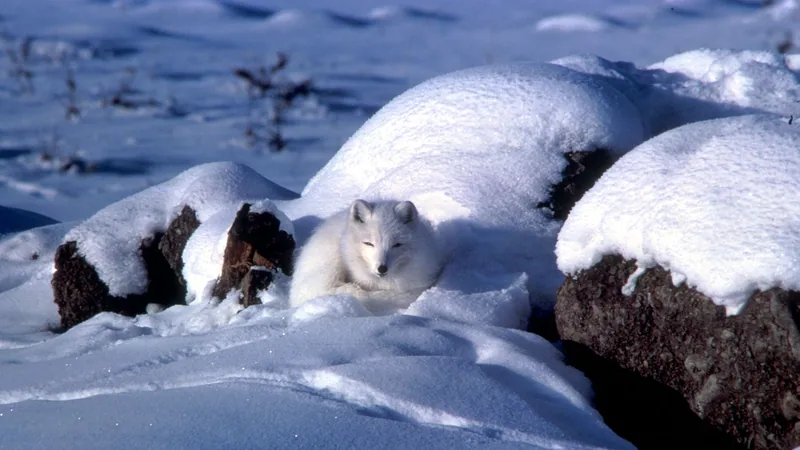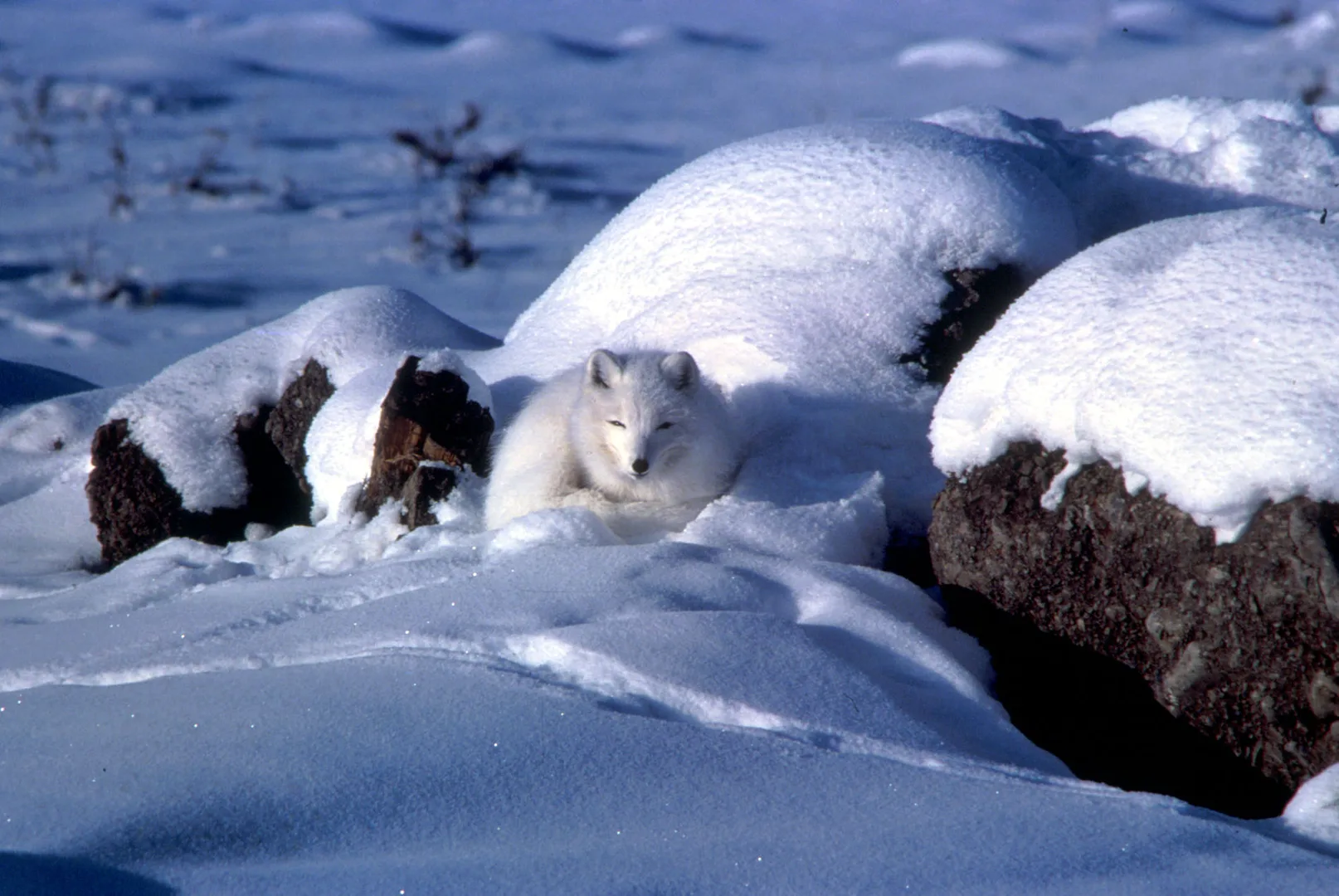
Arctic fox (Vulpes lagopus) curled up in snow.
Field
notes
Built Short to Hold Heat
The arctic fox (Vulpes lagopus) has short legs, a short body, short ears and dense winter fur, which make it look stocky next to its slightly larger relative, the red fox. That short, rounded shape, short muzzle included, helps it lose less heat. Fully grown arctic foxes weigh 6 to 10 pounds (2.7 to 4.5 kg) and average 43 inches (109 cm) long, including a tail of about 15 inches (38 cm). In captivity, arctic foxes have lived as long as 16.3 years. In summer they feed mainly on lemmings and tundra voles, and foxes denning near seaside cliffs often depend heavily on nesting seabirds such as puffins. They sometimes eat berries, eggs and scavenged remains, too. They live in the treeless tundra of Eurasia, North America, Greenland and Iceland, usually in coastal areas.
Paws That Refuse to Freeze
A 1972 study found that arctic foxes keep their feet just above the point where living tissue freezes, about -1°C, whether standing on extremely cold snow or with a foot dunked in a -35°C bath in the lab. Warm blood shunted through a network of blood vessels in the skin of the foot pad carried more than 99% of the heat the pad surface lost. Keeping that heat exchange in the skin touching the cold ground, rather than throughout the pad, gives maximum energy efficiency, the researchers wrote.
The rest of the fox leans on its fur. A 1991 review called it the best insulating fur of any mammal. The fox’s lower critical temperature, the point below which a body must burn extra energy to stay warm, is under -40°C, so it doesn’t need that extra burn in the temperatures it meets in the wild.
One Gene, Two Coats
Arctic foxes molt twice a year. White foxes start shedding their long winter fur in early April, and by late June the face, legs and upper body wear short brown summer fur. The switch back runs through September and October, and by November the white winter coat is complete. Blue foxes stay dark brown or charcoal all year, just slightly lighter in winter. White foxes make up over 90% of the world’s arctic foxes.
A 2021 study of Scandinavian arctic foxes named one gene, MC1R, as the only cause of the difference. Its white version is recessive and its blue version dominant: 878 of 882 foxes with two white copies were white, and 230 of 243 with at least one blue copy were blue.
Long Trips Onto the Sea Ice
In winter, many arctic foxes venture onto the sea ice to feed on the remains of seals killed by polar bears. Satellite tracking of foxes on Canada’s Bylot Island showed how far they will go. They often traveled more than 10 kilometers, and up to 40, to reach hotspots on the sea ice where they were likely scavenging marine mammal carcasses. Each hotspot lasted one to two weeks and drew up to 12 foxes, with as many as nine there on the same day. After 30 of the 35 visits, the fox was back inside its home range the next day.
Rabbit-Footed by Name In winter, dense fur sheathes the arctic fox’s paws, which sets it apart from other canids. That is where its scientific name comes from: lagopus means “rabbit-footed.”
Published Updated
Traits
Intel
& FAQ
Guess
first
How big is a Arctic Fox, really? Slide, lock in, and see what the sources say. Every answer is a figure from this page, quoted from where it came from.
Sources
- 01Arctic Fox. Alaska Department of Fish and Game.
- 02Vulpes lagopus (Arctic fox). Animal Diversity Web, University of Michigan.
- 03AnAge entry for Vulpes lagopus. AnAge: The Animal Ageing and Longevity Database, Build 15, 2023.
- 04Tietgen et al. (2021). Fur colour in the Arctic fox: genetic architecture and consequences for fitness. Proceedings of the Royal Society B: Biological Sciences.
- 05Henshaw, Underwood & Casey (1972). Peripheral Thermoregulation: Foot Temperature in Two Arctic Canines. Science.
- 06Prestrud (1991). Adaptation by the Arctic Fox (Alopex lagopus) to the Polar Winter.
- 07Lai, Bêty & Berteaux (2015). Spatio–temporal hotspots of satellite–tracked arctic foxes reveal a large detection range in a mammalian predator. Movement Ecology.
- 08Angerbjörn & Norén (2025). Vulpes lagopus. The IUCN Red List of Threatened Species 2025: e.T899A223595394.
What the sources say: 51 claims checked word for word against these sources →