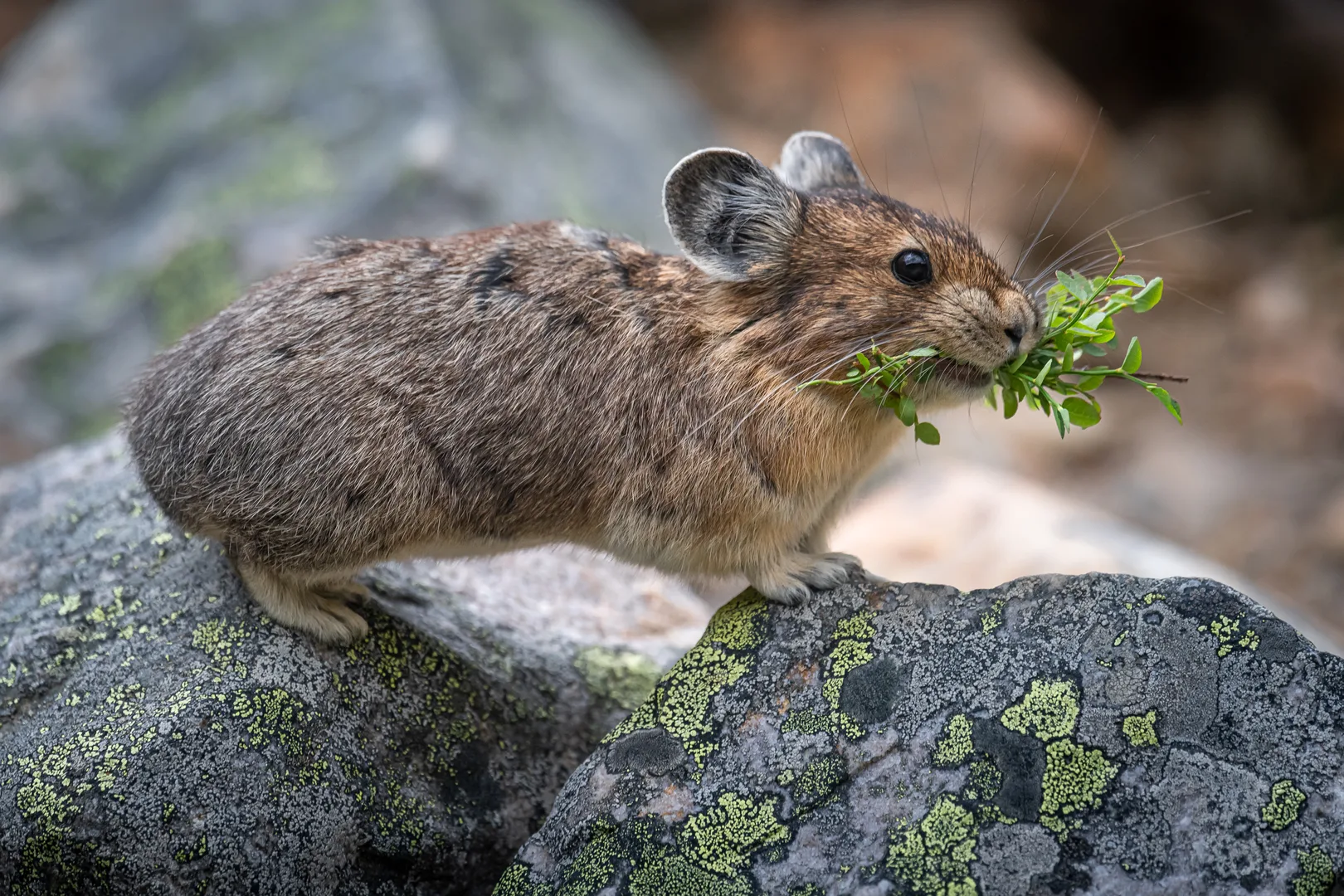
Gathering food on a glacial moraine, Mount Edith Cavell
Field
notes
Stacking hay for a winter it will not sleep through
The American pika is a small mammal that does not hibernate. Instead, it spends the summer building haypiles, which are stacks of plants it will eat in winter. A single haypile can hold up to 30 plant species. Pikas avoid some toxic plants, yet they may still store them. Some toxins act as natural preservatives that wear off by the time the plant is eaten. In winter it tunnels through the snow to reach meadows and its haypiles.
Second helpings A pika makes two kinds of droppings: a hard brown pellet and a soft, shiny string called a caecal pellet. It eats the soft ones or stores them for later. Only about 68% of the food it swallows is assimilated (taken up by the body), making those soft pellets an important part of its diet.
Small, furry and prone to overheating
A pika is a relative of rabbits and hares, not a rodent. It weighs 121 to 176 grams and is 162 to 216 millimetres long, with short ears, short legs and no visible tail. Its body temperature averages 40.1°C, and its average upper lethal temperature, the heat that kills it, is 43.1°C. Its thick fur and fast metabolism fight the winter cold but leave it prone to overheating. Just two hours above 28°C can be fatal.
Pikas mostly live in talus, fields of broken rock and boulders, where the temperature is fairly stable year-round. That lets them keep cool in summer. In one study at four sites in the Columbia River Gorge, the gaps between rocks at sites with heavy moss cover stayed a steady 6 to 8°C even when the air was over 35°C.
Running out of mountain
Pikas live in the mountains of western North America, from British Columbia south to California and New Mexico. They favour broken rock beside alpine meadows. In the north they range from sea level to 3,000 metres, while in the south they are rarely found below 2,500 metres.
Pikas warn their neighbours with alarm calls. These calls usually change in frequency depending on whether the predator is large or small.
In the Great Basin, records from 1898 to 2008 showed that four of ten local pika extinctions had happened since 1999, and that the low edge of their range was moving uphill at an average of about 145 metres per decade. The pattern is not the same everywhere. In the Southern Rocky Mountains, a survey of 69 sites historically occupied by pikas found only four populations lost over the past few decades. The IUCN lists the species as Least Concern.
The maximum recorded lifespan is 7 years, in a captive pika.
Published
Traits
Intel
& FAQ
Guess
first
How big is a American Pika, really? Slide, lock in, and see what the sources say. Every answer is a figure from this page, quoted from where it came from.
Sources
- 01Ochotona princeps (American pika). Animal Diversity Web, University of Michigan.
- 02AnAge entry for Ochotona princeps. AnAge: The Animal Ageing and Longevity Database, Build 15, Human Ageing Genomic Resources.
- 03American Pika at Mount Rainier National Park: Keeping an eye on one of Mount Rainier's most climate sensitive species. National Park Service.
- 04Smith & Beever (2016). Ochotona princeps. The IUCN Red List of Threatened Species 2016: e.T41267A45184315.
- 05Beever et al. (2011). Contemporary climate change alters the pace and drivers of extinction. Global Change Biology.
- 06Erb, Ray & Guralnick (2011). On the generality of a climate-mediated shift in the distribution of the American pika (Ochotona princeps). Ecology.
- 07Varner & Dearing (2014). The Importance of Biologically Relevant Microclimates in Habitat Suitability Assessments. PLoS ONE.
What the sources say: 51 claims checked word for word against these sources →