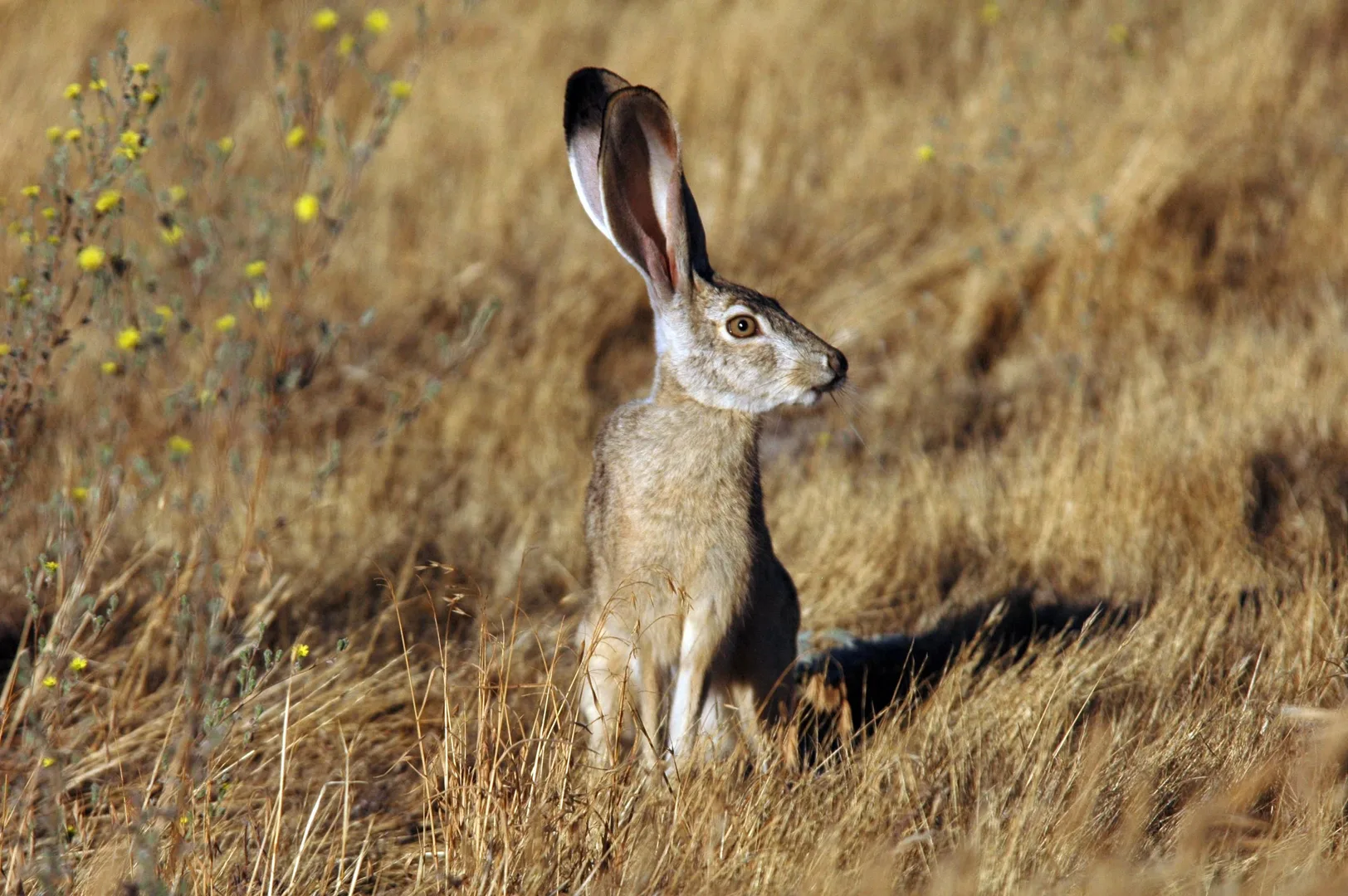
Sitting alert in dry grass
Field
notes
Built to Bolt
Coyotes, mountain lions, bobcats, foxes, hawks, eagles, owls and snakes all eat hares and rabbits. To escape, a jackrabbit runs a zigzag course at up to 40 miles per hour (64 km/h). It can hop up to 20 feet when panicked.
During a moderate run, every four to five leaps is an exceptionally high one, to see its surroundings or predators. Its eyes sit on the sides of its head, which enables it to see in front, to the side and behind.
A bone study compared it with pikas and a rabbit and found the jackrabbit typically had the longest distal segments, the parts of the limb farthest from the body. The park service adds that it has poor endurance and often ends up as some animal’s dinner.
Hare, Not Rabbit
The jackrabbit is actually a hare. Hares are born with hair and open eyes, and can run and hop shortly after birth. Rabbits are born hairless, blind and helpless.
It weighs between four and eight pounds (1.8 to 3.6 kg), and its total length is between 18 and 26 inches (46 to 66 cm). The female is larger than the male. A black stripe runs along the top of the tail and onto the rump, which is where the name comes from.
It is found throughout the southwestern United States into Mexico, as far east as Missouri and north into Washington. Look for it in desert scrub, prairies, farmland and dunes, from sea level to about 3,800 m.
In captivity it lives 5 to 6 years, and one wild-born hare was about 11.8 years old when it died in captivity. Wild jackrabbits often die much sooner.
Eating Everything Twice
To help digest tough plants, the jackrabbit’s appendix serves as a pre-digesting chamber that starts breaking food down before it reaches the stomach.
Second helping It makes two types of droppings. The first is soft, moist and coated in mucus, and the jackrabbit eats it, as it is high in protein and certain B vitamins formed by bacteria in the intestines.
Grasses and herbaceous matter are its preferred foods. When other plants are not available, twigs and young bark of woody plants are the staple food. Jackrabbits eat almost constantly: 15 of them eat as much as one large grazing cow in one day. Its upper front teeth never stop growing, so it must constantly gnaw on vegetation to wear them down. It gets nearly all its water from the plants it eats.
Fast Breeders
Fast breeding is an adaptation to being preyed on by so many carnivores. A female can have up to six litters a year, with as many as eight young in each, though two to four is more common. The pregnancy lasts 41 to 47 days. Within two weeks the young can forage for themselves, and after one month they live on their own.
Published
Traits
Intel
& FAQ
Guess
first
How big is a Black-Tailed Jackrabbit, really? Slide, lock in, and see what the sources say. Every answer is a figure from this page, quoted from where it came from.
Sources
- 01Brown, Lorenzo & Álvarez-Castañeda (2019). Lepus californicus. The IUCN Red List of Threatened Species 2019: e.T41276A45186309.
- 02Jackrabbits. Big Bend National Park, National Park Service.
- 03Lepus californicus (black-tailed jackrabbit). Animal Diversity Web, University of Michigan.
- 04AnAge entry for Lepus californicus. AnAge: The Animal Ageing and Longevity Database, Build 15, Human Ageing Genomic Resources.
- 05Young et al. (2014). Limb bone morphology, bone strength, and cursoriality in lagomorphs. Journal of Anatomy.
What the sources say: 42 claims checked word for word against these sources →