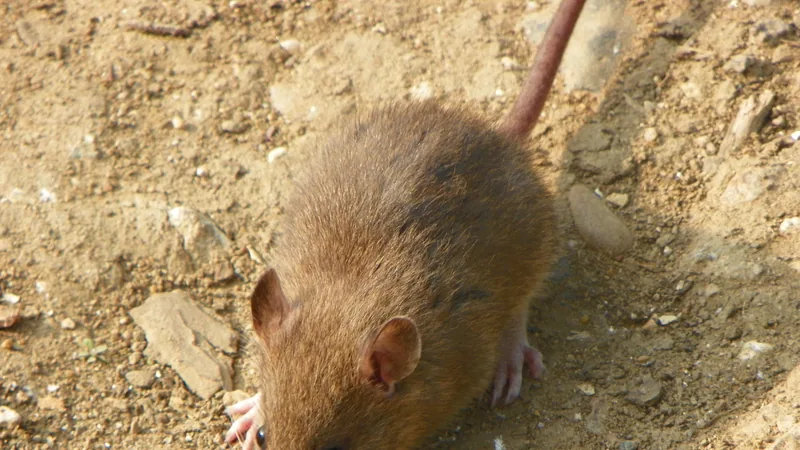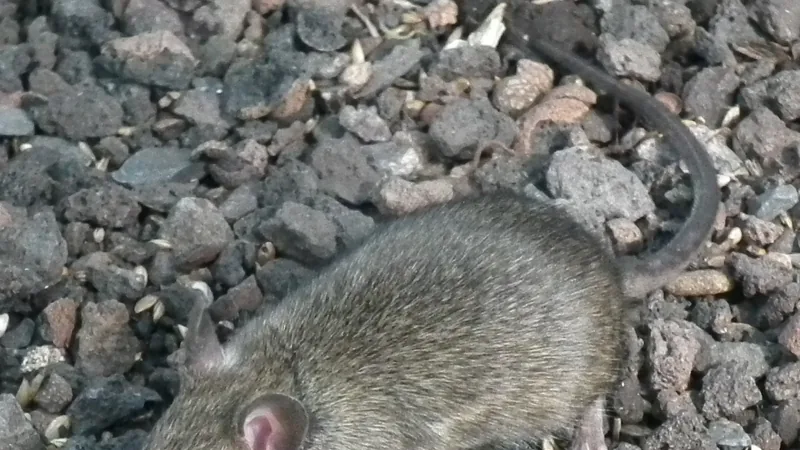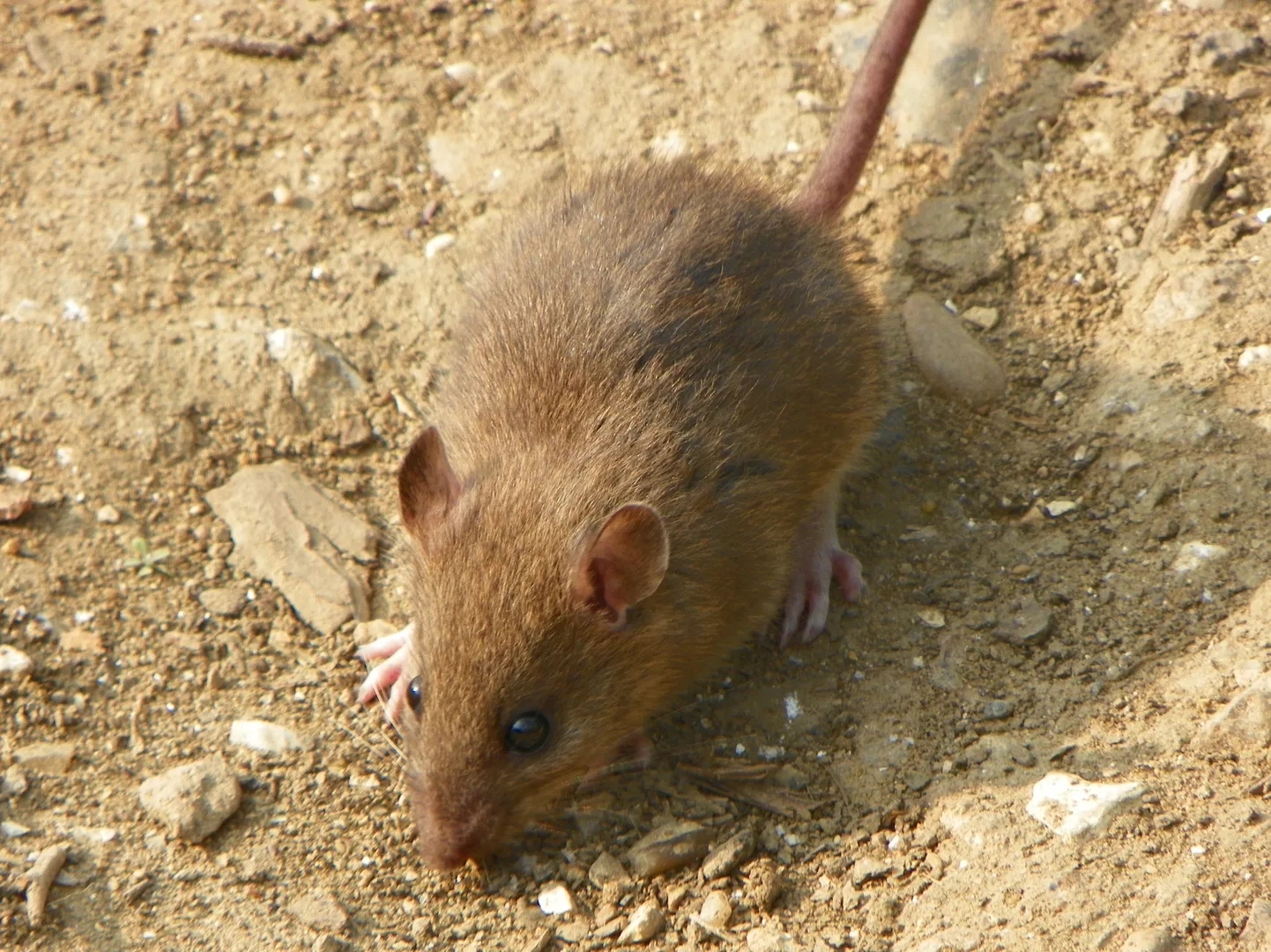
A brown rat outdoors.
Field
notes
Built to Multiply
Wild rats reach sexual maturity at about 11 weeks, stay pregnant for 21 to 24 days and give birth to litters of about 7 or 8 pups. They can breed all year and average 3 to 5 litters a year. The pups arrive almost naked, blind and totally dependent on their mother, then start leaving the nest and eating solid food at about 14 days.
Wired for Whiskers and Scent
Wild Norway rats have relatively poor eyesight and are sensitive to sharp light. Their main sensory input is touch from the facial whiskers, plus a particularly well-developed sense of smell. Animal Diversity Web adds that they can feel their way through total darkness with their paws and whiskers. They hear from about 0.25 to 80 kHz, which enables them to communicate with ultrasound, calls humans cannot hear without special equipment.
Sniff test Rats develop preferences for particular foods by sniffing at the mouth and fur of an individual who has finished eating.
They also have no sweat glands. They regulate body temperature through behavior, such as hiding in burrows, and the sparsely haired tail plays a part.
An Asian Rat That Went Global
Despite the name, the Norway rat most likely originated in Asia. Its indigenous range is often cited as northern China, Mongolia and/or south-eastern Siberia. It was most likely transported globally on ships, apparently sometime in the 1700s, and reached North America between 1750 and 1775. Today it lives on every continent except Antarctica.
They weigh 140 to 500 g and average 399 mm from nose to tail, with males usually larger. The wild life is short: AnAge says wild rats rarely live more than a year, and one large study found a captive maximum of 3.8 years.
Eats Almost Anything, Wary of New Food
In cities, brown rats survive mainly on discarded human food. Some rats living near the sea have been observed catching fish with their paws, and one wild rat’s stomach in Germany held 4000 items, most of them plants. Yet rats are cautious about new things. After an unfamiliar food, they markedly reduce what they eat, and they develop an aversion to foods that cause adverse effects within up to 6 hours. That often limits the effectiveness of traditional pest control. Like the black rat, the Norway rat often lives close to humans and may carry various pathogens and parasites.
Published
Traits
Intel
& FAQ
Guess
first
How big is a Brown Rat, really? Slide, lock in, and see what the sources say. Every answer is a figure from this page, quoted from where it came from.
Sources
- 01Rattus norvegicus. Animal Diversity Web, University of Michigan.
- 02AnAge entry for Rattus norvegicus. AnAge: The Animal Ageing and Longevity Database, Human Ageing Genomic Resources.
- 03Modlinska & Pisula (2020). The Norway rat, from an obnoxious pest to a laboratory pet. eLife.
- 04Hulme-Beaman, Orton & Cucchi (2021). The origins of the domesticate brown rat (Rattus norvegicus) and its pathways to domestication. Animal Frontiers.
- 05Biancolini & Johnson (2026). Rattus norvegicus. The IUCN Red List of Threatened Species 2026: e.T19353A286459858.
What the sources say: 55 claims checked word for word against these sources →