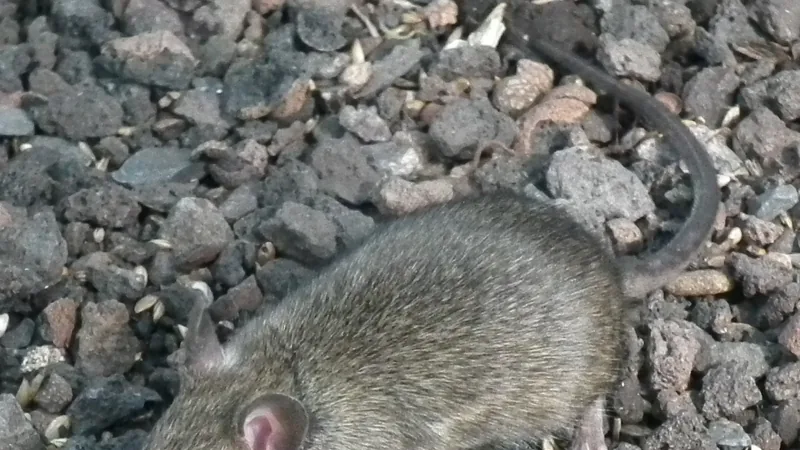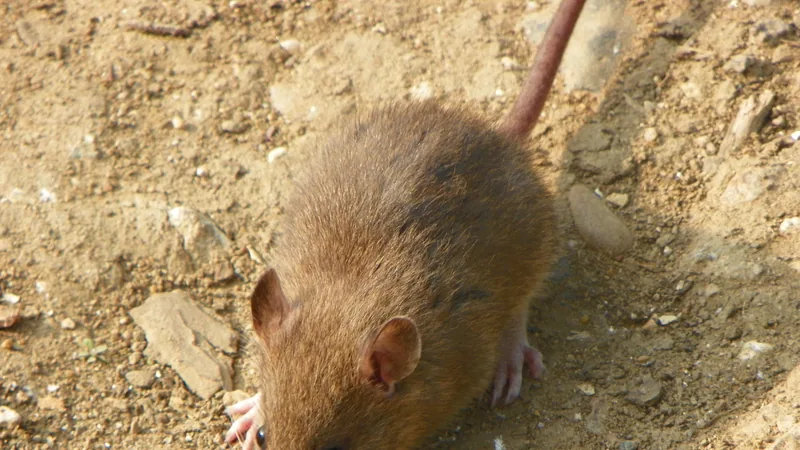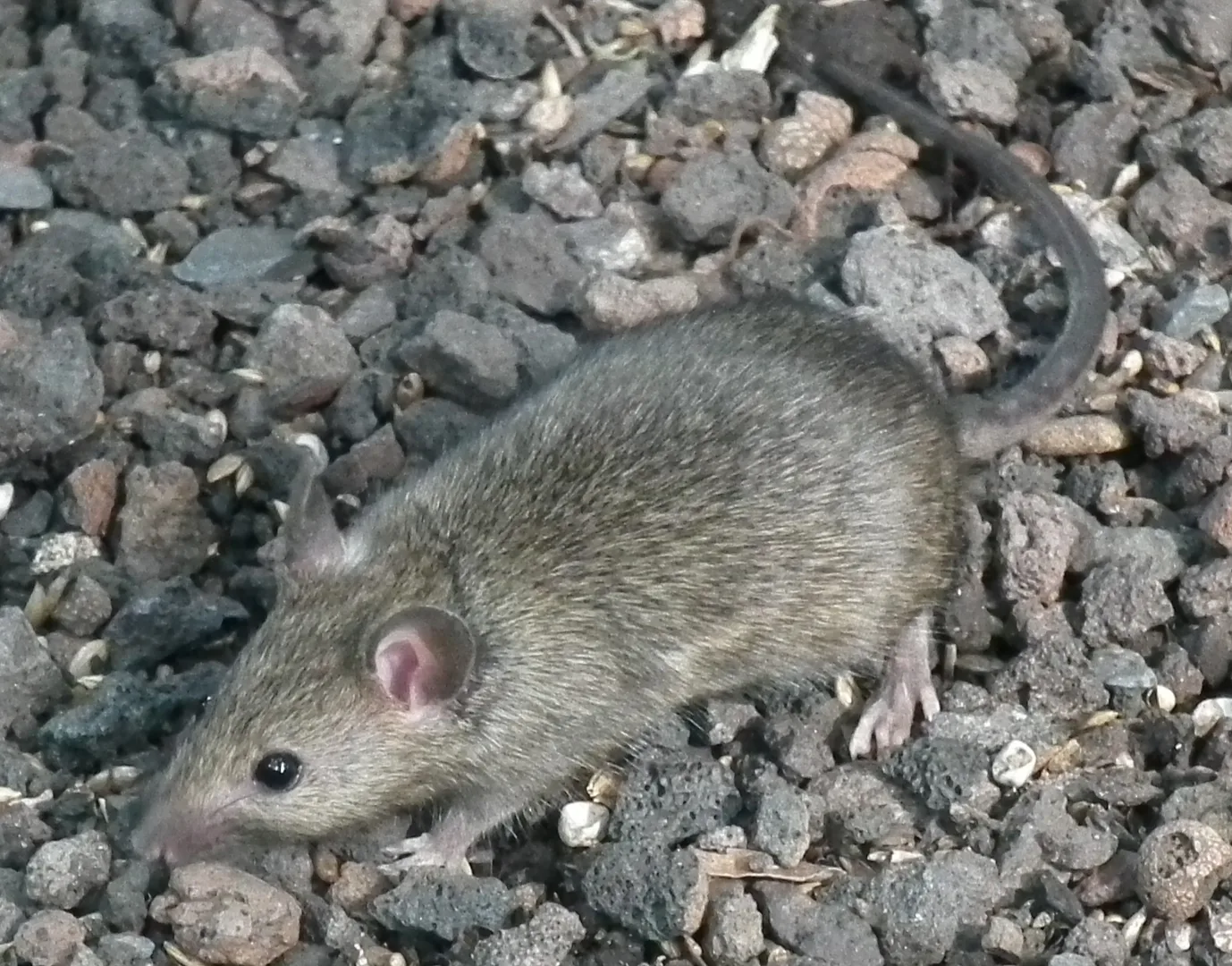
A house mouse in the open.
Field
notes
The house mouse (Mus musculus) sings, but you will never hear it. When a male smells a female’s sex pheromones, the chemical signals animals use to send messages, he produces complex songs in ultrasound, sound pitched above the range of human hearing. The squeaks mice trade in the nest are the part you can hear. Mice also swap information by smell, using pheromones and other scents to tell each other who is dominant, who is family and who is ready to breed. Their whiskers read air movements and surface textures.
A very small animal
An adult measures 65 to 95 mm from nose to the end of its body, with a nearly hairless tail of 60 to 105 mm, and weighs 12 to 30 g. In the wild, mice generally dwell in cracks in rocks or walls, or in underground burrows. They are generally nocturnal, run at up to 8 miles per hour, and climb, jump and swim well.
They can look fragile, but the species is a numbers machine.
Built to rebound A female comes back into heat 12 to 18 hours after giving birth. Mice reproduce so rapidly that their populations can recover quickly from predators such as cats, owls and snakes.
When conditions suit, females generally have 5 to 10 litters a year. Each litter holds 3 to 12 pups, usually 5 or 6, born naked and blind. Gestation lasts 19 to 21 days. The pups are weaned at 3 weeks and sexually mature at 5 to 7 weeks.
A lodger in our houses
The house mouse’s original range may have run from the Mediterranean to China. Humans have spread it throughout the world, and it now lives as a commensal, an animal that shares our space and food. It generally lives in houses, barns and granaries and seldom strays far from buildings, and living with people has let it settle tundra and desert it could not occupy independently. Commensal populations can reach 10 mice per square meter, while wild ones may be less than 1 per 100 square meters.
In the wild a mouse eats seeds, fleshy roots, leaves and stems, plus insects and carrion when it can. Indoors, it eats any accessible human food, and even glue and soap. Indoors it builds nests from rags and paper. Mice spoil stored food with their droppings, and they contribute to the spread of diseases such as murine typhus and salmonella.
How long a mouse lasts
The record for a normal mouse is 4 years, set by a male from a wild-derived strain kept in a lab, so it shows what a mouse can do in captivity, not what one does outdoors. A wild mouse’s life expectancy is less than a year, depending on its surroundings.
Domestic strains are another story. Humans have bred many domestic forms, from white to black and spotted. One genetic strain, the “dancing” mouse, has inner ear defects that make it weave, circle and wobble as it walks. The wild species is rated Least Concern by the IUCN Red List.
Published Updated
Traits
Intel
& FAQ
Guess
first
How big is a House Mouse, really? Slide, lock in, and see what the sources say. Every answer is a figure from this page, quoted from where it came from.
Sources
- 01Amori (2025). Mus musculus. The IUCN Red List of Threatened Species 2025: e.T13972A221783227.
- 02Mus musculus (house mouse). Animal Diversity Web, University of Michigan.
- 03AnAge entry for Mus musculus. AnAge: The Animal Ageing and Longevity Database, Build 15, Human Ageing Genomic Resources.
- 04Perlman (2016). Mouse Models of Human Disease: An Evolutionary Perspective. Evolution, Medicine, and Public Health.
What the sources say: 46 claims checked word for word against these sources →