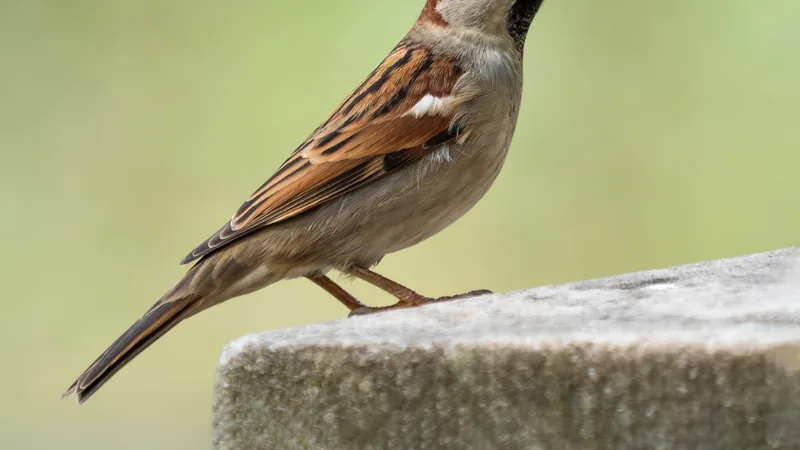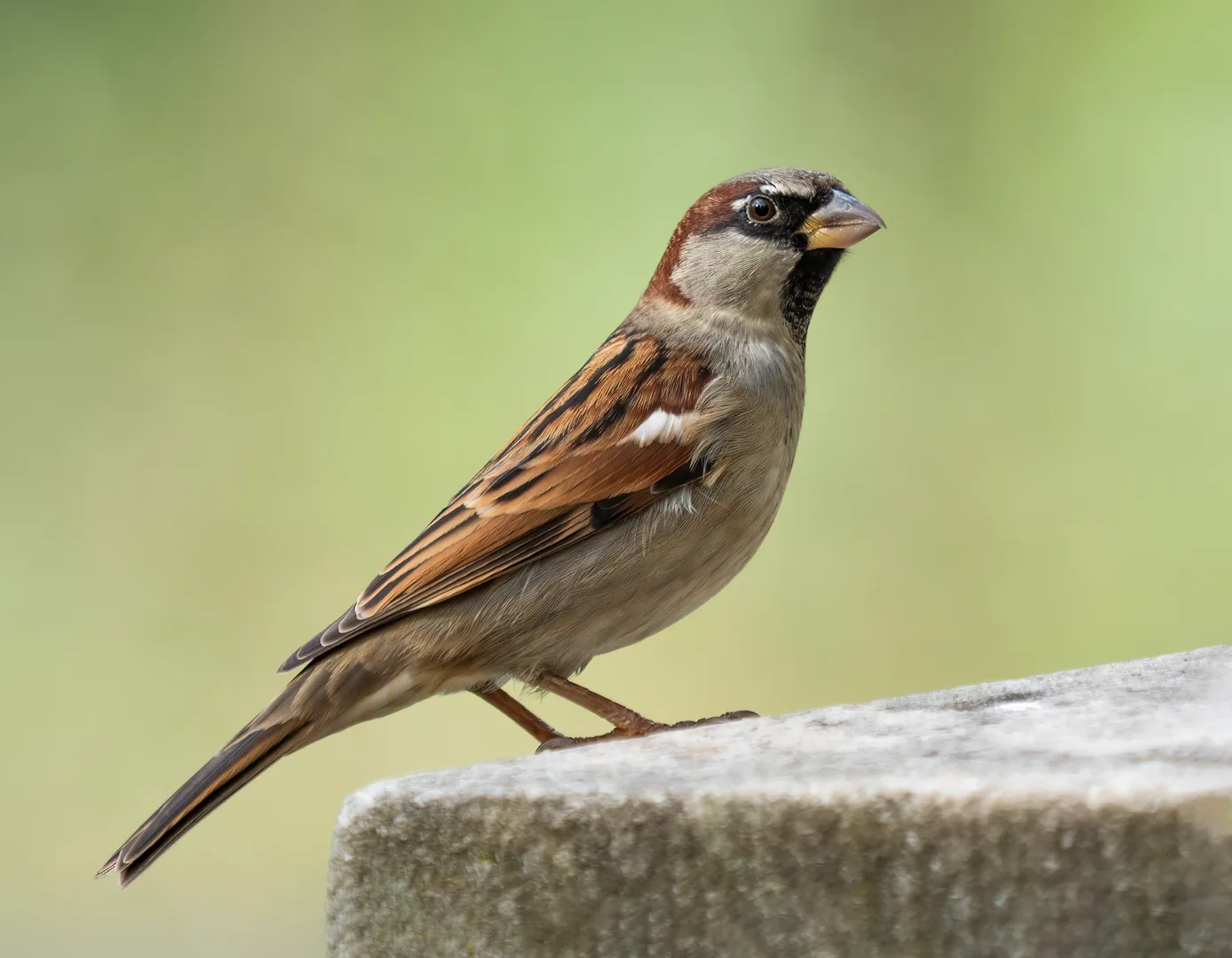
Male house sparrow in Prospect Park
Field
notes
New continent, new races
The house sparrow, Passer domesticus, is a plain brown bird that turned into an evolution experiment. A group of 100 birds from England was released in Brooklyn, New York, in 1851. Since then North American sparrows have changed in color and size.
Fast evolution Since its introduction in the middle of the 19th century, the sparrow has shown clear adaptive differences in color and size in North America and Hawaii. Its patterns of variation parallel those of native species that have several races. Researchers wrote that racial differentiation may need no more than 50 years.
Small bird, huge range
Live adults weighed by BTO average 27.3 g, with 77.1 mm wings. Males have white cheeks and a black bib. Females do not.
The species is native to Eurasia and North Africa. People have taken it to South Africa, South America, Australia, New Zealand and America. It likes places changed by people: farms, homes and cities. It is absent from uninhabited woodlands, deserts, forests and grasslands.
Seeds, crevices and short lives
House sparrows eat many kinds of seed, plus some insects. Rural birds eat more waste seed from animal dung and fields. Urban birds eat more birdseed and weed seed. They nest in crevices in and on buildings, and in trees. A typical clutch is four or five eggs, laid in two or three broods a year in Britain. Both parents feed the chicks by regurgitation, which means bringing swallowed food back up. Sparrows also defend a small territory around the nest site, and they have been seen threatening, and if necessary attacking, birds of 70 other species that come into it.
Life is brief. A sparrow that reaches breeding age typically lives about 3 years, and the oldest ringed bird on BTO’s records reached 12 years and 12 days. Sparrows avoid predators by foraging in small flocks, so many eyes watch for predators such as hawks and owls.
Common, but slipping
The IUCN Red List rates the species Least Concern. Yet in the UK it has been on the national Red List of birds since 2002, and its numbers have fallen since the mid-1970s.
Published
Traits
Intel
& FAQ
Guess
first
How big is a House Sparrow, really? Slide, lock in, and see what the sources say. Every answer is a figure from this page, quoted from where it came from.
Sources
- 01Passer domesticus. The IUCN Red List of Threatened Species 2021: e.T103818789A199147773.
- 02Passer domesticus, house sparrow. Animal Diversity Web, University of Michigan.
- 03House Sparrow, Passer domesticus. BirdFacts, British Trust for Ornithology.
- 04Johnston & Selander (1964). House Sparrows: Rapid Evolution of Races in North America. Science.
- 05Martin, Scheuerlein & Wikelski (2003). Immune activity elevates energy expenditure of house sparrows: a link between direct and indirect costs? Proceedings of the Royal Society of London. Series B: Biological Sciences.
What the sources say: 42 claims checked word for word against these sources →