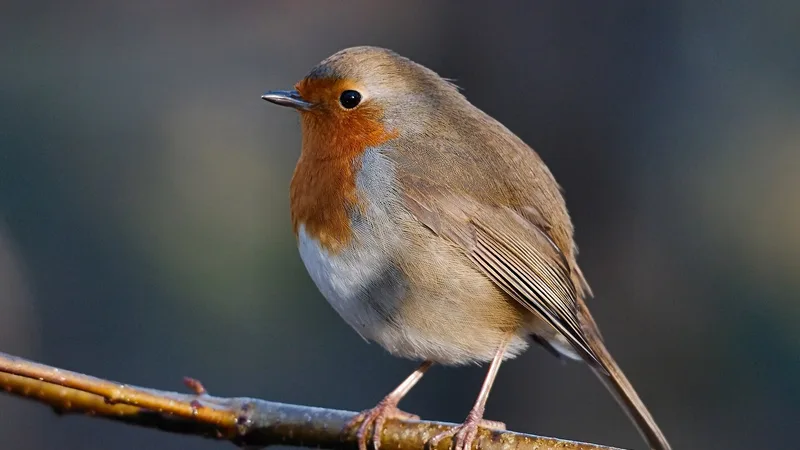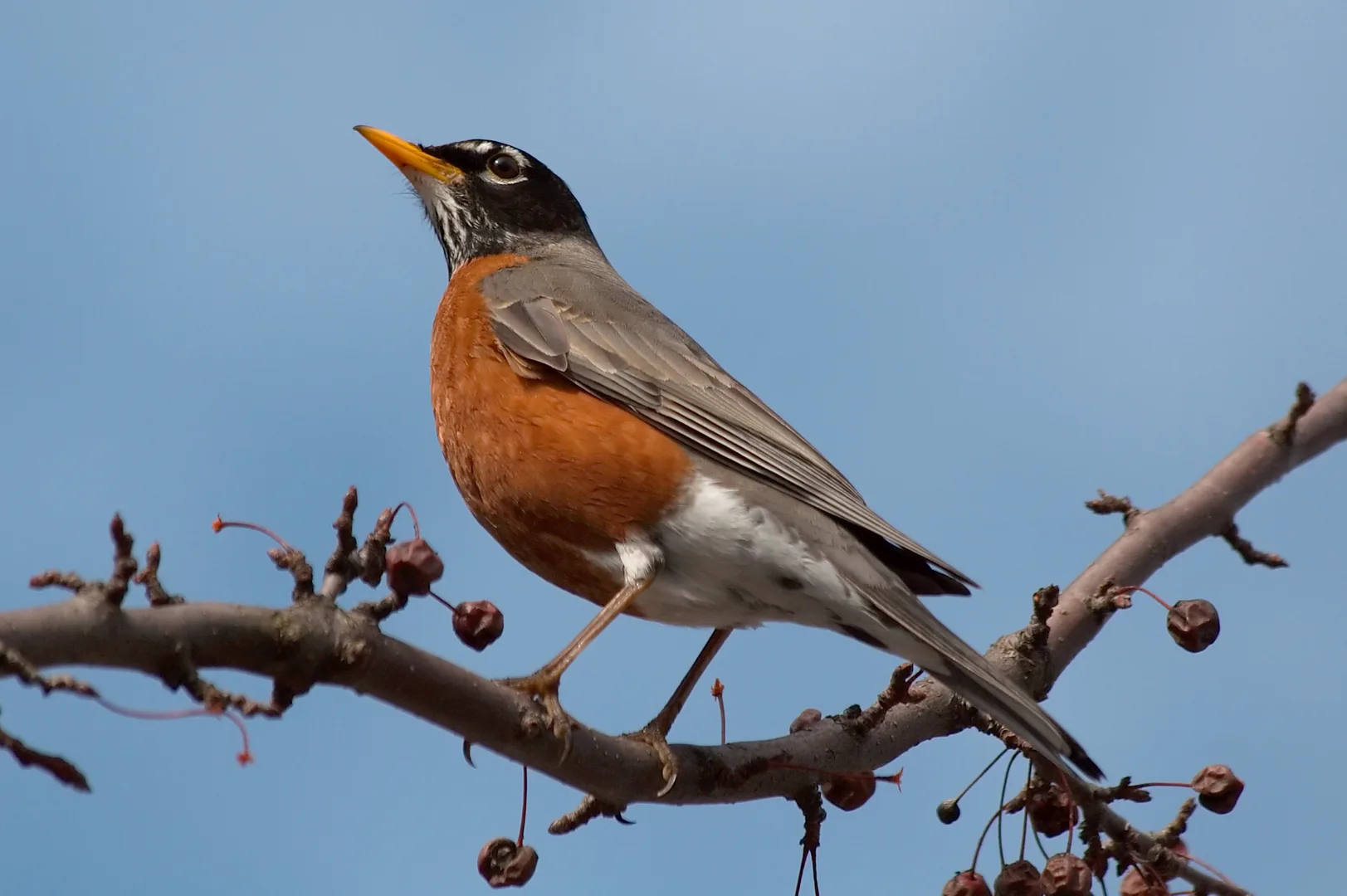
An adult on a twig.
Field
notes
Worm hunting, with a question mark
A robin does much of its foraging on the ground, running and pausing on open lawns, and earthworms are on the menu. Audubon says the robin apparently locates earthworms by sight (not, as had been suggested, by hearing them move underground). In a series of aviary experiments, four robins found buried mealworms even with sight, smell and vibration cues removed, and their foraging success dropped significantly when white noise obscured sound. The authors say that suggests robins can use hearing to find prey.
The first robin of spring When northerners see their “first robin of spring,” it may be a bird that has wintered only a few miles away, not one that has just arrived from southern climates, says Audubon.
Small, common and everywhere
An adult robin is 20 to 28 centimeters (7.9 to 11 inches) long, with a wingspan of 31 to 40 centimeters, and weighs 77 to 85 grams, about the same as three AA batteries. Audubon calls it a very familiar bird over most of North America. It lives in forest edges, pastures and farmland, and it is extremely common in parks, gardens, backyards and cities.
Some robins that breed in the northern United States and Canada fly south for the winter to the southern U.S., Mexico and Central America. Many others stay in colder areas year-round, traveling to wherever they can find food. In the wild a robin typically lives one to two years, though the National Zoo says one can live up to 13.
Worms by morning, fruit by afternoon
In early summer, insects make up the majority of a robin’s diet, and it also eats many earthworms, snails and spiders. It feeds heavily on fruit, especially in winter, when robin flocks gather in wooded areas where trees or shrubs carry good crops of berries. In some areas robins even keep a schedule, eating worms and insects in the morning and switching to fruit in the afternoon.
A mud foundation and a very early song
Their rich caroling is among the earliest bird songs heard at dawn in spring and summer, often beginning just before first light. The nest is a cup of grasses and twigs worked into a solid foundation of mud. The female incubates the eggs for 12 to 14 days, and the young leave the nest about 14 to 16 days after hatching. A pair raises 2 broods a season, sometimes 3.
Because it is so familiar and occurs around places where people live, the robin sometimes serves as an early warning of environmental problems, such as overuse of pesticides. The Red List rates it Least Concern.
Published
Traits
Intel
& FAQ
Guess
first
How big is a American Robin, really? Slide, lock in, and see what the sources say. Every answer is a figure from this page, quoted from where it came from.
Sources
- 01Turdus migratorius. The IUCN Red List of Threatened Species 2021: e.T103889499A139392811.
- 02American robin. Smithsonian's National Zoo and Conservation Biology Institute.
- 03American Robin. Audubon Guide to North American Birds.
- 04Montgomerie & Weatherhead (1997). How robins find worms. Animal Behaviour.
What the sources say: 40 claims checked word for word against these sources →