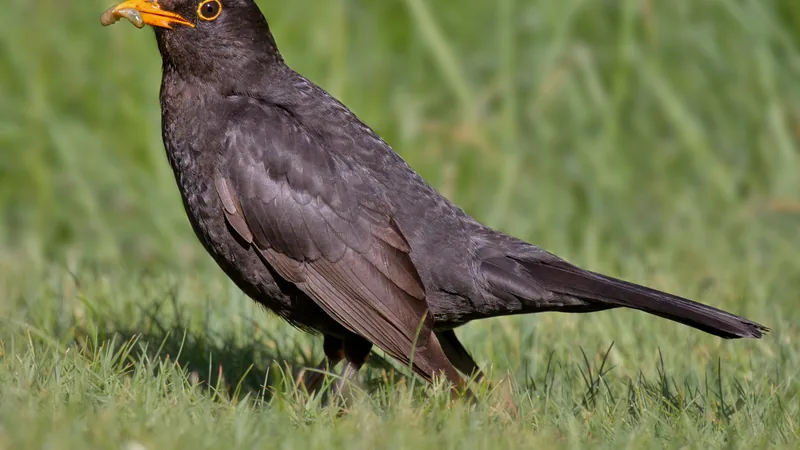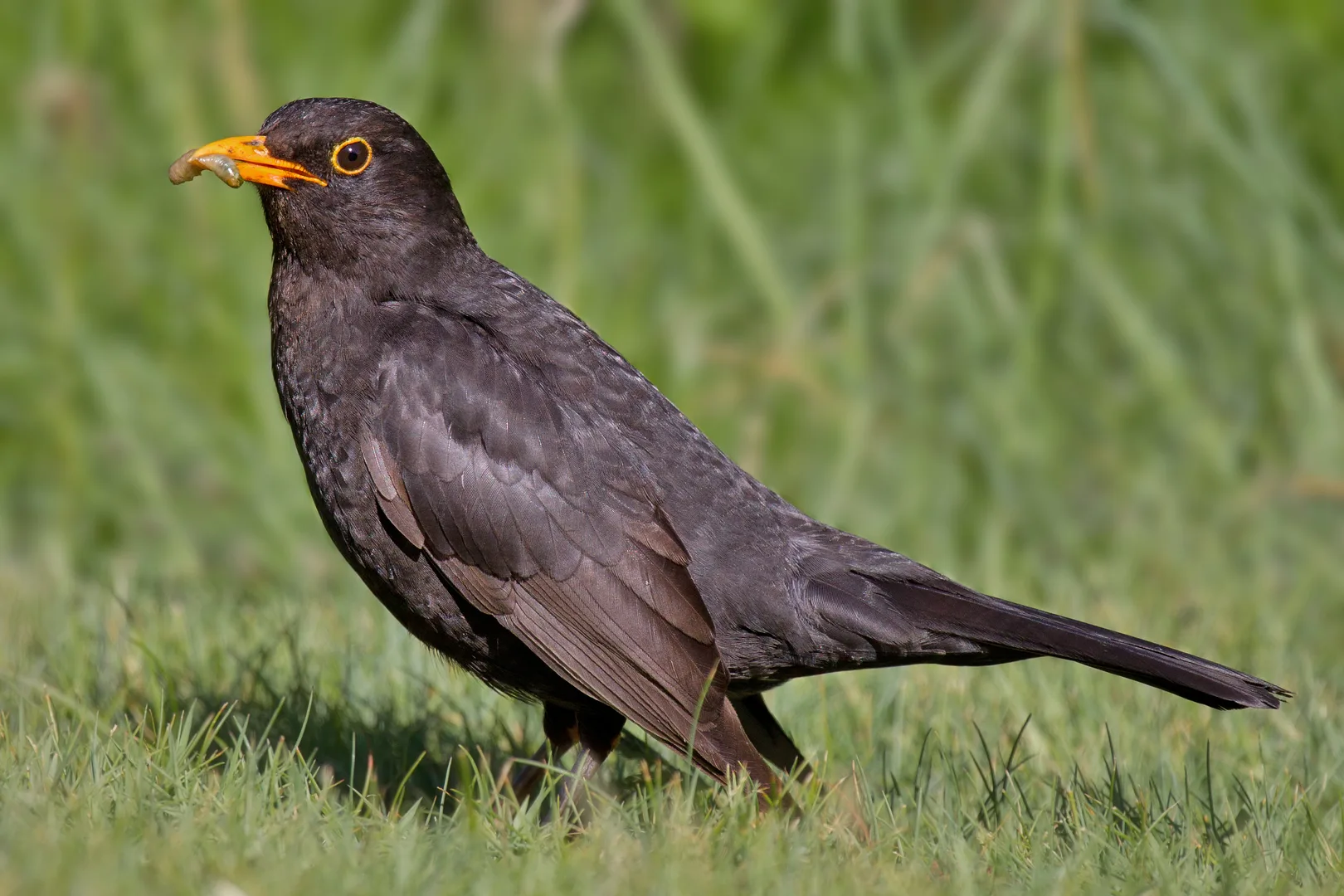
Adult male.
Field
notes
Lights on, melatonin down
Blackbirds are widespread in Europe and breed successfully in cities. Researchers caught adult males in Munich and in a forest 40 km away, moved them indoors, and kept one group under a dim 0.3 lux glow at night, the level recorded on free-living city blackbirds, and the other in near darkness (0.0001 lux). The glowing group released less melatonin, a hormone that is normally released at night. They were also more active, with activity rising sharply before dawn.
A second study tested the calendar. Under the same faint night light, captive blackbirds had their reproductive system developed up to a month ahead of birds given dark nights, and their moult came earlier too.
Listening for worms on the lawn
A blackbird is about 24 cm long with a 36 cm wingspan. BTO measurements of live birds put the adult average at 101.8 g, and 90 percent of adults weigh between 87 and 122 g. Males are entirely black, set off by a yellow bill and a yellow eye-ring. Females are dark brown with streaking on the chest and throat.
Look for them on lawns, heads cocked to one side, listening for earthworms. They also eat insects, berries and fruit. A bird that survives to breeding age typically lives about 3 years. The oldest ringed blackbird in Britain was 15 years, 2 months and 5 days old, a record set in 2000.
Almost everywhere in Britain
In Britain and Ireland blackbirds turn up almost everywhere except the highest ground: gardens, parks, hedgerows, woodland and farmland. Most UK blackbirds stay all year, though some northern birds migrate south for winter, and large numbers from northern Europe join the residents each autumn. The UK held 5.1 million breeding pairs in 2016, and its breeding population was 21 percent lower in 2024 than in 1967.
Loud beats high
The song runs year-round, but peaks between March and June, and blackbirds are a leading voice in the UK’s dawn chorus. Where traffic fills a city with low rumble, birds have been seen singing both louder and higher. Researchers picked blackbirds and great tits, two species that sing higher in urban areas, and modelled how far each species’ song carries in city noise and in forest.
Pitch versus volume In the models, a higher pitch only marginally increased how far a song carried, while singing louder had a strong and significantly larger effect.
The authors say their results indicate that raising the pitch is not very effective at beating traffic masking.
Published
Traits
Intel
& FAQ
Guess
first
How big is a Common Blackbird, really? Slide, lock in, and see what the sources say. Every answer is a figure from this page, quoted from where it came from.
Sources
- 01Turdus merula. The IUCN Red List of Threatened Species 2024: e.T103888106A264548442.
- 02Dominoni et al. (2013). Urban-like night illumination reduces melatonin release in European blackbirds (Turdus merula): implications of city life for biological time-keeping of songbirds. Frontiers in Zoology.
- 03Dominoni, Quetting & Partecke (2013). Artificial light at night advances avian reproductive physiology. Proceedings of the Royal Society B: Biological Sciences.
- 04Nemeth & Brumm (2010). Birds and Anthropogenic Noise: Are Urban Songs Adaptive? The American Naturalist.
- 05BirdFacts: Blackbird. British Trust for Ornithology.
- 06Blackbird. Welsh Wildlife Trusts.
- 07Blackbird. RSPB.
What the sources say: 40 claims checked word for word against these sources →