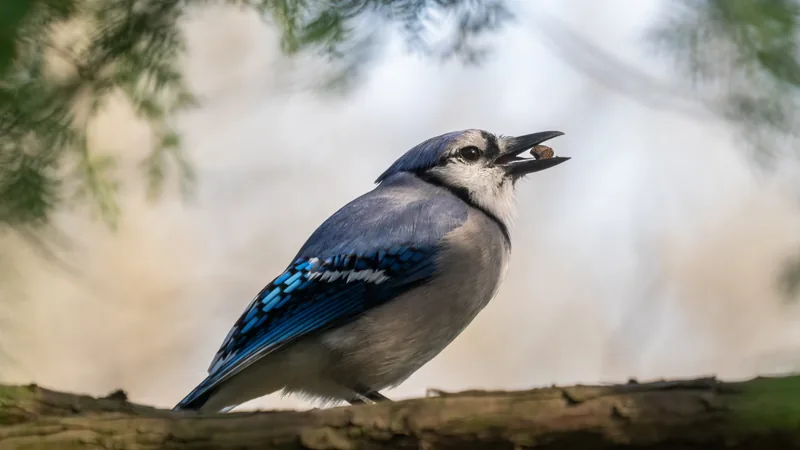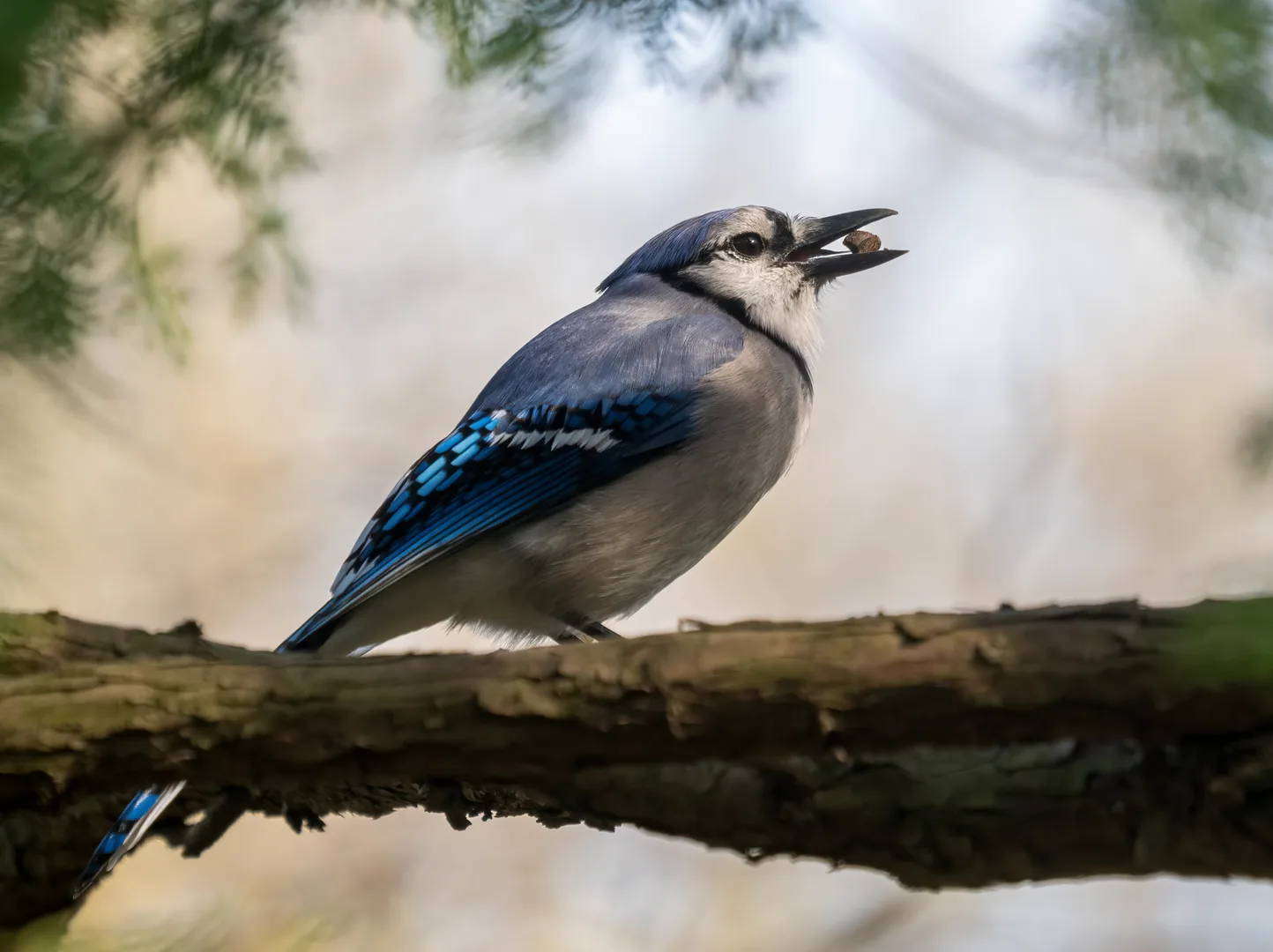
Blue jay with food in BBG
Field
notes
Hawk impressions
A blue jay’s raucous jay-jay is one of many calls. Audubon lists a rich variety of others, and one is a musical queedle-queedle. One call is almost identical to the scream of the Red-shouldered Hawk, and the jay can do a remarkable imitation of it.
It has a crest, a black necklace, bright blue wings and tail, and white wing-bars.
Stashing 133,000 acorns
Blue jays harvest acorns and store them in holes in the ground. A Virginia study looked at one stand of oak trees. Jays carried one to five nuts per trip, 2.2 on average, and the caches lay a mean 1.1 km from the seed trees (100 m to 1.9 km). Each nut was cached singly and covered with debris. Jays also ate a further 20% of the stand’s acorns where they collected them.
The authors concluded that jays facilitate colonization by members of the Fagaceae, the plant family that includes oaks and beeches.
Acorn delivery service In that Blacksburg, Virginia study, blue jays transported and cached 133,000 acorns, which was 54% of the stand’s total mast crop (its whole nut harvest).
Size, range and diet
A blue jay is 25 to 30 cm long, with a wingspan of 34 to 43 cm, and weighs 70 to 100 g. Males are slightly larger than females. The record for a wild jay is 18.3 years. One captive female lived to 26.2 years.
Blue jays are present all year in most of their range. Some migrate south in fall, but not south of the United States. They live in southern Canada and the United States east of the Rocky Mountains, in oak and pine woods, suburban gardens and towns.
Blue jays are omnivores that may feed on almost anything, Audubon says. Up to 75% of the diet over a year is vegetable matter, and more of it in winter. Jays also eat many insects, especially caterpillars, beetles and grasshoppers.
Tools and a trained eye
Audubon calls the blue jay intelligent and adaptable. In one study, laboratory-raised jays tore pieces from newspaper pages and used them as tools to rake in food pellets that were otherwise out of reach. How often they did it depended on the jay’s motivational state and on whether pellets were there.
In another study, jays trained to spot Catocala moths in slides improved over successive encounters when a series showed one species. No similar effect occurred when two species were mixed. The authors called this a direct demonstration of a specific search image.
Published
Traits
Intel
& FAQ
Guess
first
How big is a Blue Jay, really? Slide, lock in, and see what the sources say. Every answer is a figure from this page, quoted from where it came from.
Sources
- 01Blue Jay. National Audubon Society, Guide to North American Birds.
- 02AnAge entry for Cyanocitta cristata. AnAge: The Animal Ageing and Longevity Database, Build 15, Human Ageing Genomic Resources.
- 03Frysinger. Cyanocitta cristata (blue jay). Animal Diversity Web, University of Michigan.
- 04Darley-Hill & Johnson (1981). Acorn dispersal by the blue jay (Cyanocitta cristata). Oecologia.
- 05Jones & Kamil (1973). Tool-Making and Tool-Using in the Northern Blue Jay. Science.
- 06Pietrewicz & Kamil (1979). Search Image Formation in the Blue Jay (Cyanocitta cristata). Science.
- 07Cyanocitta cristata. The IUCN Red List of Threatened Species 2025: e.T22705611A137739324.
What the sources say: 45 claims checked word for word against these sources →