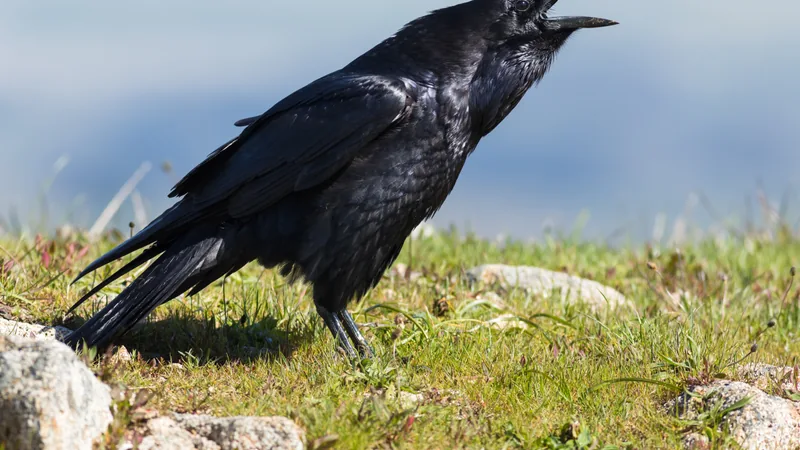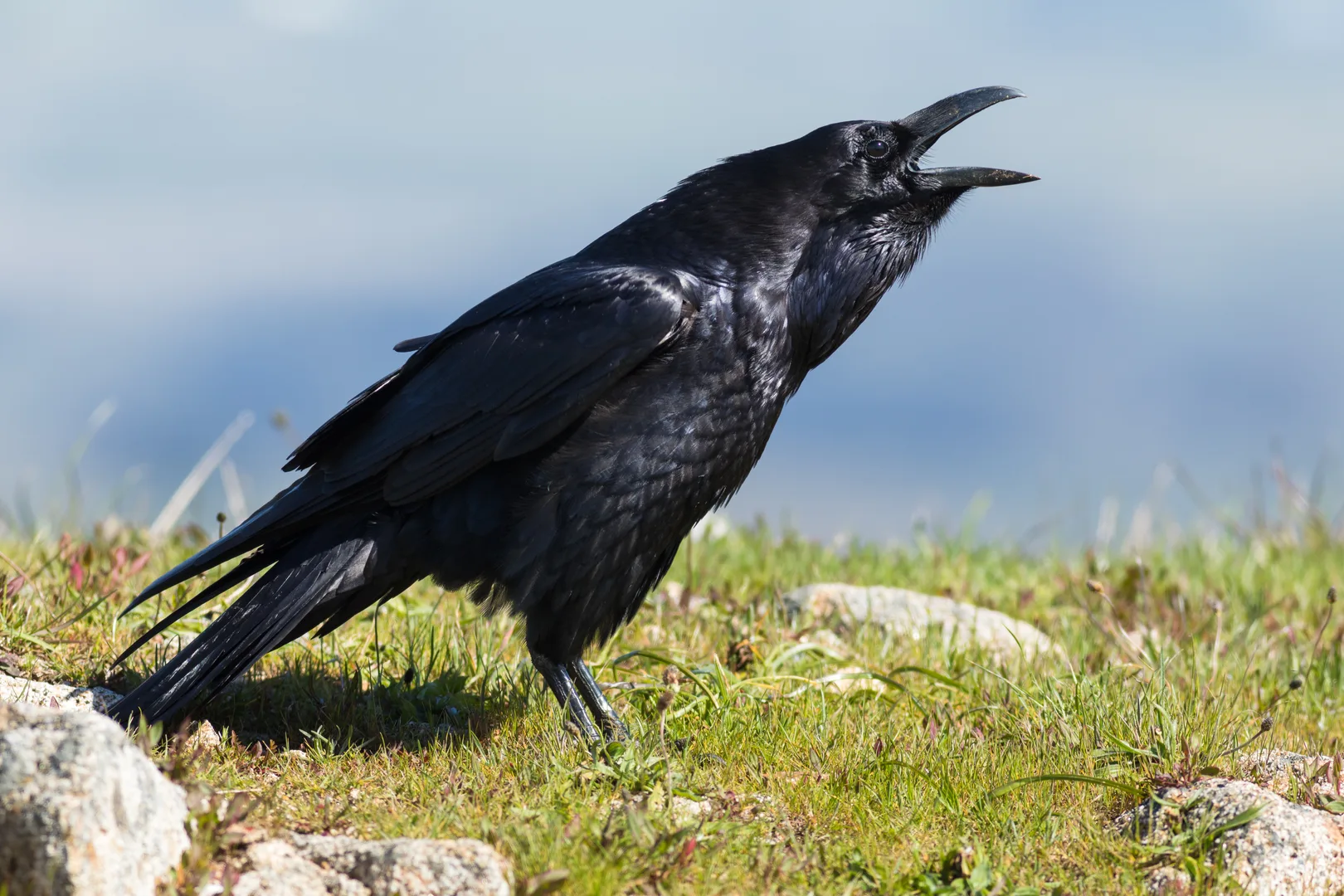
Common raven (Corvus corax) calling at Point Reyes National Seashore, California.
Field
notes
The Biggest Perching Bird
The Common Raven (Corvus corax) is usually set apart from other crows by its large size. Adults reach up to 69 centimeters long and weigh between 0.7 and 1.6 kilograms, and Animal Diversity Web lists them as the largest of the passerines, the perching birds. The oldest raven in the British Trust for Ornithology’s ringing records survived 17 years, 11 months and 15 days.
At Home Almost Anywhere but Rainforest
Common ravens range from northern Europe, the British Isles, mostly coastal Greenland and Iceland east across Asia to the Pacific, south to the Himalayas, the Middle East, northwest Africa and the Canary Islands, and through North and Central America. They prefer open country such as treeless tundra, seacoasts, rocky cliffs, mountain forests, plains and deserts, but turn up in most habitat types except rainforest. Ravens are mainly scavengers, but they also eat small mammals, birds, reptiles, amphibians and insects, and round things out with grains, acorns, fruit and buds. Stomach analyses show their diet is mostly mammal flesh, followed by insects and birds.
Hiding a Meal From a Thief
Ravens hide food of all kinds, from nuts and bones to eggs and meat, in caches. In one study of four captive ravens, a small amount of food that any one bird could have carried off in several trips got all four caching sooner and faster. When there was only enough food for one bird to control, caching was greatly delayed. Given space to get out of their rivals’ sight, the birds cached farther from the food.
Guarding Against an Unseen Rival In another experiment, ravens hid food while a hidden loudspeaker played sounds recorded from a rival raven, though the room next door was empty. They guarded their caches against discovery when a peephole in the wall between the rooms was open, but not when it was shut. The researchers suggest ravens can infer the possibility of being seen from their own experience.
Teamwork With Conditions Attached
Without any training, nine captive ravens spontaneously cooperated in a puzzle where two birds had to pull both ends of a string at the same moment to drag a food platform within reach. Pulling one end alone unthreaded the string and left the platform where it was. The more tolerant two birds were of each other, the more successfully they cooperated. A bird whose partner had taken both rewards on the last successful try was less likely to pull on the next one. Ravens have more than 30 different vocalizations on record, including alarm calls, chase calls and calls for advertising territories, and in human care they can mimic simple sounds, even human speech.
Published Updated
Traits
Intel
& FAQ
Guess
first
How big is a Common Raven, really? Slide, lock in, and see what the sources say. Every answer is a figure from this page, quoted from where it came from.
Sources
- 01Corvus corax (common raven). Animal Diversity Web, University of Michigan.
- 02Common raven. Smithsonian's National Zoo and Conservation Biology Institute.
- 03Raven. BirdFacts, British Trust for Ornithology.
- 04Corvus corax. The IUCN Red List of Threatened Species 2025: e.T22706068A281841771.
- 05Heinrich & Pepper (1998). Influence of competitors on caching behaviour in the common raven, Corvus corax. Animal Behaviour.
- 06Bugnyar, Reber & Buckner (2016). Ravens attribute visual access to unseen competitors. Nature Communications.
- 07Massen, Ritter & Bugnyar (2015). Tolerance and reward equity predict cooperation in ravens (Corvus corax). Scientific Reports.
What the sources say: 52 claims checked word for word against these sources →