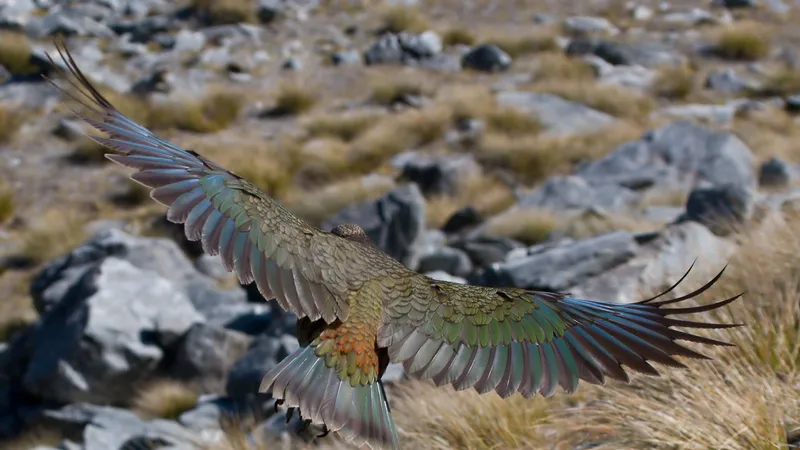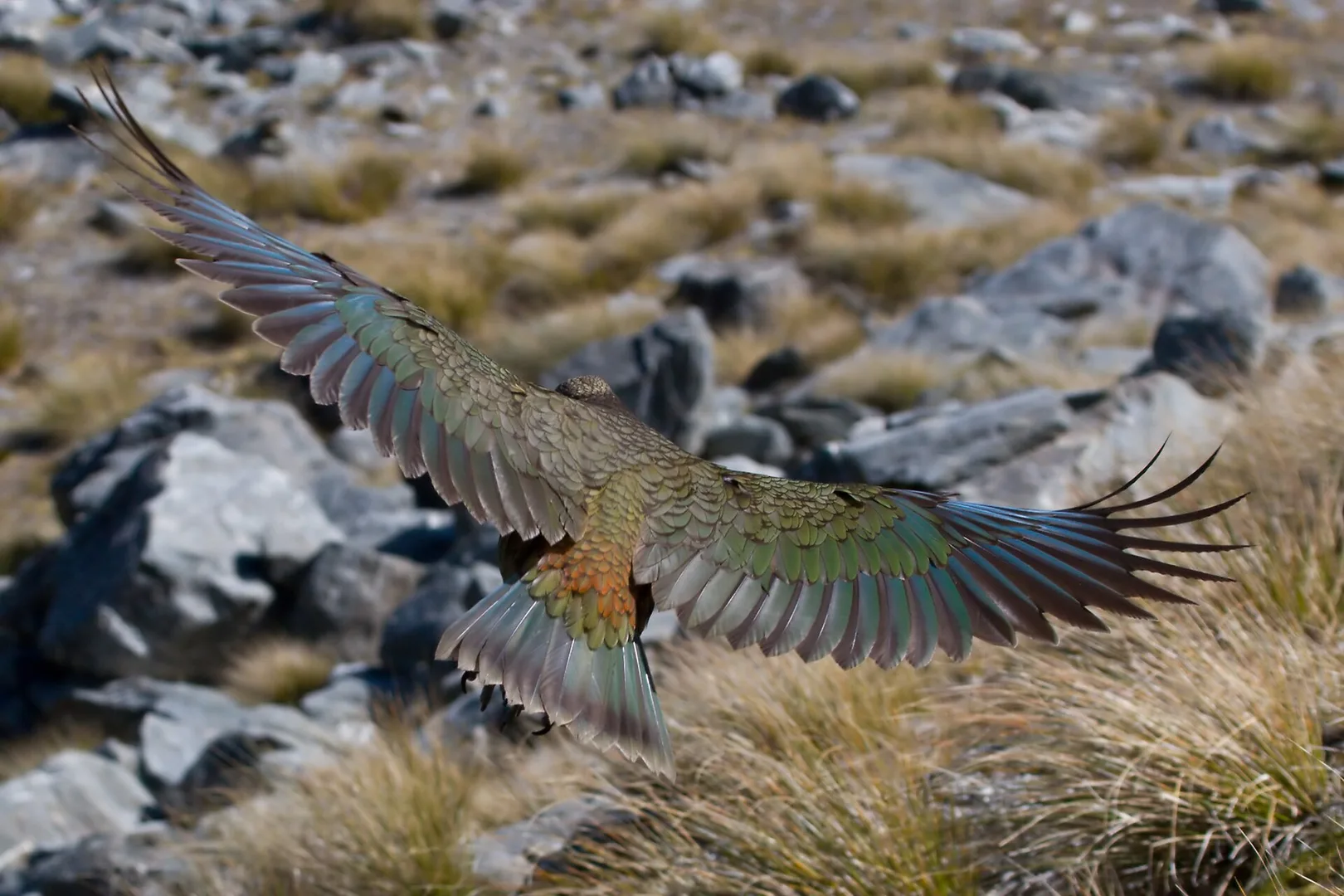
A kea (Nestor notabilis) flying on The Remarkables near Queenstown, New Zealand.
Field
notes
A Parrot Built for the Mountains
The kea (Nestor notabilis) lives only on New Zealand’s South Island, ranging over about four million hectares of its axial ranges from Farewell Spit to Waitutu. Kea can be found from coastal dunes to high alpine peaks. An adult grows to about 46 centimetres long. Males weigh 900 to 1,100 grams; females weigh about 20 percent less, with a shorter, less curved upper bill. Kea have been recorded living at least 22 years. They are opportunistic omnivores, eating plants and animals alike: beech leaves, buds and nuts, berries, nectar and roots, huhu grubs dug out of rotten logs, and the carcasses of deer, chamois, tahr and sheep.
Hunted as a Sheep Killer for a Century
Some kea perch on a sheep’s back and dig through skin and muscle to reach the fat around its kidneys, a wound that can turn septic and kill the sheep. The behaviour was not common, but it was the reason kea were persecuted for over a hundred years: about 150,000 were shot between 1860 and 1970. Bounty hunting of kea to protect sheep was outlawed in 1971, and full protection was finally granted in 1986.
Ground Nests in a World of Stoats and Cats
Kea nest on the ground, in natural cavities such as rock crevices, hollow logs and hollows under tree roots. That leaves eggs and chicks exposed to introduced stoats and feral cats, which kill adult kea too. A 2021 Department of Conservation article reported feral cats killing kea in numbers comparable to stoats in eastern parts of the South Island. Where predators are controlled, about 70% of kea nests succeed; without control, success can drop to 10% or less. The Department of Conservation estimates there are 1,000 to 5,000 kea, though counting kea across such rugged terrain is difficult, and any estimate is little more than a guess.
The Bird That Does the Math
In a 2020 study of six male kea at Willowbank Wildlife Reserve, the birds showed three signatures of statistical inference. Watching an experimenter draw from two jars of mixed tokens, they picked the hand more likely to hold a rewarding one by comparing relative quantities, then factored in a barrier and whether the experimenter sampled with a bias. The authors say this is evidence that true statistical inference exists outside the great apes. Kea love tinkering: they often turn on taps, and they have been known to destroy car wipers and weather stripping. A kea at Mueller Hut once even managed to lock a mountaineer inside the toilet. Captive kea can learn a complicated task just by watching others, though this has not been shown in wild kea.
A Call That Spreads Play Kea have a distinct play call, and when researchers played recordings of it to wild kea, both juveniles and adults played more. The call likely works as a positive emotional contagion, an emotive behaviour that spreads from one individual to another, the way laughter does in humans.
Published Updated
Traits
Intel
& FAQ
Guess
first
How big is a Kea (Alpine Parrot), really? Slide, lock in, and see what the sources say. Every answer is a figure from this page, quoted from where it came from.
Sources
- 01Kea. New Zealand Birds Online.
- 02Nestor notabilis (kea). Animal Diversity Web, University of Michigan.
- 03Kea. New Zealand Department of Conservation.
- 04The hidden risk for the world's smartest bird. New Zealand Department of Conservation, 2021.
- 05Bastos & Taylor (2020). Kea show three signatures of domain-general statistical inference. Nature Communications.
- 06Schwing et al. (2017). Positive emotional contagion in a New Zealand parrot. Current Biology.
- 07Goodman, Hayward & Hunt (2018). Habitual tool use innovated by free-living New Zealand kea. Scientific Reports.
- 08Nestor notabilis. The IUCN Red List of Threatened Species 2017: e.T22684831A119243358.
What the sources say: 45 claims checked word for word against these sources →