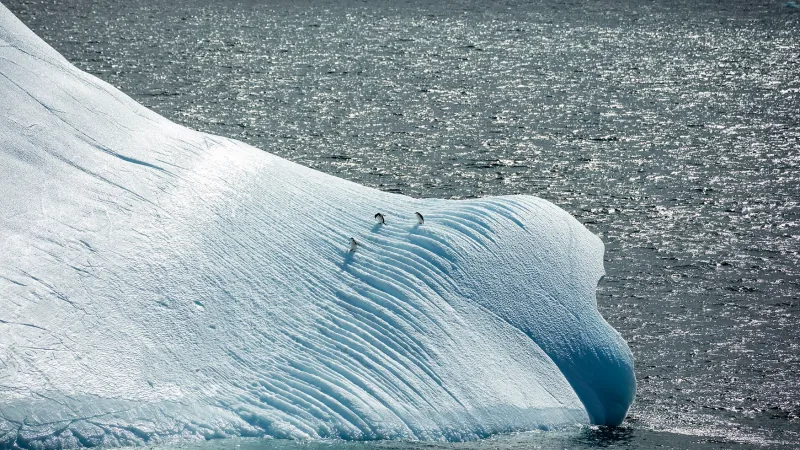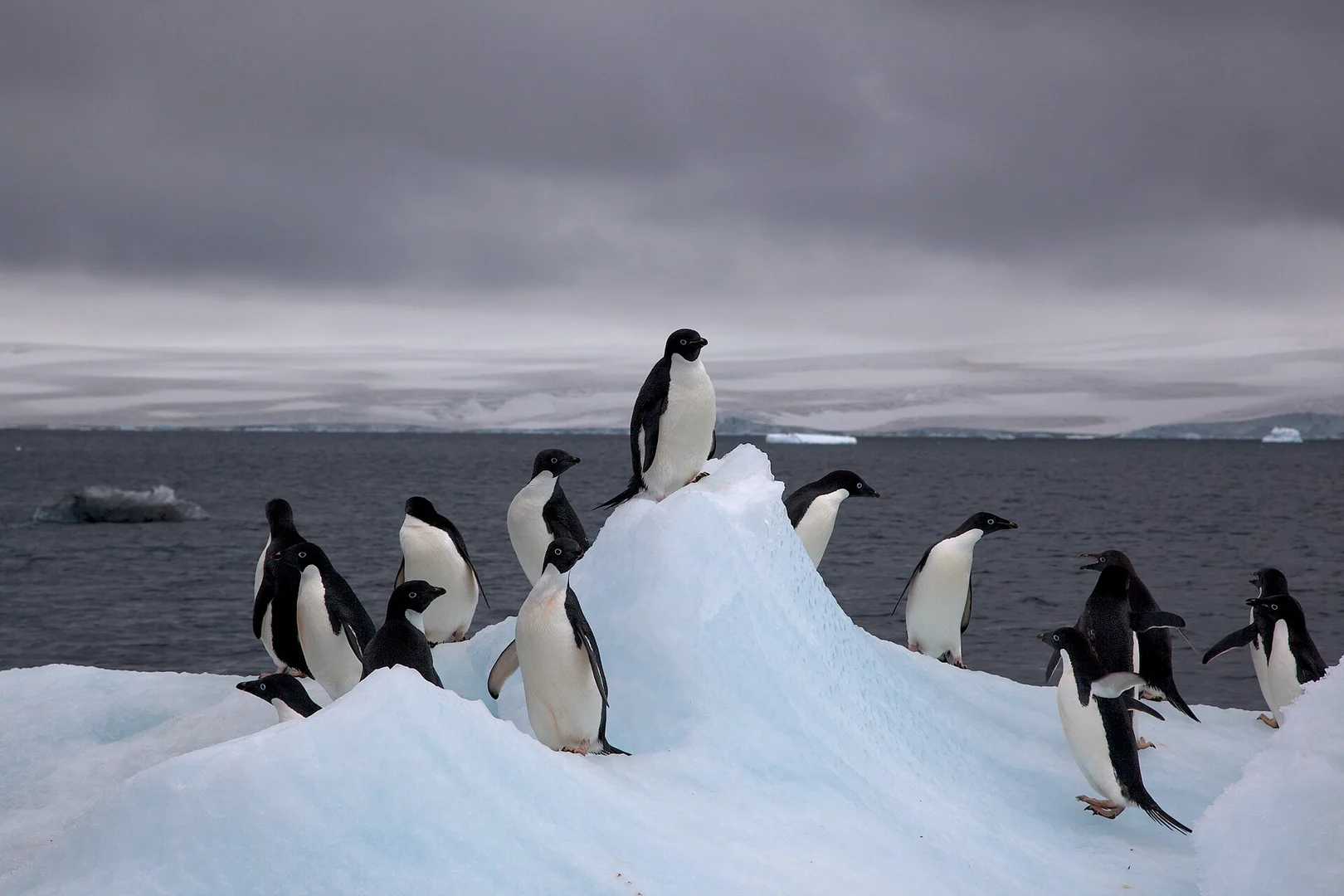
Adélie penguins on an iceberg.
Field
notes
The Tuxedo on the Rocks
At 70 cm tall and 3 to 6 kg, the Adélie Penguin (Pygoscelis adeliae) is a medium-sized penguin and a very determined long-distance walker. It is one of only 5 penguin species that live on the Antarctic continent, and it breeds around the entire coast and its small islands, wherever there is exposed rock. A drone and ground survey published in 2018 counted 751,527 breeding pairs on the Danger Islands alone, more than the rest of the Antarctic Peninsula region combined, including what were then the third and fourth largest Adélie colonies in the world. Adults arrive at their colonies in October and fast for 3 to 4 weeks while they claim territory, court and build nests. Once the eggs are laid, females feed at sea while males fast for another 10 to 16 days through the first incubation shift. Adélies have a life expectancy of 10 to 20 years.
Waddle, Toboggan, Swim
On the ice an Adélie walks at an average 2.5 km/h, or, when there is enough snow, flops onto its belly and toboggans. In the water it swims at 4 to 8 km/h and can porpoise, shooting out to skim above the surface and grabbing a quick breath while it is out of the water. Some Adélies can dive to depths of up to 175 metres, though they usually feed in the top 70 metres. In droppings collected across the Antarctic Peninsula and Scotia Sea, Antarctic krill turned up in 85% of Adélie samples, and fish and amphipods are part of the diet too. Parents feeding chicks swim 5 to 120 km offshore on trips lasting 5 to 72 hours, and tracking shows these penguins can swim more than 1,200 km from their breeding site. Leopard seals are their main predators, and in a six-year study most of the seals’ hunting took place near the beach. Ashore, a penguin is safe from them, because leopard seals only come ashore to sleep or rest.
The Pebble Economy Adélies build their nests from pebbles on sloping ground, so meltwater runs away from the nest. A researcher who followed 450 nests in camera photos said stealing rocks from other penguins is “a major thing that they do.” The more rocks a nest held, the better the chance of one or more chicks surviving.
A Sun Compass, and One Bird Far Inland
In a study published in 1964, male Adélies carried from coastal colonies to featureless ice plateaus inland set off in straight lines when conditions were good. Birds from the same colony held the same heading wherever they were released, even when it did not point home. The researchers concluded that the penguins steer by the sun, using a biological clock to allow for its changing position, and that this could guide lost birds toward feeding areas off the coast.
Sometimes things still go wrong, and a penguin may become disoriented. On 5 January 2026, an Adélie was seen near Troll Research Station in Dronning Maud Land, 200 km from the nearest open sea and about 1,300 km from the closest breeding colony. It appeared to be in good condition, stayed among the station buildings until 3 pm, then walked east and disappeared. The scientists who reported it know of only one comparable peer-reviewed record: Adélie tracks found 300 km from the coast in 1958.
Published Updated
Traits
Intel
& FAQ
Guess
first
How big is a Adélie Penguin, really? Slide, lock in, and see what the sources say. Every answer is a figure from this page, quoted from where it came from.
Sources
- 01Adélie penguin. Australian Antarctic Division, Australian Government.
- 02Pygoscelis adeliae (Adelie penguin). Animal Diversity Web, University of Michigan.
- 03Borowicz et al. (2018). Multi-modal survey of Adélie penguin mega-colonies reveals the Danger Islands as a seabird hotspot. Scientific Reports.
- 04Fragão et al. (2021). Microplastics and other anthropogenic particles in Antarctica: Using penguins as biological samplers. Science of The Total Environment.
- 05Emlen & Penney (1964). Distance navigation in the Adelie penguin. Ibis.
- 06Chappell, Morgan & Bucher (1990). Weather, microclimate, and energy costs of thermoregulation for breeding Adélie Penguins. Oecologia.
- 07Descamps, Cristea & Aspnes (2026). An Adélie penguin (Pygoscelis adeliae) 200 km from the sea. Polar Research.
- 08Ainley et al. (2005). Leopard seal predation rates at penguin colonies of different size. Antarctic Science.
- 09Pygoscelis adeliae. The IUCN Red List of Threatened Species 2020: e.T22697758A157660553.
What the sources say: 61 claims checked word for word against these sources →