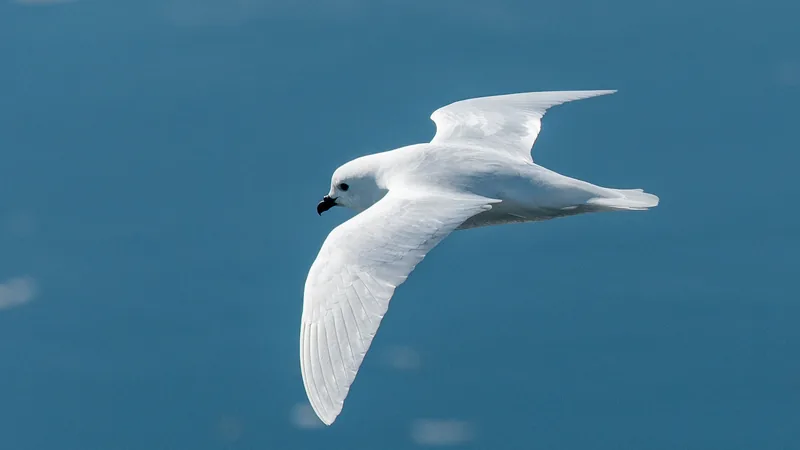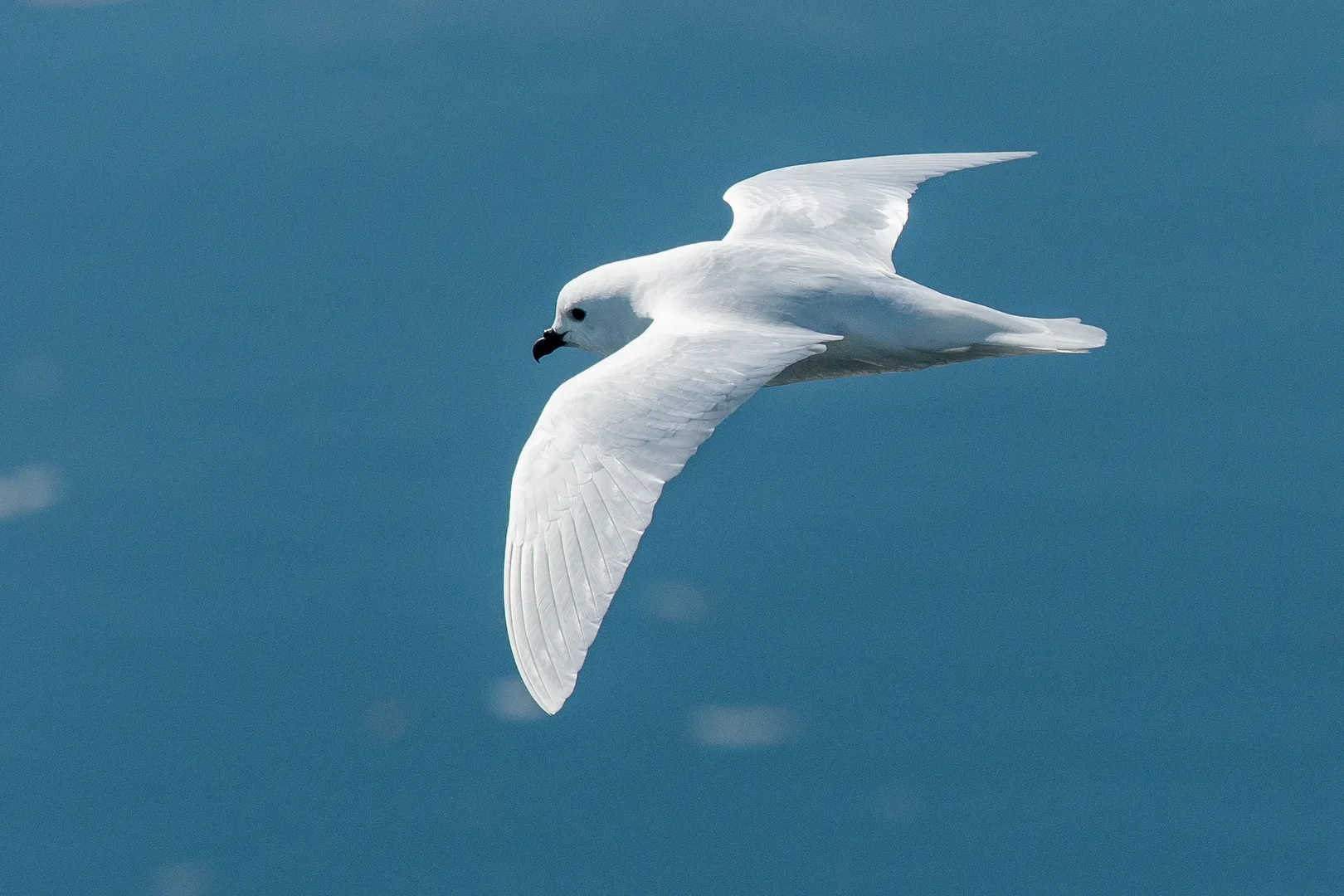
Snow petrel in flight, Dallmann Bay, Antarctica
Field
notes
Skating low over Antarctic pack ice, the Snow Petrel (Pagodroma nivea) looks like a loose scrap of snow that decided to fly. Its plumage is all white apart from dark eyes, a small black bill and blue-grey feet, and it is almost entirely restricted to cold Antarctic waters around pack ice, icebergs and ice floes.
A Weapon Made of Stomach Oil
A snow petrel spits oil made from partially digested krill, squid and fish as a defense against predators, and the oil can accumulate around the nest entrance over hundreds or thousands of years. The deposits are a mix of stomach oil, guano, feathers and wind-blown sediment, and one studied deposit shows distinct layers that built up at rates of up to 30 millimeters per thousand years.
A defense that outlives the bird Radiocarbon dating of these deposits has confirmed that snow petrels were present onshore during the Last Glacial Maximum, about 23,000 to 19,000 years ago, when sea ice likely covered twice today’s extent.
Nests on the Roof of Antarctica
Snow petrels breed on South Georgia, the South Sandwich and South Orkney Islands, Bouvet, the Balleny Islands, Scott Island, and at numerous sites on the Antarctic Peninsula and continent. Colonies usually sit on cliffs near the sea, but birds sometimes breed as far as 325 kilometers inland, nesting in crevices and scree on nunataks, mountains that poke through the Antarctic Ice Sheet.
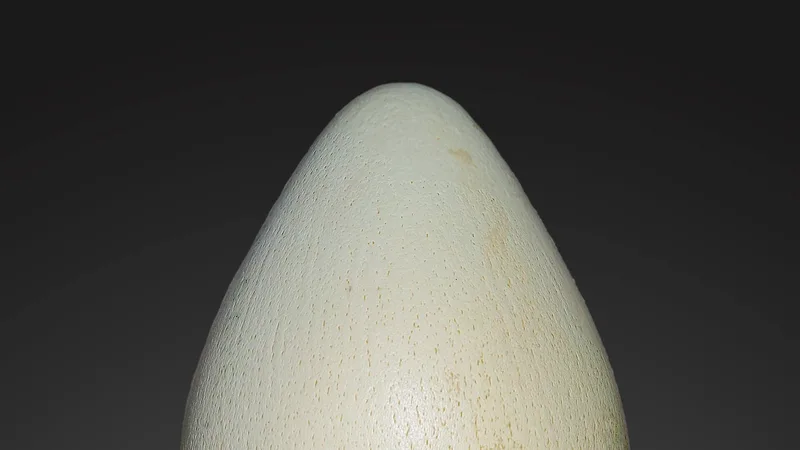
One white egg is laid in a pebble-lined scrape, usually in a rock crevice, between late November and mid-December. Incubation takes 41 to 49 days and the chick is brooded for 8 days, then stays in the nest for another 7 weeks, leaving between late February and mid-May.
A Nose for the Ice
Birds are widely regarded as relying mainly on sight and hearing, yet the snow petrel’s olfactory bulb ratio (the bulb’s greatest diameter against the cerebral hemisphere’s) is 12 times the black-capped chickadee’s, one of the largest measured in birds. Its estimated set of smell-receptor genes is relatively small, though, which the researchers suggest fits a specialist daytime forager whose olfactory system may be highly sensitive to only a limited variety of odours.
Snow petrels forage in the sea ice, traveling hundreds of kilometers from their nests. For one Dronning Maud Land nest site, researchers mapped a mean breeding-season foraging range of about 700 kilometers and a maximum of about 2,600. At sea they eat mainly fish, with some squid, other molluscs and krill, and they also feed on seal placenta and the carcasses of dead seals, whales and penguins.
Built to Last
Adults weigh 268 grams on average, but the species varies greatly in size: the largest birds are over twice as heavy as the smallest. Individuals have lived at least 46 years in the wild.
At Pointe Géologie in Adélie Land, birds first bred at 9.9 years old on average, and annual adult survival was 93.4% across 21 years of data, though it varied. A later study on Pétrels Island, Terre Adélie, found 44% of the year-to-year variation in adult survival from 1981 to 1997 was linked, inversely, to how far winter sea ice extended offshore.
Published Updated
Traits
Intel
& FAQ
Guess
first
How big is a Snow Petrel, really? Slide, lock in, and see what the sources say. Every answer is a figure from this page, quoted from where it came from.
Sources
- 01McClymont et al. (2022). Snow petrel stomach-oil deposits as a new biological archive of Antarctic sea ice. Past Global Changes Magazine.
- 02Steiger et al. (2008). Avian olfactory receptor gene repertoires: evidence for a well-developed sense of smell in birds? Proceedings of the Royal Society B: Biological Sciences.
- 03Snow petrel. Australian Antarctic Program, 2010.
- 04Carboneras, Jutglar & Kirwan (2020). Snow Petrel (Pagodroma nivea). Birds of the World.
- 05Chastel, Weimerskirch & Jouventin (1993). High annual variability in reproductive success and survival of an Antarctic seabird, the snow petrel Pagodroma nivea: A 27-year study. Oecologia.
- 06Barbraud et al. (2000). Effect of sea-ice extent on adult survival of an Antarctic top predator: the snow petrel Pagodroma nivea. Oecologia.
- 07Jouventin & Viot (1985). Morphological and genetic variability of Snow Petrels Pagodroma nivea. Ibis.
- 08Pagodroma nivea. AnAge: The Animal Ageing and Longevity Database, Human Ageing Genomic Resources.
- 09Pagodroma nivea. The IUCN Red List of Threatened Species 2018: e.T22697885A132611127.
What the sources say: 36 claims checked word for word against these sources →