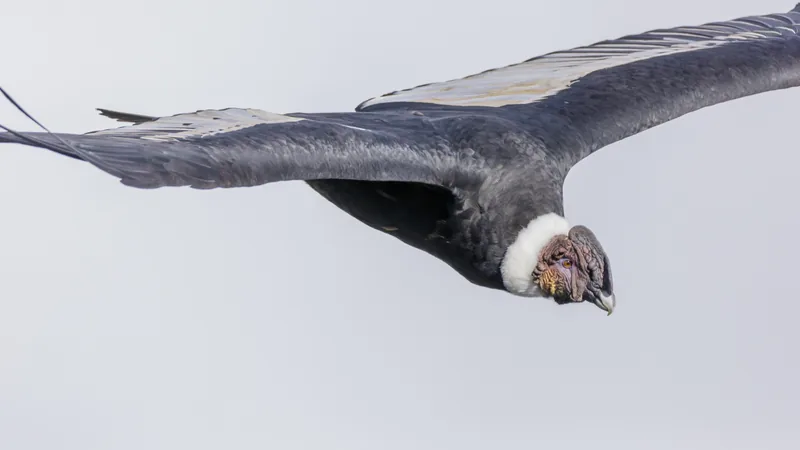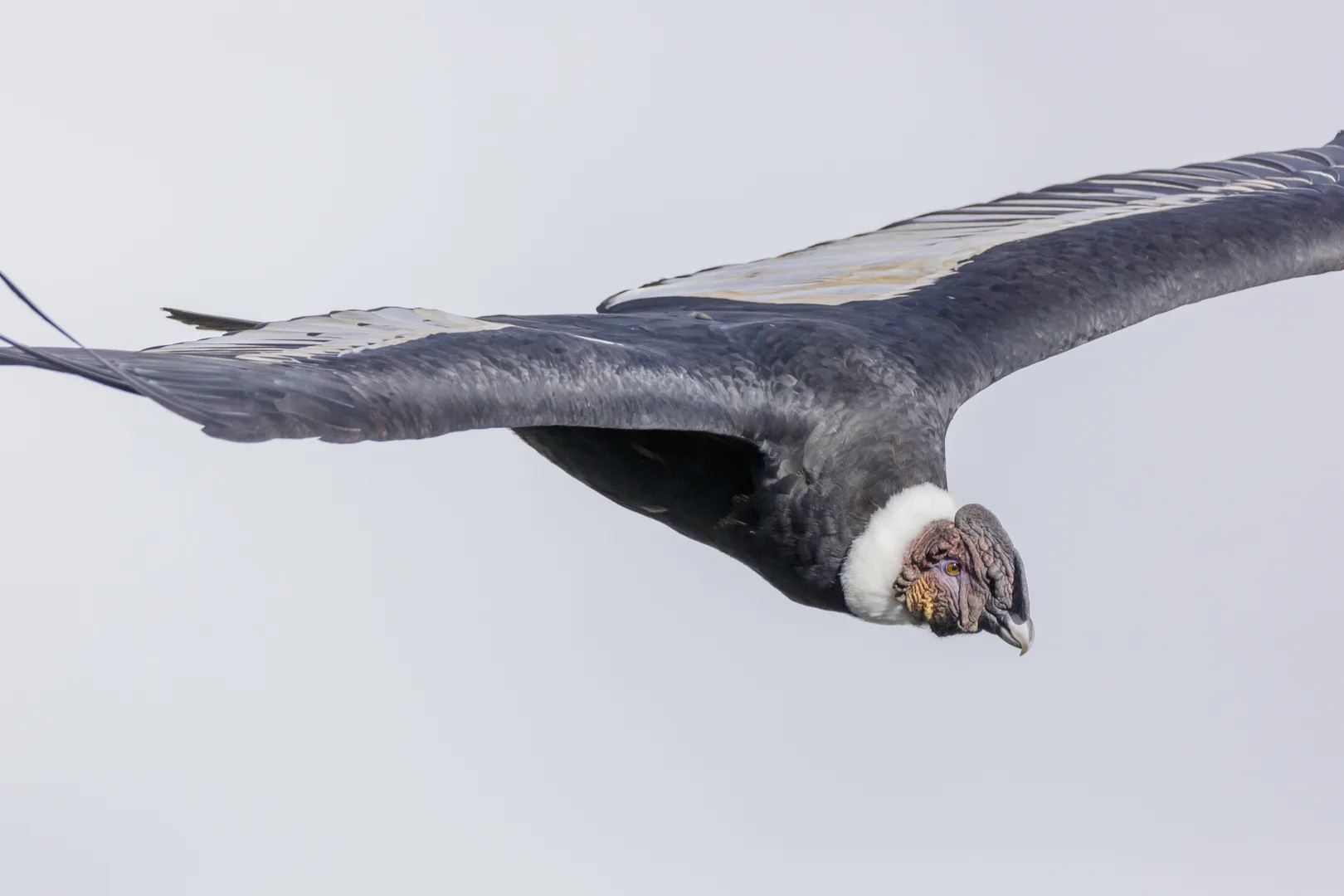
Soaring over Colca Canyon, Peru.
Field
notes
The bird that barely flaps
The Andean condor (Vultur gryphus) is the world’s heaviest soaring bird. Researchers fitted eight young condors in Argentina with flight recorders that logged every wingbeat. Across more than 216 hours in the air, the condors flapped for only 1% of their flight time. One bird flew for more than 5 hours without flapping, covering about 172 km.
More than 75% of the flapping was linked to takeoffs. A condor uses warm air currents, called thermals, to gain altitude and soar. By gliding from thermal to thermal, a condor may need to flap its wings only once every hour.
Flap budget Lighter species appear to flap much more. White storks flapped for 17% and ospreys for 25% of their over-land migratory flights, against 1% for the condors in the study.
Size and years
A male weighs up to 33 pounds (15 kg) and a female up to 24 pounds (11 kg). A condor is up to 4.25 feet (1.3 m) long, and its wingspan reaches up to 10.5 feet (3.2 m) across. The young condors in the tracking study weighed 9.5 to 13.9 kg.
Condors mature at 6 to 8 years old, though limited food may delay it. The San Diego Zoo gives their life span as the late 50s to late 60s.
Youngsters are brown. Around six years old a condor molts (sheds) its brown feathers and grows black plumage with white secondary feathers and white neck ruffles. Males have a comb on top of the head and brown eyes, while females lack the comb and have red eyes. Males keep the comb all their life. That makes the sex of a chick easy to tell as soon as it hatches.
High peaks, featherless heads
Andean condors live in the highest peaks of the Andes. They nest in rocky crags and soar over open grasslands and lowland desert regions. They once lived from the highlands of northern South America to the tip of Tierra del Fuego. Today they are most often seen in Peru, Chile and Argentina, and they soar to heights of 18,000 feet (5,500 m).
Like all vultures, condors are scavengers that eat carrion, meaning dead animals. A featherless head keeps them from getting too messy while buried in a carcass, and the curved beak helps them tear and rip their food. One condor can eat more than 15 pounds (6.8 kg) of meat at one time and may not be able to fly after such a large meal.
Condors have no syrinx (similar to our larynx), so they cannot vocalize. They hiss, click and grunt instead.
A slow family
A female lays a single egg, which the parents take turns incubating for 50 to 60 days. Both parents care for the chick over about a year and a half, though it fledges (is ready to fly) at six months. A pair lays one egg every other year, though a second may follow 4 to 6 weeks later if the first is lost.
The IUCN Red List rates the species Vulnerable. The San Diego Zoo says condors are threatened over most of their range, mostly by people. Poisoned livestock carcasses, set out to ward off mountain lions and foxes, harm condors too, and lead bullets, habitat loss and reduced food sources put them at risk.
Published
Traits
Intel
& FAQ
Guess
first
How big is a Andean Condor, really? Slide, lock in, and see what the sources say. Every answer is a figure from this page, quoted from where it came from.
Sources
- 01Blanco et al. (2013). Need and Seek for Dietary Micronutrients: Endogenous Regulation, External Signalling and Food Sources of Carotenoids in New World Vultures. PLoS ONE.
- 02Vultur gryphus. The IUCN Red List of Threatened Species 2020: e.T22697641A181325230.
- 03Williams et al. (2020). Physical limits of flight performance in the heaviest soaring bird. Proceedings of the National Academy of Sciences.
- 04Andean Condor. San Diego Zoo Wildlife Alliance.
What the sources say: 47 claims checked word for word against these sources →