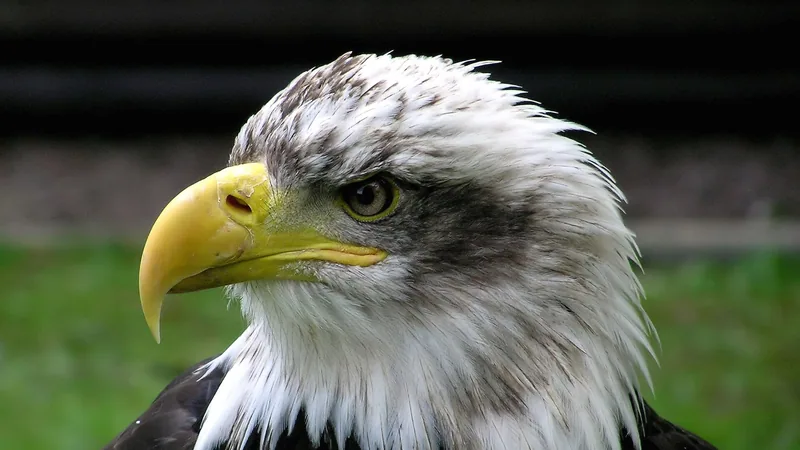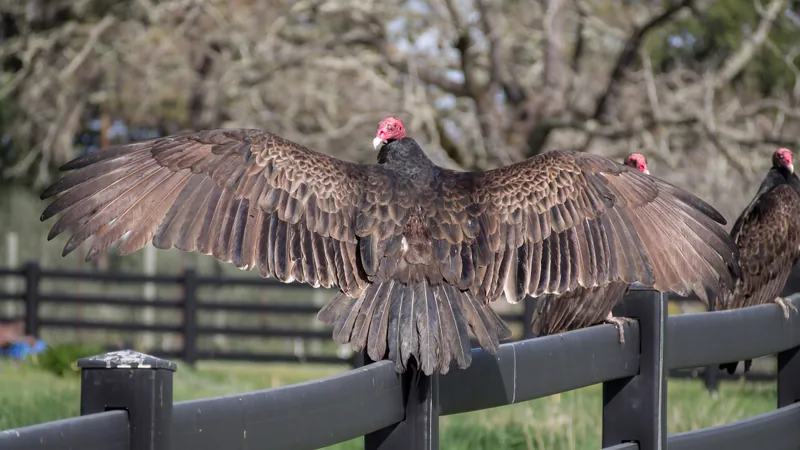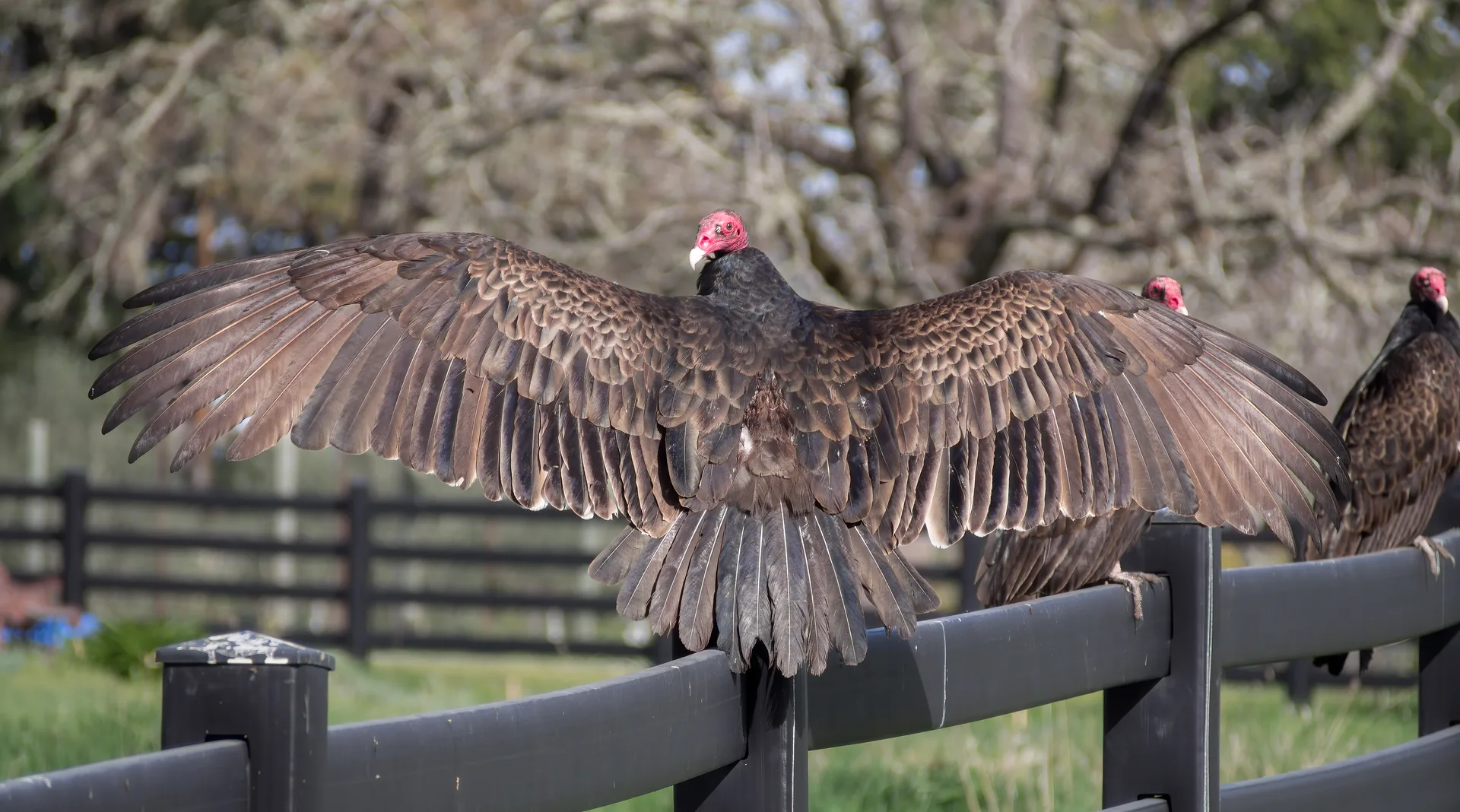
A turkey vulture spreads its wings on a rail in Santa Rosa, California.
Field
notes
The vulture with a nose
Most birds are believed to have a very poor sense of smell. The turkey vulture is an exception. Its highly developed olfactory sense (the sense of smell) lets it find concealed carcasses beneath forest canopies. It also watches the ground and the actions of other scavengers. Black vultures often follow turkey vultures to food and sometimes crowd them off a carcass through sheer numbers.
Rare bird skill Animal Diversity Web counts the turkey vulture among the only bird species worldwide that uses smell extensively.
Built to float
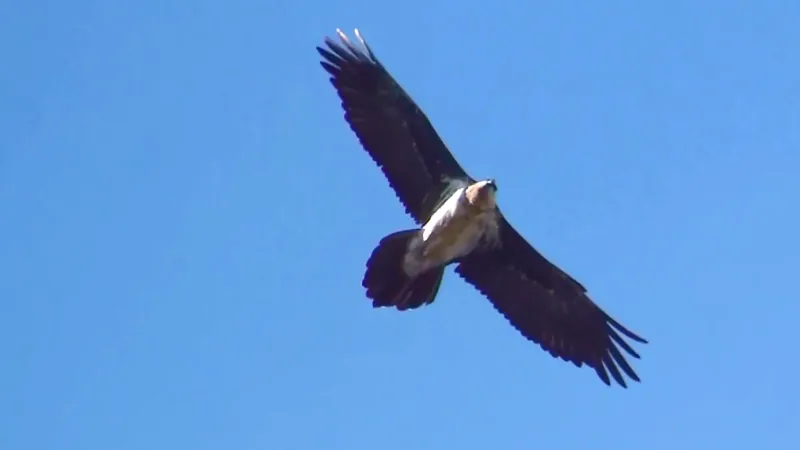
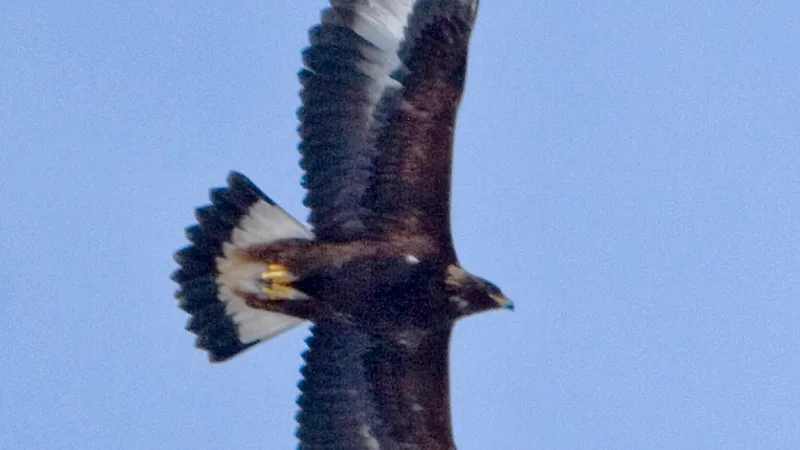
A turkey vulture is 64 to 81 cm long, with a wingspan of 170 to 183 cm. It weighs 0.85 to 2 kg, depending on the subspecies. Its wings carry little weight for their surface area, which makes it more buoyant than other vultures and better at using thermals, columns of rising warm air. A GPS tracking study found that turkey vultures nearly exclusively used thermal lift on autumn migration across eastern North America. One vulture wore a heart-rate logger for 124 hours of flight over 38 days. Its heart rate rose only a little as its daily distance grew, which suggests soaring does not greatly increase the energy cost of flight.
The species breeds from southern Canada to southernmost South America. Birds of the World calls it the most migratory and widely distributed vulture in the Americas.
Dinner, fresh and otherwise
Audubon says the turkey vulture feeds mainly on dead animals and prefers those recently dead. It cannot get through the thick skin of larger animals, so it waits for some decay to open up the body cavity. It occasionally eats decaying plants, live insects or live fish in drying-up ponds.
It has few natural predators, though owls sometimes take young and adults. The bird defends itself by regurgitating semi-digested meat, and the putrid smell deters most attackers. Chicks do the same when approached in the nest, and they hiss as well.
Nests and years
Turkey vultures nest in dark recesses beneath boulders, on cliff ledges, and in caves and hollow trees. A clutch is two eggs, sometimes one, and incubation usually takes 34 to 41 days. Young birds first fly at about 9 to 10 weeks. AnAge lists a maximum longevity of 20.8 years.
The IUCN Red List rates the species Least Concern.
Published
Traits
Intel
& FAQ
Guess
first
How big is a Turkey Vulture, really? Slide, lock in, and see what the sources say. Every answer is a figure from this page, quoted from where it came from.
Sources
- 01Cathartes aura. The IUCN Red List of Threatened Species 2018: e.T22697627A131941613.
- 02Kirk et al. (2024). Turkey Vulture (Cathartes aura). Birds of the World.
- 03Mandel et al. (2008). Movement ecology of migration in turkey vultures. Proceedings of the National Academy of Sciences.
- 04Bohrer et al. (2011). Estimating updraft velocity components over large spatial scales: contrasting migration strategies of golden eagles and turkey vultures. Ecology Letters.
- 05Cathartes aura. Animal Diversity Web, University of Michigan.
- 06Turkey Vulture. Audubon Field Guide.
- 07AnAge entry for Cathartes aura. AnAge: The Animal Ageing and Longevity Database.
What the sources say: 47 claims checked word for word against these sources →