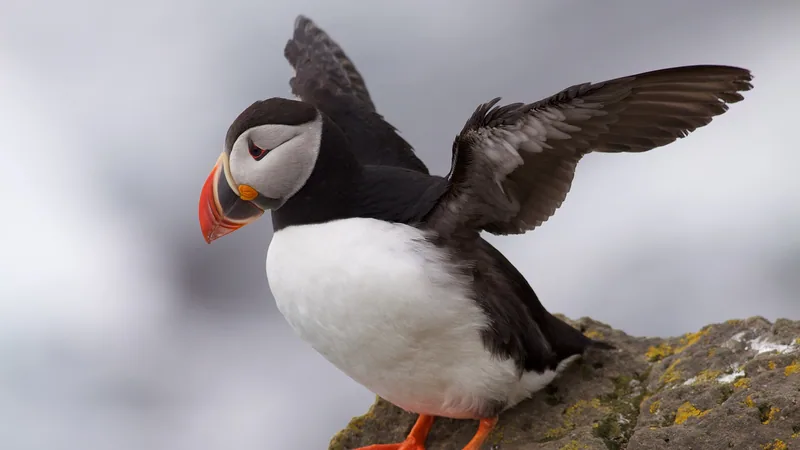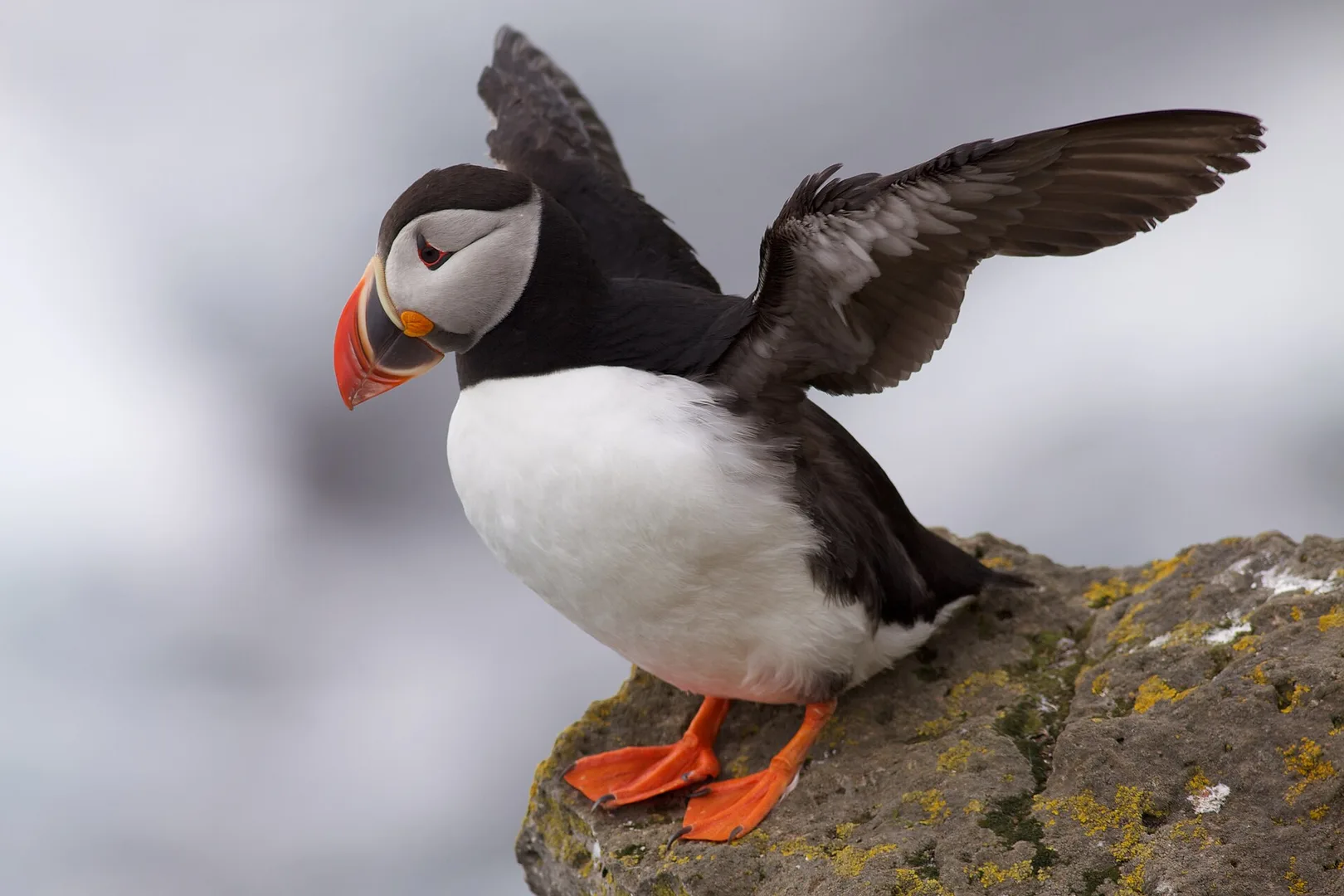
Atlantic puffin (Fratercula arctica) spreading its wings, Iceland
Field
notes
A Beak Full of Fish
The Atlantic puffin (Fratercula arctica) stretches 26 to 29 centimeters long with a wingspan of 47 to 63 centimeters, and adults weighed in Britain average about 390 grams. It usually first breeds at about five years old. In the British Trust for Ornithology’s ringing data, a puffin that reaches breeding age has a typical life expectancy of 18 years, and the oldest ringed puffin was 42 years and 21 days old, a record set in 2019. Jagged marks on its upper bill help it carry more fish when it hunts. Both parents feed the chick, carrying fish in their bills, and a parent may fly back to the nest with a dozen small fish held crosswise in its bill. Backward-pointing spines on its tongue and the roof of its mouth hold the catch in place while it grabs more. Puffins eat small fish about 5 to 15 centimeters long, mainly sandeels, sprat, capelin, herring, hake and cod.
A Bill for the Breeding Season After the breeding season, a puffin sheds the colorful plates on its bill and around its eyes, and its head fades to gray. Its legs, usually bright reddish orange in summer, turn a muted yellow. It is rarely seen like this, because in winter it is usually far out at sea.
Wings Built for Two Jobs
The puffin is a wing-propelled diver: its wings drive it through the air and underwater. Auks have often been studied to see whether flying underwater costs them flying ability in the air. A 2000 study found the puffin’s primary flight muscles are largely aerobic. Its authors suggest both kinds of flight need muscle like that, and that auks are a stable adaptation to both rather than a compromise. Depth recorders on 13 adult puffins in Maine logged 8,097 dives: 86 percent were shallower than 15 meters, and the deepest reached 40.7 meters.
Burrows in Summer, Open Ocean in Winter
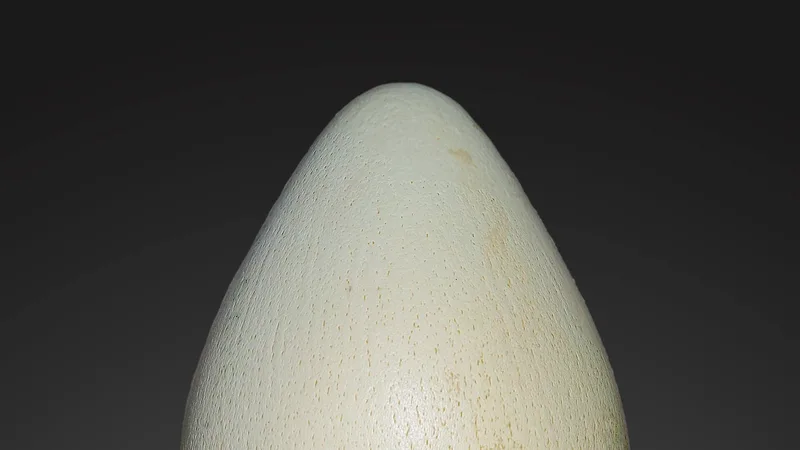
Puffins breed in colonies, in burrows or among rocks on sea islands, and often on grassy slopes above cliffs. Many of the burrows are dug by the puffins themselves, but they will also take over burrows from rabbits or Manx shearwaters. A puffin usually lays a single egg, whitish at first but quickly stained brown with dirt and mud, and incubation typically lasts five to six weeks. Most chicks leave at night, without their parents, and by morning are at sea, far from the colony.
Sociable at its colonies, the puffin often feeds alone or with one other bird in winter, out on the open ocean. Puffins tracked from Skomer, an island in Wales, spread widely outside the breeding season: some went as far as Greenland, and later in the winter some reached the Mediterranean. Each bird was more likely to follow a route similar to its own previous migration than another puffin’s.
The IUCN lists the species as Vulnerable. The UK is home to about 9 percent of Europe’s puffins, and according to the 2023 Seabirds Count it lost 23 percent of them in the previous 20 years. Climate change and industrial-scale overfishing have hit puffins hard. In the southern parts of their range, including the UK, sandeels are a staple food. In 2024 the UK banned industrial sandeel fishing in the English North Sea and all Scottish waters to protect seabirds. The EU challenged the ban, and after a 2025 arbitration ruling the UK government said the closures would stay in place.
Published Updated
Traits
Intel
& FAQ
Guess
first
How big is a Atlantic Puffin, really? Slide, lock in, and see what the sources say. Every answer is a figure from this page, quoted from where it came from.
Sources
- 01Puffin. BTO BirdFacts.
- 02Puffin. The Wildlife Trusts.
- 03Puffin. RSPB.
- 04Fratercula arctica (Atlantic puffin). Animal Diversity Web, University of Michigan.
- 05Kovacs & Meyers (2000). Anatomy and histochemistry of flight muscles in a wing-propelled diving bird, the Atlantic Puffin, Fratercula arctica. Journal of Morphology.
- 06Guilford et al. (2011). A Dispersive Migration in the Atlantic Puffin and Its Implications for Migratory Navigation. PLoS ONE.
- 07BirdLife International (2021). Fratercula arctica. The IUCN Red List of Threatened Species 2021: e.T22694927A166290968.
- 08Barrett (2015). Atlantic Puffin Fratercula arctica chick growth in relation to food load composition. Seabird Journal.
- 09Spencer. Diving Behavior and Identification of Sex of Breeding Atlantic Puffins (Fratercula arctica), and Nest-Site Characteristics of Alcids on Petit Manan Island, Maine. Masters thesis, University of Massachusetts Amherst.
- 10Response to arbitration tribunal final report: UK-Sandeel (The European Union v. the United Kingdom of Great Britain and Northern Ireland). GOV.UK.
- 11Atlantic Puffin Life History. All About Birds, Cornell Lab of Ornithology.
- 12Atlantic Puffin. Hinterland Who's Who.
What the sources say: 67 claims checked word for word against these sources →