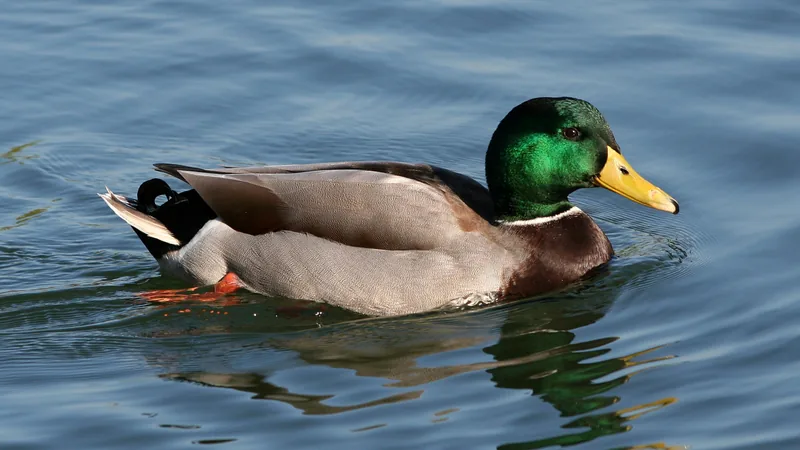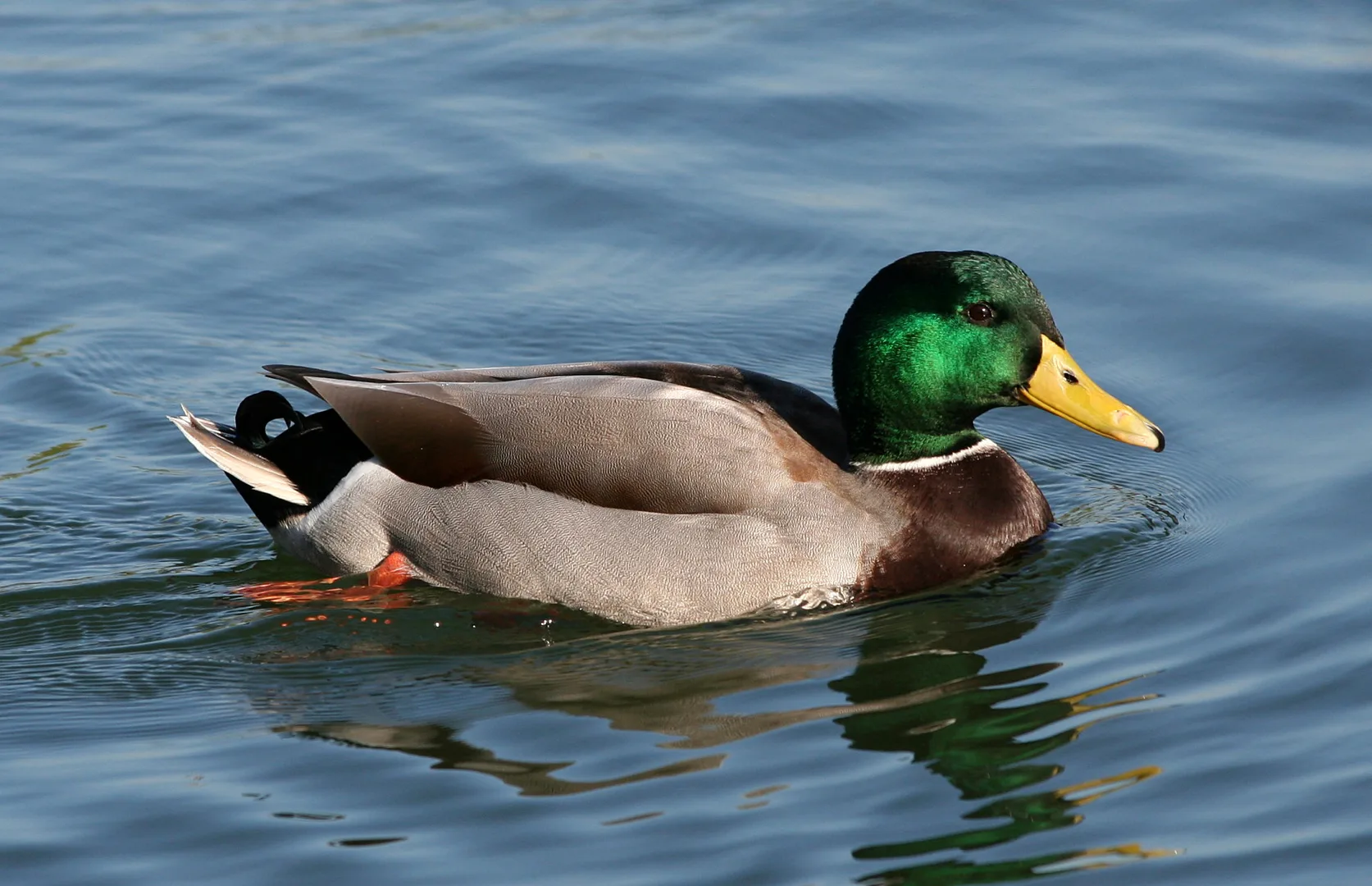
Male Mallard ( Anas platyrhynchos ).
Field
notes
Bigger eggs for a preferred mate
A hen mallard’s eggs can depend on her mate. In a study reported in Nature, individual females laid larger eggs after copulating with preferred males and smaller eggs after copulating with less preferred males. As a result, they produced offspring in better body condition when paired with preferred males.
Courtship is a crowd act. Groups of four to five drakes may swim around a female, arch their necks and whistle. Then they dip their bills below the water and jerk them up to their breasts, spurting water toward the preferred female. This water-flick may take only a fraction of a second.
Where farm ducks come from Nearly all domestic ducks, such as the Pekin duck, descend from wild Eurasian mallards, domesticated in China around 500 B.C.
Size and lifespan
A mallard is a medium to large dabbling duck, 50 to 65 cm long with a wingspan of 82 to 95 cm. Males and hens are similar in size, and both weigh 0.9 to 1.4 kg. A mallard usually lives 5 to 10 years in the wild, and the oldest known was a male that lived to 27.
Dabbling for dinner
Mallards forage in water by dabbling, by submerging the head and neck, or by up-ending. They rarely dive. On land they graze and pluck seeds. The majority of the diet is plant material, including seeds, stems and roots. They also eat insects, mollusks, tadpoles, frogs, earthworms and small fish.
Like other dabbling ducks of the genus Anas, a mallard can spring into the air without running across the water first. It is the most numerous Holarctic waterfowl species, found across the whole Northern Hemisphere. In North America, most mallards are migratory, breeding in the northern United States and Canada and wintering in the southern United States and Mexico.
The familiar quack comes from the female. Her decrescendo call is given when she wants to bring other ducks, such as her ducklings, to her. The hen leads the young within a day after hatching.
Ducks in the city
Audubon notes that in many places the mallard has managed to domesticate itself, relying on handouts in city parks. There is a catch. Game-farm mallards are released into the wild on purpose, and the spread of their genes into wild populations has been hypothesized to at least partly explain recent mallard declines in eastern North America.
Published
Traits
Intel
& FAQ
Guess
first
How big is a Mallard, really? Slide, lock in, and see what the sources say. Every answer is a figure from this page, quoted from where it came from.
Sources
- 01Mallard (Anas platyrhynchos). U.S. Fish and Wildlife Service.
- 02Mallard. National Audubon Society, Guide to North American Birds.
- 03Mallard. National Wildlife Federation, Wildlife Guide.
- 04Rogers (2001). Anas platyrhynchos (mallard). Animal Diversity Web, University of Michigan.
- 05Cunningham & Russell (2000). Egg investment is influenced by male attractiveness in the mallard. Nature.
- 06Schummer et al. (2023). Population genetics and geographic origins of mallards harvested in northwestern Ohio. PLOS ONE.
- 07Kraus et al. (2011). Evolution and connectivity in the world-wide migration system of the mallard: Inferences from mitochondrial DNA. BMC Genetics.
- 08Duck Displays. Stanford Birds.
- 09Anas platyrhynchos. The IUCN Red List of Threatened Species 2025: e.T22680186A281835571.
What the sources say: 45 claims checked word for word against these sources →