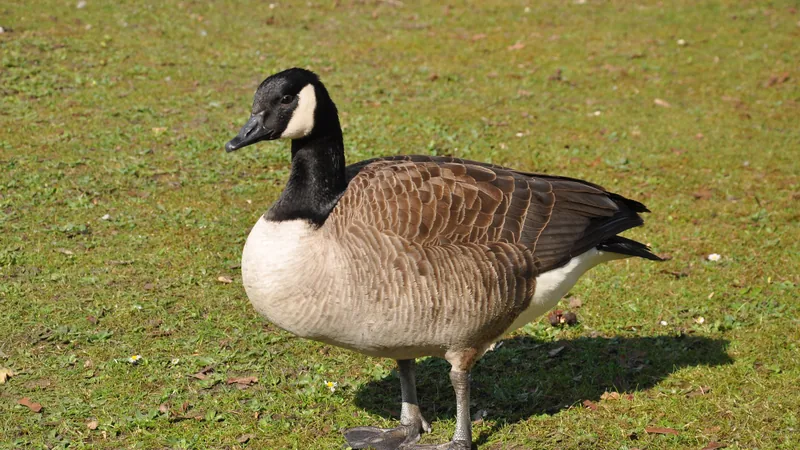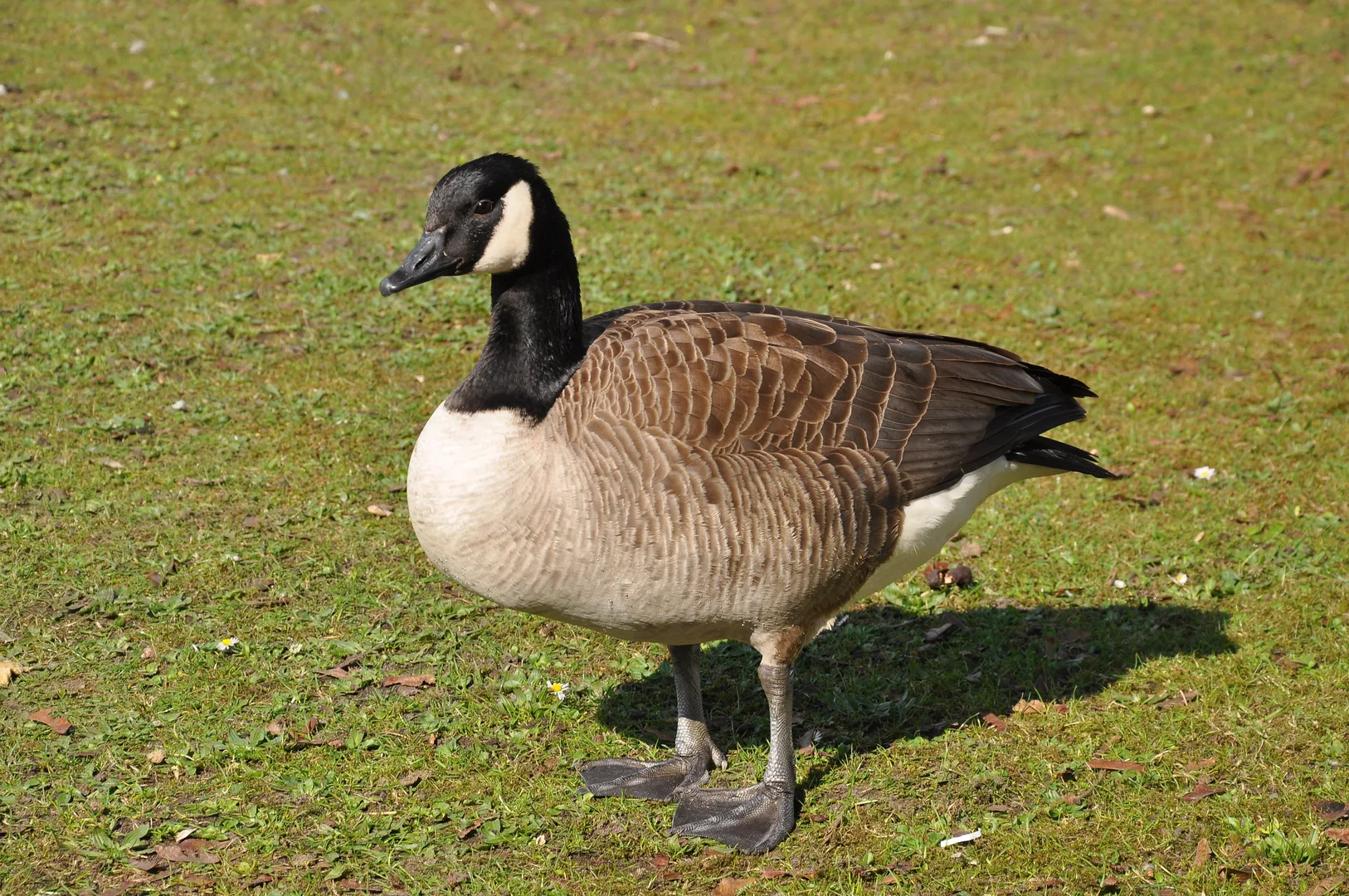
Canada Goose ( Branta canadensis ) near the pond Lac de la Station in Vésinet , Yvelines department, France .
Field
notes
A flightless giant cousin
The Canada goose has relatives on Hawaii. DNA from fossils revealed a radiation of Hawaiian geese, which means a burst of new species from one ancestor. Only one is still alive: the Hawaiian goose, or nene. A 2002 study placed the whole group inside the Canada goose species as then defined, related most closely to its large-bodied lineage.
One fossil species on the island of Hawaii was closely related to the nene but over four times larger, flightless and heavy-bodied. The study suggests it evolved in less than 500,000 years.
One species became two Local forms of Canada goose vary greatly in size, and the smallest ones are now regarded as a separate species, the Cackling Goose.
Size and lifespan
An adult Canada goose is 76 cm to 1.2 m long, with a wingspan of 1.3 to 1.7 m. Males are slightly larger. Weight runs from 2.9 to 8.9 kg, and populations vary greatly in size and body color. AnAge, a database of animal lifespans, lists a maximum longevity of 42 years.
Grazer with a honk
This is the most widely distributed goose in North America. It breeds from eastern Labrador to western Alaska, on tundra, marshes and lakeshores, and Audubon describes its call as rich musical honking. In recent years it has also become a resident of city parks and suburban ponds.
The diet is almost entirely plants. A Canada goose grazes mostly while walking on land, eating stems and shoots of grasses and sedges, plus seeds, berries and many cultivated grains. It also feeds in water, submerging its head and neck, and sometimes up-ends. Occasionally it eats some insects, mollusks, crustaceans or small fish.
Pairs for life
Canada geese may mate for life. Pair bonds usually form during the second year, and the young stay with their parents through their first year. The male defends the territory with displays that include lowering his head almost to the ground, bill slightly raised and open, and hissing.
The female builds the nest and incubates the eggs for 25 to 28 days while the male stands guard nearby. Parents lead the young away from the nest 1 to 2 days after hatching. The goslings feed themselves, and their first flight usually comes at 7 to 9 weeks.
Published Updated
Traits
Intel
& FAQ
Guess
first
How big is a Canada Goose, really? Slide, lock in, and see what the sources say. Every answer is a figure from this page, quoted from where it came from.
Sources
- 01Canada Goose. NatureCounts, The State of Canada's Birds.
- 02Canada Goose. National Audubon Society, Guide to North American Birds.
- 03Mowbray et al. (2020). Canada Goose (Branta canadensis). Birds of the World.
- 04AnAge entry for Branta canadensis. AnAge: The Animal Ageing and Longevity Database, Build 15, Human Ageing Genomic Resources.
- 05Paxinos et al. (2002). mtDNA from fossils reveals a radiation of Hawaiian geese recently derived from the Canada goose ( Branta canadensis ). Proceedings of the National Academy of Sciences.
- 06Branta canadensis. The IUCN Red List of Threatened Species 2021: e.T22679935A166195258.
What the sources say: 49 claims checked word for word against these sources →