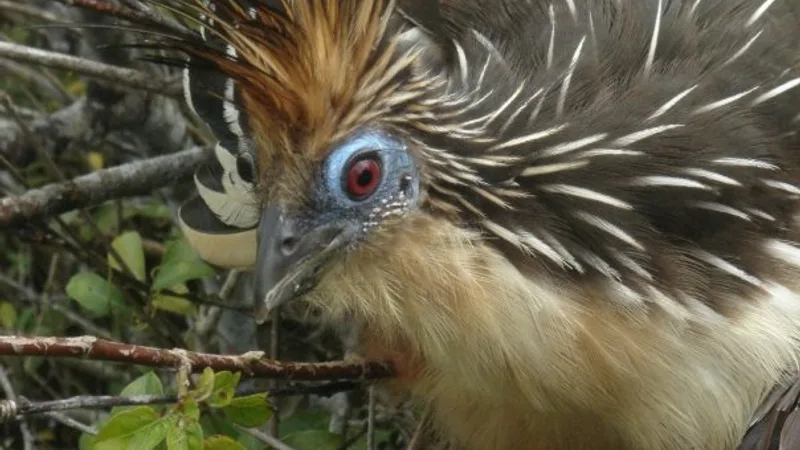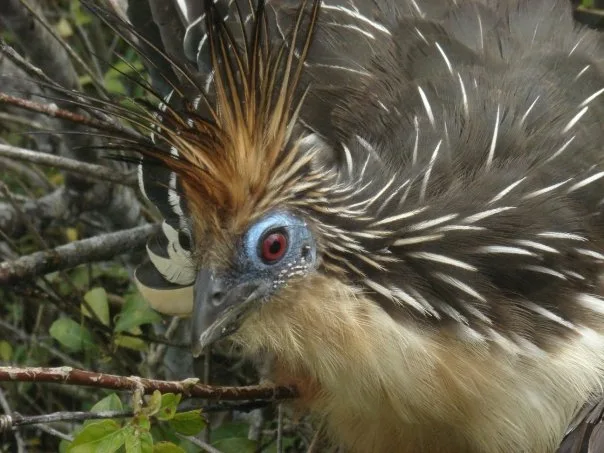
A hoatzin close up at Hato El Cedral, Apure, Venezuela.
Field
notes
A Crop That Works Like a Cow’s Stomach
At 62 to 70 centimetres from bill to tail and 700 to 900 grams, the hoatzin is the only bird known to digest by foregut fermentation. It digests leaves mainly in an enlarged crop and lower oesophagus, where microbes ferment them. Since the hoatzin cannot chew, the walls inside have folds and ridges lined with tough, horny tissue that break leaves into pieces small enough for its resident bacteria to digest. A 1989 study suggested the system may pay off through more efficient digestion, nutrients made by the microbes, and the detoxifying of plant compounds. The same study called hoatzins one of the smallest warm-blooded animals with this form of digestion.
It is known as “a flying cow” because its crop digests leaves with the help of bacteria in a process akin to the fermentation used by ruminant mammals such as cows, a system that evolved independently in birds and mammals.
Built Around Its Stomach
That foregut is enormous, accounting for up to a quarter of the bird’s weight. To make room for it, the hoatzin’s breastbone is much reduced, limiting it to weak flapping and gliding over short distances. It spends much of the hottest part of the day resting in trees while its food digests. It lives throughout the Amazon and Orinoco basins, in vegetation along and overhanging rivers, lakes, swamps and mangroves. Its digestive system also earned it the nicknames “stink bird” and “stinking pheasant,” after its strong, musky smell of fresh cow dung.
Chicks That Drop and Swim
Hoatzins are highly social, often gathering in flocks of up to 100 in the dry season. They breed in the wet season, cooperatively: a monogamous pair and up to six helpers, usually males and mostly from earlier broods, defend a small territory next to water. The nest is a flat platform of sticks overhanging water, and the whole group incubates the two to four eggs for around a month. The chicks carry claws on two digits of each wing, the alula and the major digit. Their predators include monkeys, hawks and snakes. When one threatens, a chick drops out of the nest into the water, swims, then climbs back into the vegetation using its wing claws. The claws shrink as the chick grows and are lost in the adult. On their low-nutrient diet the chicks grow slowly, and they can’t fly until they are around 60 days old.
A Family Tree Still Unresolved
The hoatzin was described in 1776, and its classification has been debated ever since. Over the years it has been thought to be related to game birds, cuckoos, turacos, and more recently the group containing oilbirds and potoos, but as a 2025 species account put it, “the Hoatzin has defied easy classification, and its exact relationships with other birds is still not fully resolved.” A 2007 study of bird anatomy noted that “recent attempts to resolve the uncertainty of position of this monotypic lineage by molecular means have proven largely unsuccessful.” A 2024 genome-based tree places the “enigmatic hoatzin” in a lineage of aquatic groups that branch off one after another next to the core waterbirds, such as penguins, albatrosses and pelicans.
Published Updated
Traits
Intel
& FAQ
Guess
first
How big is a Hoatzin (Stinkbird), really? Slide, lock in, and see what the sources say. Every answer is a figure from this page, quoted from where it came from.
Sources
- 01Hoatzin. World Land Trust.
- 02Opisthocomus hoazin (hoatzin). Animal Diversity Web, University of Michigan.
- 03Opisthocomus hoazin. The IUCN Red List of Threatened Species 2024: e.T22684428A264086808.
- 04García-Amado & Billerman (2025). Hoatzin (Opisthocomus hoazin). Birds of the World, Cornell Lab of Ornithology.
- 05Grajal et al. (1989). Foregut Fermentation in the Hoatzin, a Neotropical Leaf-Eating Bird. Science.
- 06Livezey & Zusi (2007). Higher-order phylogeny of modern birds (Theropoda, Aves: Neornithes) based on comparative anatomy. II. Analysis and discussion. Zoological Journal of the Linnean Society.
- 07Wu et al. (2024). Genomes, fossils, and the concurrent rise of modern birds and flowering plants in the Late Cretaceous. Proceedings of the National Academy of Sciences.
- 08Wright, Northwood & Obispo (2009). Rumen-like methanogens identified from the crop of the folivorous South American bird, the hoatzin (Opisthocomus hoazin). The ISME Journal.
- 09Godoy-Vitorino et al. (2011). Comparative analyses of foregut and hindgut bacterial communities in hoatzins and cows. The ISME Journal.
What the sources say: 41 claims checked word for word against these sources →