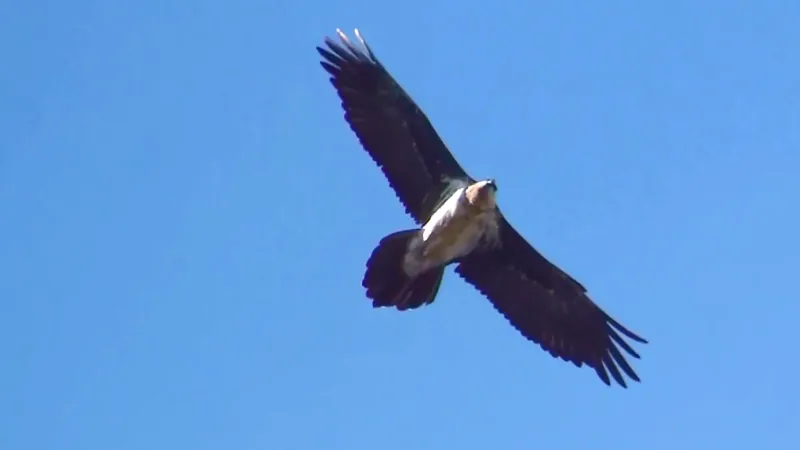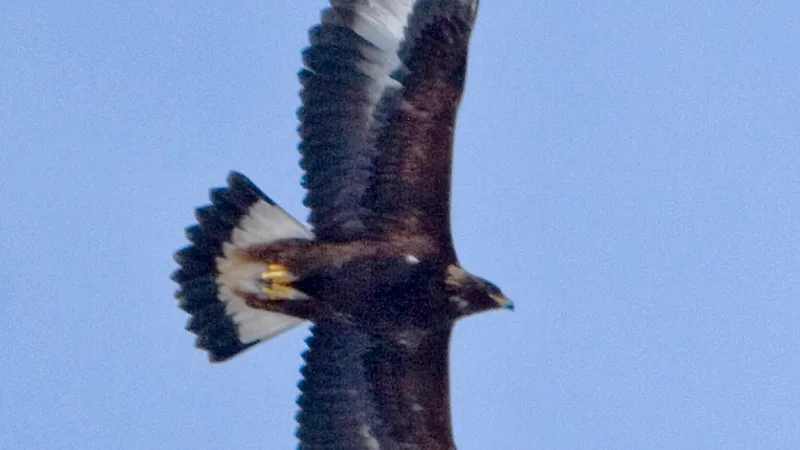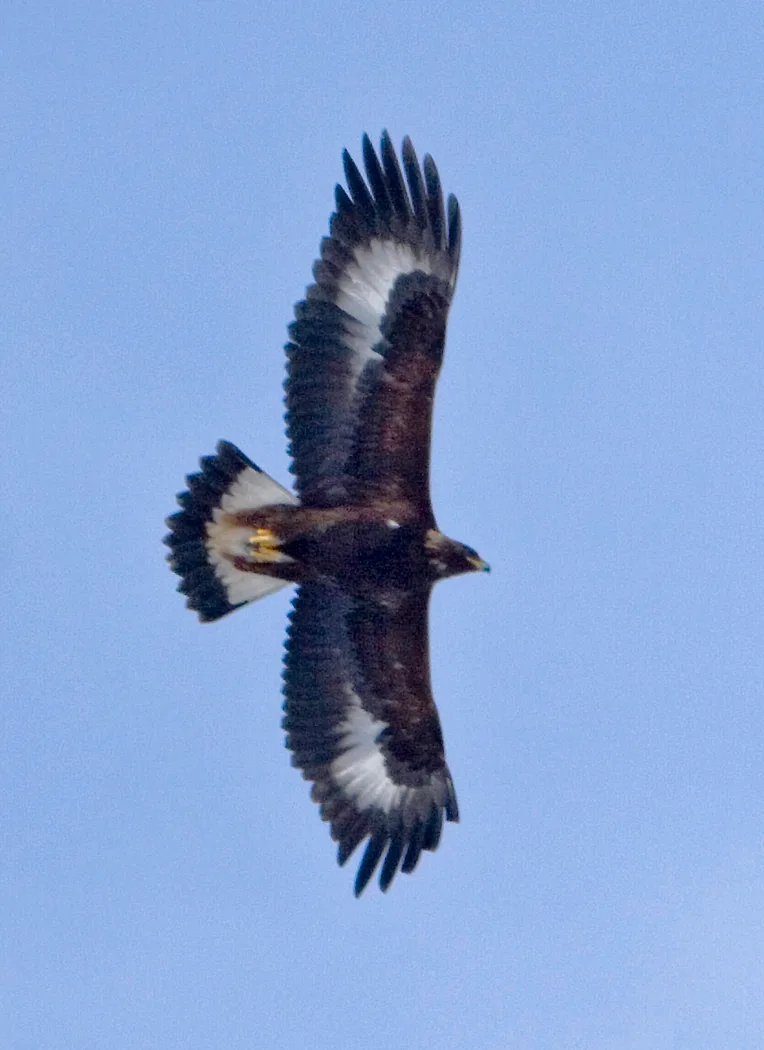
Aquila chrysaetos in flight, Žďárské vrchy, CZ
Field
notes
A Fast Dive and a Hunting Partner
The Golden Eagle (Aquila chrysaetos) stands 75 to 90 centimeters tall (2.5 to 3 feet), with a wingspan that stretches 1.9 to 2.3 meters (6.2 to 7.4 feet) tip to tip. San Diego Zoo Wildlife Alliance gives females 3.6 to 6.6 kilograms and males 2.8 to 4.5 kilograms. A wild golden eagle can live up to 38 years, and up to 50 in expert care. It can hit up to 120 miles per hour (193 km/h) in a dive, in play or after prey. Golden eagles often hunt in pairs: one eagle drives the prey toward its waiting partner. The talons, the claws on the feet, kill and carry the prey, and the beak is only for eating.
A Hunter Across the Northern World
This is a Holarctic species, spread across the northern continents. Animal Diversity Web lists it throughout Eurasia, in northern Africa, and in the western half of North America from Alaska down to central Mexico, with small numbers in eastern Canada and scattered pairs in the eastern United States. It lives in open and semi-open country from sea level up to 3,600 meters, including tundra, shrubland, grassland, and coniferous forest, and most golden eagles are found in mountainous areas. Rabbits, hares, ground squirrels, and marmots are the primary diet, rounded out with birds and reptiles, and occasionally a coyote or badger. San Diego Zoo adds that it sometimes takes deer, and it may eat carrion when live prey is scarce.
Riding Ridge Winds on Migration
The migrations of soaring birds are shaped by weather that produces two kinds of uplift: thermal lift from rising warm air, and orographic lift from wind forced upward by the landscape. A GPS-tracking study followed golden eagles and turkey vultures during autumn migration across eastern North America to compare how each species used them.
A different kind of lift Turkey vultures nearly exclusively used thermal lift, while golden eagles primarily used orographic lift, the wind pushed upward as it hits a mountain ridge.
Nests, Siblings and Lead
A golden eagle pair mates for life and builds several nests within its territory over the years, adding material every year so each one gets bigger and bigger. The largest nest on record, according to Animal Diversity Web, measured 6.1 meters tall and 2.59 meters wide. The female usually lays two eggs, three to four days apart, and incubation lasts 41 to 45 days. The chicks hatch several days apart, and the oldest often attacks its younger sibling and sometimes kills it. In the western United States a pair’s breeding-season home range covers 20 to 33 square kilometers, and the pair defends its boundaries with flight displays. Golden eagles have few recorded predators: wolverines and grizzly bears are the only recorded predators of their nestlings. A serious threat is lead from hunting ammunition. A tracking study found that even sublethal lead levels in scavenging golden eagles’ blood can likely harm how high they fly and how fast they move, and lead levels in the livers of dead eagles suggested that such exposure raises the risk of dying.
Published Updated
Traits
Intel
& FAQ
Guess
first
How big is a Golden Eagle, really? Slide, lock in, and see what the sources say. Every answer is a figure from this page, quoted from where it came from.
Sources
- 01Aquila chrysaetos (golden eagle). Animal Diversity Web, University of Michigan.
- 02Golden Eagle. San Diego Zoo Wildlife Alliance.
- 03Westrip et al. (2022). Aquila chrysaetos. The IUCN Red List of Threatened Species 2022: e.T22696060A210501592.
- 04Bohrer et al. (2011). Estimating updraft velocity components over large spatial scales: contrasting migration strategies of golden eagles and turkey vultures. Ecology Letters.
- 05Ecke et al. (2017). Sublethal Lead Exposure Alters Movement Behavior in Free-Ranging Golden Eagles. Environmental Science & Technology.
What the sources say: 35 claims checked word for word against these sources →