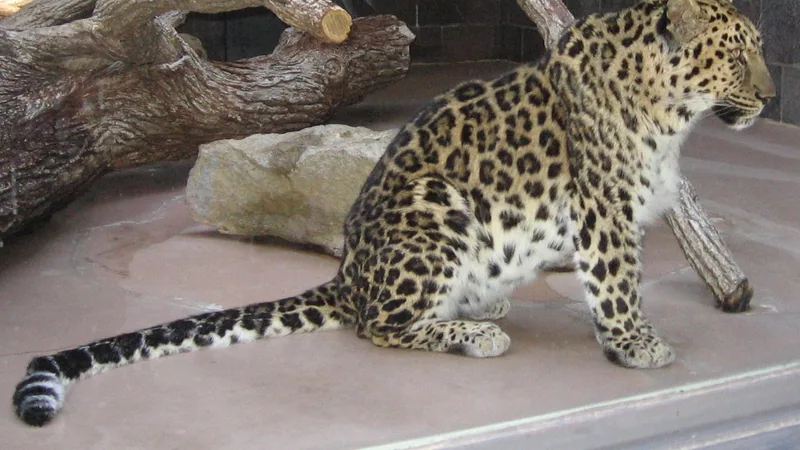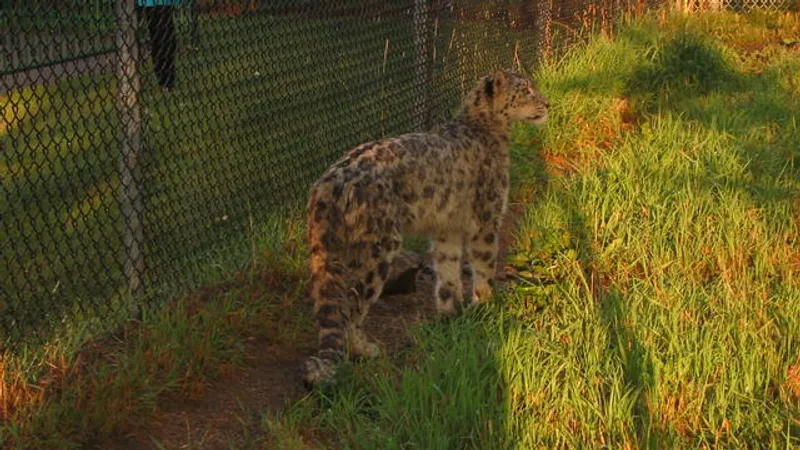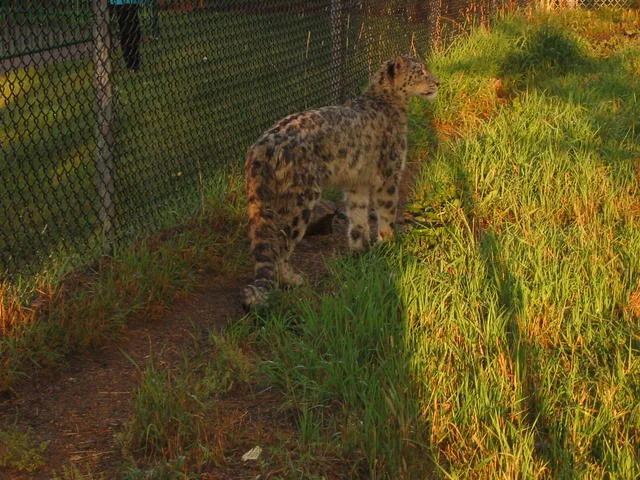
Snow leopard at Karlsruhe Zoo, Germany
Field
notes
Built for a Vertical World
A snow leopard’s body is adapted for life high in the mountains. Its oversized, furred paws work like snowshoes, keeping it from sinking into the snow and giving it traction across it, while short, strong front legs and longer hind legs give it the spring to launch itself up to 30 feet (10 metres) in one leap. Its nasal cavity is enlarged, and it warms the air on its way to the lungs, while short, rounded ears cut down on heat loss.
Then there is the tail. At up to a metre long, it can make up 75 to 90 percent of the snow leopard’s total body length. It is thought to help the cat balance on steep slopes, and it doubles as a scarf: wrapped around the body, it holds in warmth while the cat curls up to rest.
Built for high altitude The IUCN’s cat specialists list three adaptations to life at high elevation: an enlarged nasal cavity, shortened forelimbs and well-developed chest muscles.
Stalk, Then Ambush
Snow leopards are solitary and mainly active at dawn and dusk. They hunt by stalking prey from above, using rocky terrain and vegetation to stay hidden, and then ambush it, chasing it down steep slopes. They primarily prey on wild sheep and goats, including blue sheep, ibex, markhor, argali and musk deer, and also take marmots, pikas and hares. They frequently take domestic livestock too. A snow leopard can kill an animal up to three times its own weight, and may stay with a kill for up to a week if undisturbed.
It does not roar. Its vocal folds lack the fibro-elastic tissue other big cats have for a deep roar, and it hisses, growls, moans and yowls instead, along with a friendly chuffing sound called a prusten, and can even purr.
A Ghost Getting Harder to Find
Snow leopards range across the high mountains of 12 Central Asian countries, from the Himalaya to the Altai, typically between 3,000 and 5,000 metres and occasionally above 5,500 metres in the Himalaya. Their grey, rosette-spotted fur gives them excellent camouflage in the mountains, and they blend in so well that they are almost impossible to locate and study in the wild. GPS collars fitted to snow leopards in Mongolia’s South Gobi showed home ranges from 100 to over 1,000 square kilometres.
The IUCN lists the species as Vulnerable. The most recent estimate puts the global population at 7,446 to 7,996 snow leopards, with 2,710 to 3,386 of those being mature adults. Threats generally include conflict with livestock herders, habitat degradation, prey declines, retaliatory killings, and poaching for hides, bones and other body parts.
Published Updated
Traits
Intel
& FAQ
Sources
- 01Snow Leopard (Panthera uncia). IUCN/SSC Cat Specialist Group.
- 02Uncia uncia (snow leopard). Animal Diversity Web, University of Michigan.
- 03Physical Features. Snow Leopard Trust.
- 04Snow Leopard. San Diego Zoo Wildlife Alliance.
What the sources say: 42 claims checked word for word against these sources →