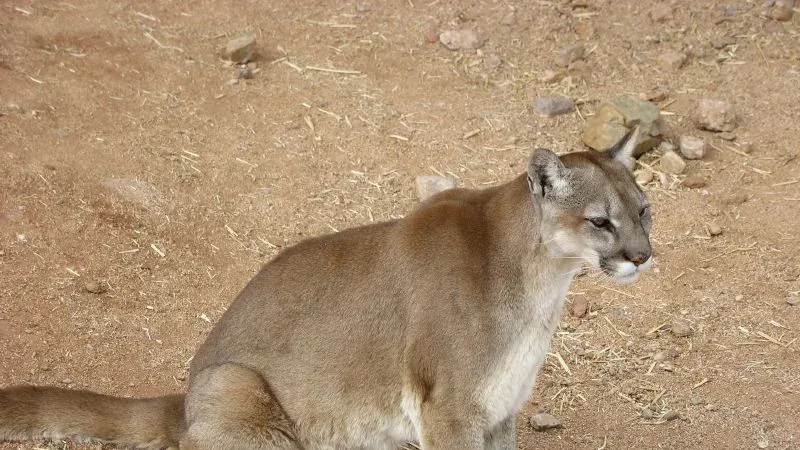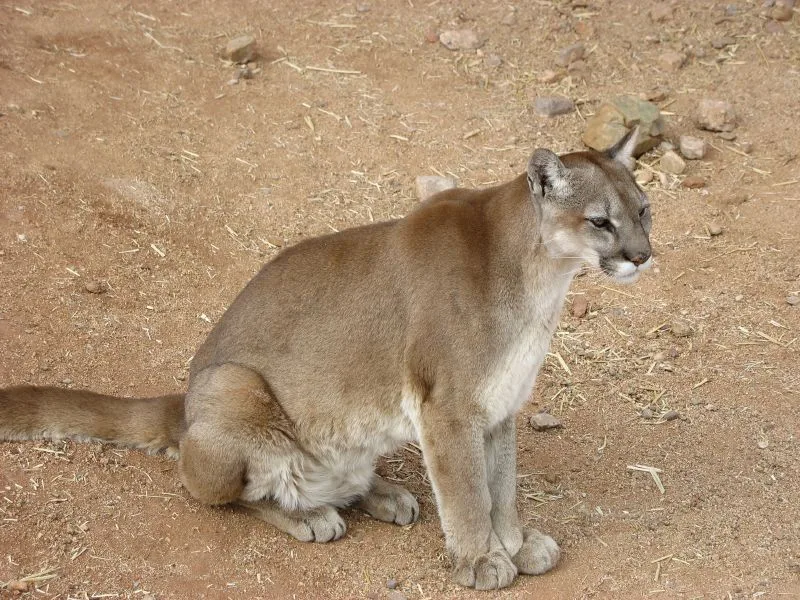
Cougar sitting
Field
notes
The Ghost Cat of the Western Wilderness
Roaming silently through rugged mountain canyons from the Canadian Yukon all the way to the Strait of Magellan in Chile, the Cougar (Puma concolor) holds the broadest geographic range of any native land mammal in the Western Hemisphere. Also known as the mountain lion, puma, or panther, this solitary ambush predator moves through wilderness landscapes like a ghost.
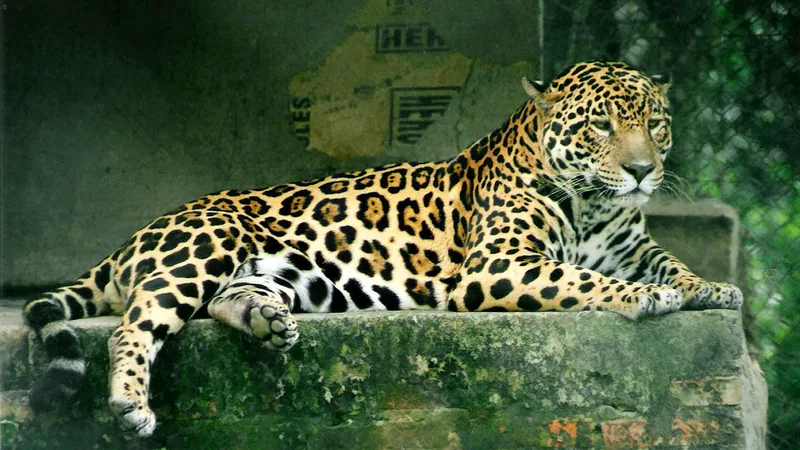
Males weigh 36 to 120 kilograms (about 80 to 265 pounds), and in Washington adult males average about 140 pounds and stand about 30 inches at the shoulder. The cougar belongs to the subfamily Felinae, while the lion, tiger and jaguar belong to Pantherinae. It cannot roar like a lion or tiger; instead, it growls, hisses and purrs like smaller cats, and lets out blood-curdling screams.
Spring-Loaded Leaping
The cougar relies on short, explosive bursts of speed to ambush its prey, and its long hind legs make it an agile, impressive jumper.
A cougar can leap as high as 18 feet (5.5 meters) straight up and cover 40 feet (about 12 meters) horizontally in one bound, according to the National Park Service.
Thirty Feet Out Cougars stalk quietly to within 30 feet of their prey, then leap onto its back with a suffocating neck bite. The impact can be enough to break the prey’s neck; if it isn’t, the cougar delivers the killing bite.
Master of the Camouflaged Stash
After bringing down a deer or elk, a cougar usually drags it to a secluded spot under cover to feed. It returns to feed several times: a large male in Washington’s Cascade Mountains eats up to 20 pounds at a time and buries the rest for later.
It often covers the remains with snow, grass, leaves, sticks or soil. A cougar may stay near this camouflaged meat locker for six to eight days, guarding it against scavengers and feeding on it.
Published Updated
Traits
Intel
& FAQ
Sources
- 01Puma concolor (cougar). Animal Diversity Web, University of Michigan.
- 02Mountain Lion. National Wildlife Federation, Wildlife Guide.
- 03Mountain Lion. National Park Service, Rocky Mountain National Park.
- 04Cougar (Puma concolor). Washington Department of Fish & Wildlife.
- 05Weissengruber et al. (2002). Hyoid apparatus and pharynx in the lion (Panthera leo), jaguar (Panthera onca), tiger (Panthera tigris), cheetah (Acinonyx jubatus) and domestic cat (Felis silvestris f. catus). Journal of Anatomy.
- 06Puma concolor - Puma. Mammal Diversity Database, American Society of Mammalogists.