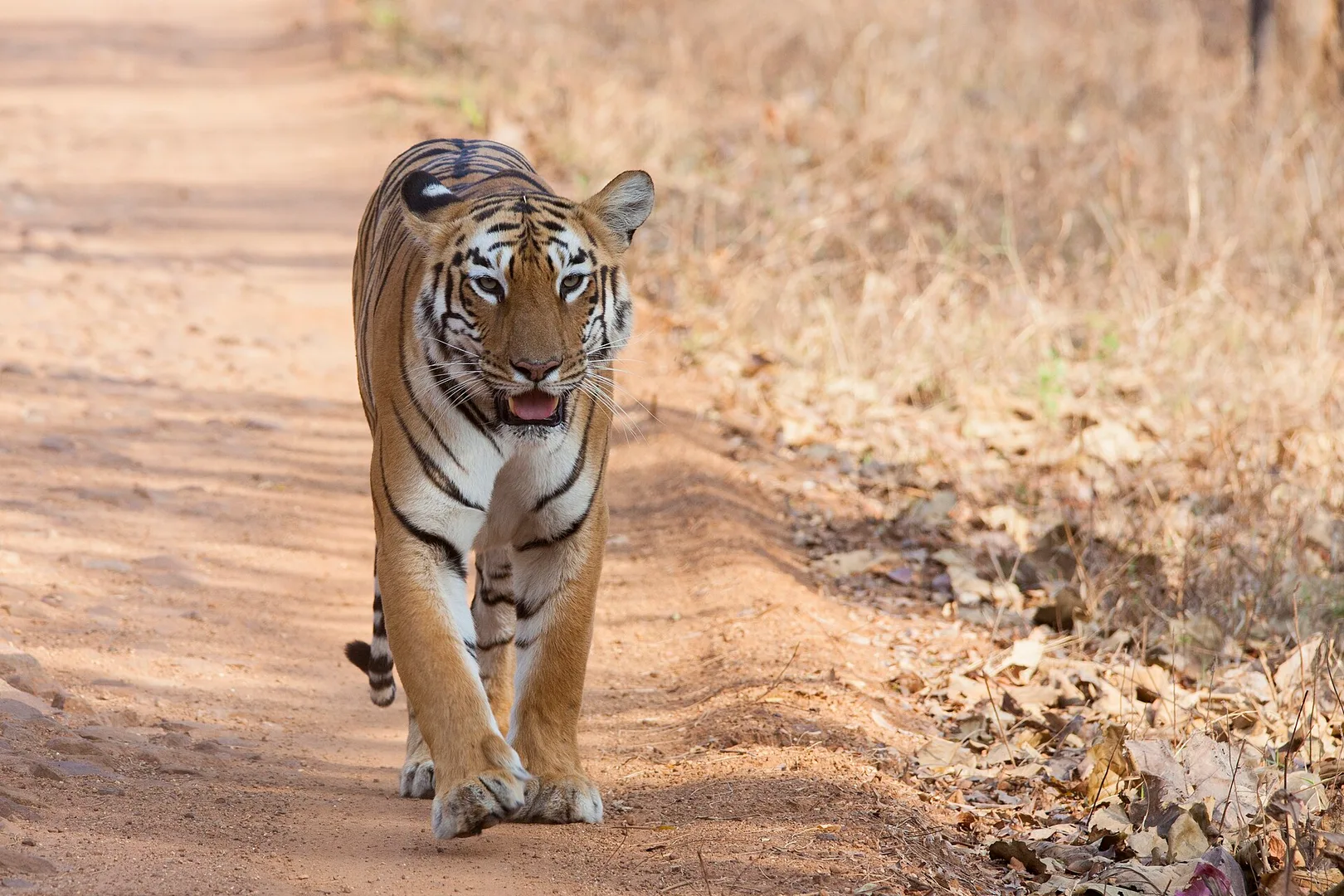
Maya of Tadoba walks on the road ..
Field
notes
Ten-Centimeter Fangs and a Two-Bite Playbook
A Bengal tiger’s canines run 7.5 to 10 centimeters long, the longest of any living big cat. It has two ways to use them, and the size of the meal decides which. Prey weighing less than half as much as the tiger gets a bite to the back of the neck: the canines slide between two neck vertebrae, force them apart and break the spinal cord. Bigger prey gets a bite to the throat that crushes its windpipe until it suffocates. The throat bite is the safer move, because it limits the blows the tiger takes while it makes the kill. Even with that toolkit, only one attack in ten or twenty ends in a meal.
180 to 258 Kilograms of Cat
An adult male measures 270 to 310 centimeters from nose to tail tip and weighs 180 to 258 kilograms. Females are smaller: 240 to 265 centimeters and 100 to 160 kilograms. Tigers are among the largest cats in the world, but the Bengal is not the biggest tiger. That title goes to the Amur tiger, whose males reach up to 300 kilograms. A wild Bengal tiger typically lives 8 to 10 years. In a zoo, that stretches to 16 to 18.
No two tigers share a stripe pattern Like a human fingerprint, every tiger’s markings are its own, so researchers studying wild tigers can tell individuals apart by their stripes.
A Roar Shaped by Vocal Cord Geometry
Most species have triangular vocal folds. A tiger’s, like a lion’s, are flat and square, and fat inside each fold helps give them that shape. Square folds respond more easily to the air rushing past them, so a tiger gets a louder roar out of less lung pressure: up to about 114 decibels from a few feet away, around 25 times as loud as a gas lawn mower. Tigers roar to challenge rivals at long range, defend a meal or attract a mate. Their other calls include grunts, hisses and chuffs, a friendly greeting usually shared between a mother and her cubs.
Life in the Tidal Mangroves
Bengal tigers live in forest, mangrove swamp and grassland. Most of them are in India, with smaller populations in Bangladesh, Nepal and Bhutan. One population lives somewhere no other tiger does: the Sundarbans, about 10,000 square kilometers of mangrove forest in the Ganges-Brahmaputra delta of Bangladesh and India, cut through by narrow creeks. These are the only tigers adapted to life in mangroves, and their DNA shows they split from other Bengal tigers around 26,000 years ago. Getting around there means getting wet, which is no problem: tigers are excellent swimmers and can easily cross rivers 6 to 8 kilometers wide. The IUCN lists the tiger as Endangered.
Published Updated
Traits
Intel
& FAQ
Sources
- 01Klemuk et al. (2011). Adapted to Roar: Functional Morphology of Tiger and Lion Vocal Folds. PLoS ONE.
- 02Born to Roar: Vocal Cord Shape Explains Loud, Low Pitch of Big Cats. EurekAlert! (University of Utah), 2011.
- 03Wroe, McHenry & Thomason (2005). Bite club: comparative bite force in big biting mammals and the prediction of predatory behaviour in fossil taxa. Proceedings of the Royal Society B: Biological Sciences.
- 04Panthera tigris (tiger). Animal Diversity Web, University of Michigan.
- 05Bengal Tiger. SACON ENVIS Resource Partner on Wetland Ecosystems, 2019.
- 06Tiger. San Diego Zoo Wildlife Alliance.
- 07Tiger. Smithsonian's National Zoo and Conservation Biology Institute.
- 08Khan & Chivers (2007). Habitat preferences of tigers Panthera tigris in the Sundarbans East Wildlife Sanctuary, Bangladesh, and management recommendations. Oryx.
- 09Aziz et al. (2022). Phylogeography of Panthera tigris in the mangrove forest of the Sundarbans. Endangered Species Research.