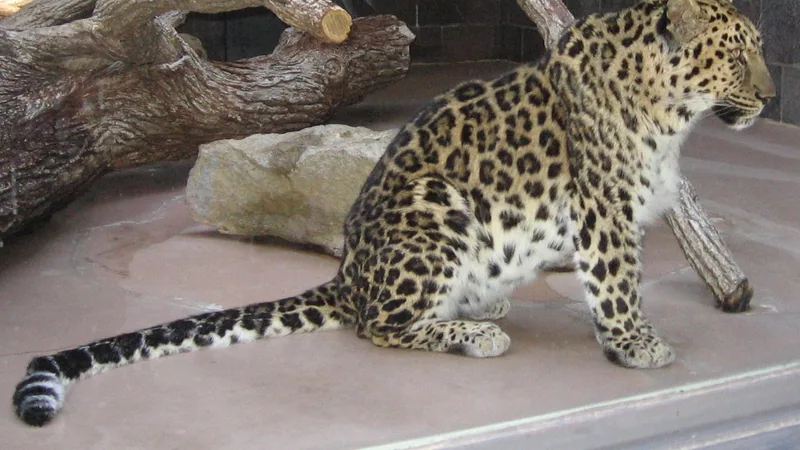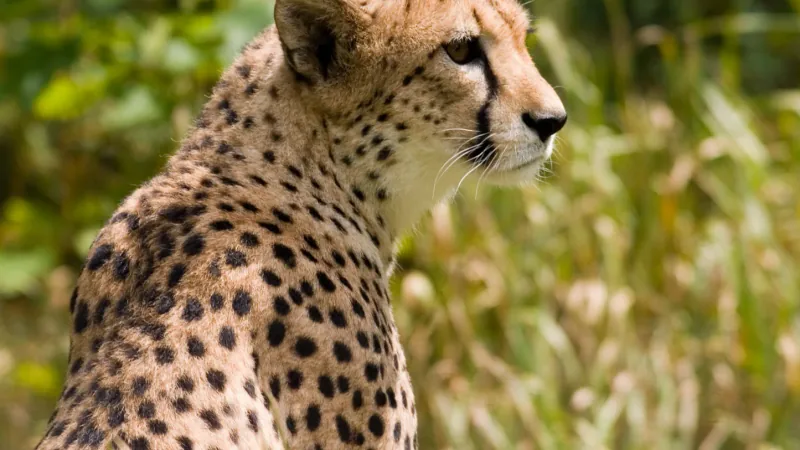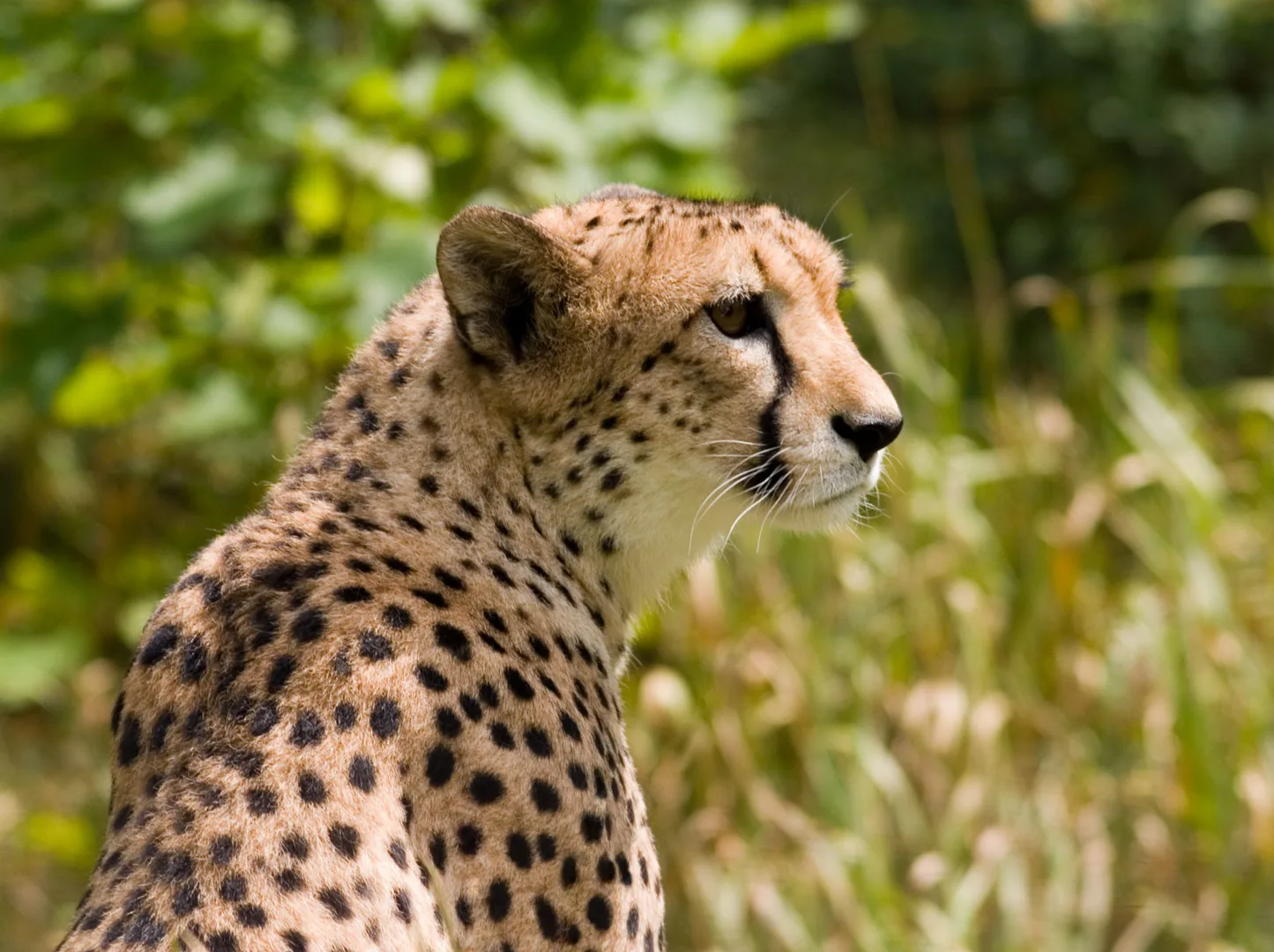
The small, high-set head and the spotted neck, turned to watch something off to one side.
Field
notes
How Fast, Really?
The measured figure comes from a 2013 study: five wild cheetahs in Botswana wore GPS-and-motion collars through 367 runs, most of them hunts. The top speed recorded was 25.9 meters per second, 58 mph (93 km/h), and most hunts involved only moderate speeds. Zoos quote 60 to 70 mph, including the Smithsonian’s own cheetah page.
Acceleration is easier to pin down: the Smithsonian records 0 to 45 mph (72 km/h) in about 2.5 seconds. At top speed a stride covers 23 feet (7 meters) and comes four times a second, with the cat off the ground more than half its running time.
A cheetah’s claws don’t get to stay sharp. Most cats retract their claws into fleshy sheaths that protect the points; cheetahs have no such sheaths, so most of their claws stay exposed and act like cleats, providing traction when they run.
Built to Sprint
An adult cheetah weighs 34 to 64 kilograms (75 to 140 pounds) and measures 112 to 142 cm (44 to 56 in) long, plus 66 to 84 cm (26 to 33 in) of tail, standing about 77 cm (30 in) at the shoulder. The tail acts as a rudder for quick turning, counteracting the cat’s body weight, while shoulder blades floating free of the collarbone and hips that swivel on a flexible spine help lengthen its stride.
Speed has a price: large nasal passages leave little room for the long roots that anchor big teeth, so larger cats like lions easily overwhelm a cheetah. It opts for flight over a fight, and its short teeth mean it kills by suffocation, clamping its jaws over the prey’s windpipe.
Hunter’s Life in the Open
Cheetahs live across a broad section of Africa, from North Africa and the Sahel through eastern and southern Africa, preferring grasslands and open plains with room to run down prey. Over the past 50 years they have become extinct in at least 13 countries, and a small, critically endangered population of Asiatic cheetahs is known to survive in Iran. Wild cheetahs live 8 to 10 years on average, and 12 to 15 in human care.
They hunt by sight, watching a herd from a termite mound, creeping close, then charging, and still catch only about half the attempts they make. Lions, hyenas and sometimes groups of vultures can bully them off a kill, costing them about 50 percent of their food. A study that implanted data loggers in five wild Namibian cheetahs found they hunted if an opportunity appeared, on occasion in the midday heat or in total darkness, and held their body temperature steady whatever the climate.
The Bottleneck in the Genome
Sequencing wild-born African cheetahs in 2015 found their genomes on average 95 percent homozygous, meaning both copies of a gene are identical, against 24 percent in an outbred housecat and 63 percent in an inbred Abyssinian. The likely cause is a population crash in Africa roughly 11,000 to 12,600 years ago, at the same time as the late Pleistocene extinction of large mammals. Unrelated cheetahs accept skin grafts from each other as if they were clones, and that same lack of variation makes them susceptible to disease.
Published Updated
Traits
Intel
& FAQ
Guess
first
How big is a Cheetah, really? Slide, lock in, and see what the sources say. Every answer is a figure from this page, quoted from where it came from.
Sources
- 01Wilson et al. (2013). Locomotion dynamics of hunting in wild cheetahs. Nature.
- 02Cheetah. Smithsonian's National Zoo and Conservation Biology Institute.
- 03Cheetah. San Diego Zoo Wildlife Alliance.
- 04Acinonyx jubatus (cheetah). Animal Diversity Web, University of Michigan.
- 05Hetem et al. (2019). Body temperature, activity patterns and hunting in free-living cheetah: biologging reveals new insights. Integrative Zoology.
- 06Dobrynin et al. (2015). Genomic legacy of the African cheetah, Acinonyx jubatus. Genome Biology.
- 07Durant et al. (2024). Acinonyx jubatus. The IUCN Red List of Threatened Species 2024: e.T219A259025524.
What the sources say: 57 claims checked word for word against these sources →